This website is managed by Ultima Markets’ international entities, and it’s important to emphasise that they are not subject to regulation by the FCA in the UK. Therefore, you must understand that you will not have the FCA’s protection when investing through this website – for example:
You will not be guaranteed Negative Balance Protection
You will not be protected by FCA’s leverage restrictions
You will not have the right to settle disputes via the Financial Ombudsman Service (FOS)
You will not be protected by Financial Services Compensation Scheme (FSCS)
Any monies deposited will not be afforded the protection required under the FCA Client Assets Sourcebook. The level of protection for your funds will be determined by the regulations of the relevant local regulator.
Note: UK clients are kindly invited to visit https://www.ultima-markets.co.uk/. Ultima Markets UK expects to begin onboarding UK clients in accordance with FCA regulatory requirements in 2026.
If you would like to proceed and visit this website, you acknowledge and confirm the following:
1.The website is owned by Ultima Markets’ international entities and not by Ultima Markets UK Ltd, which is regulated by the FCA.
2.Ultima Markets Limited, or any of the Ultima Markets international entities, are neither based in the UK nor licensed by the FCA.
3.You are accessing the website at your own initiative and have not been solicited by Ultima Markets Limited in any way.
4.Investing through this website does not grant you the protections provided by the FCA.
5.Should you choose to invest through this website or with any of the international Ultima Markets entities, you will be subject to the rules and regulations of the relevant international regulatory authorities, not the FCA.
Ultima Markets wants to make it clear that we are duly licensed and authorised to offer the services and financial derivative products listed on our website. Individuals accessing this website and registering a trading account do so entirely of their own volition and without prior solicitation.
By confirming your decision to proceed with entering the website, you hereby affirm that this decision was solely initiated by you, and no solicitation has been made by any Ultima Markets entity.
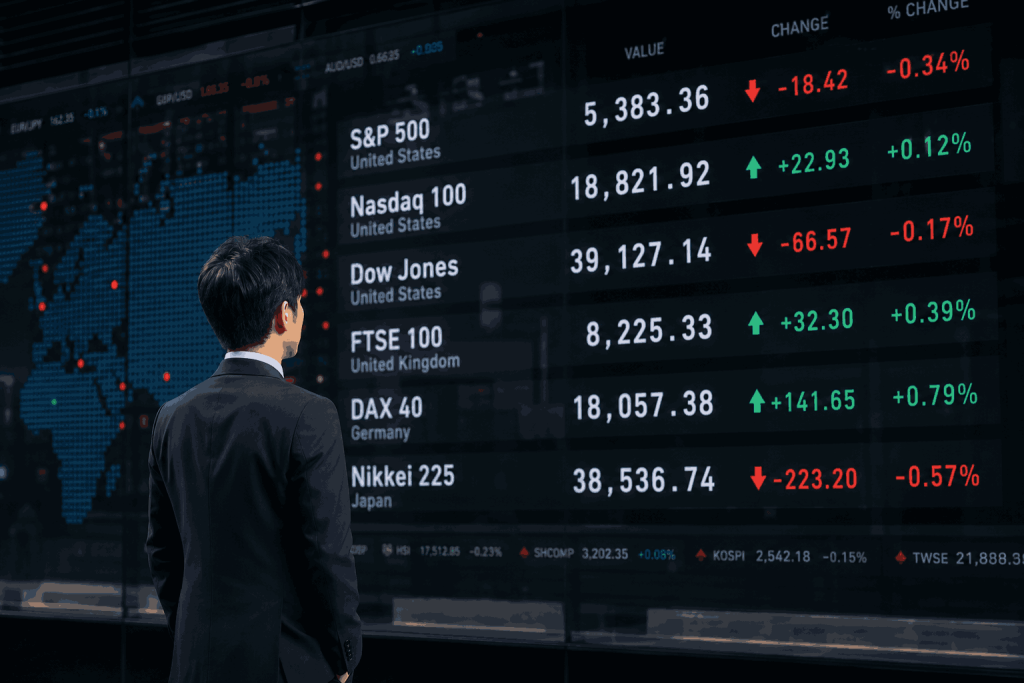
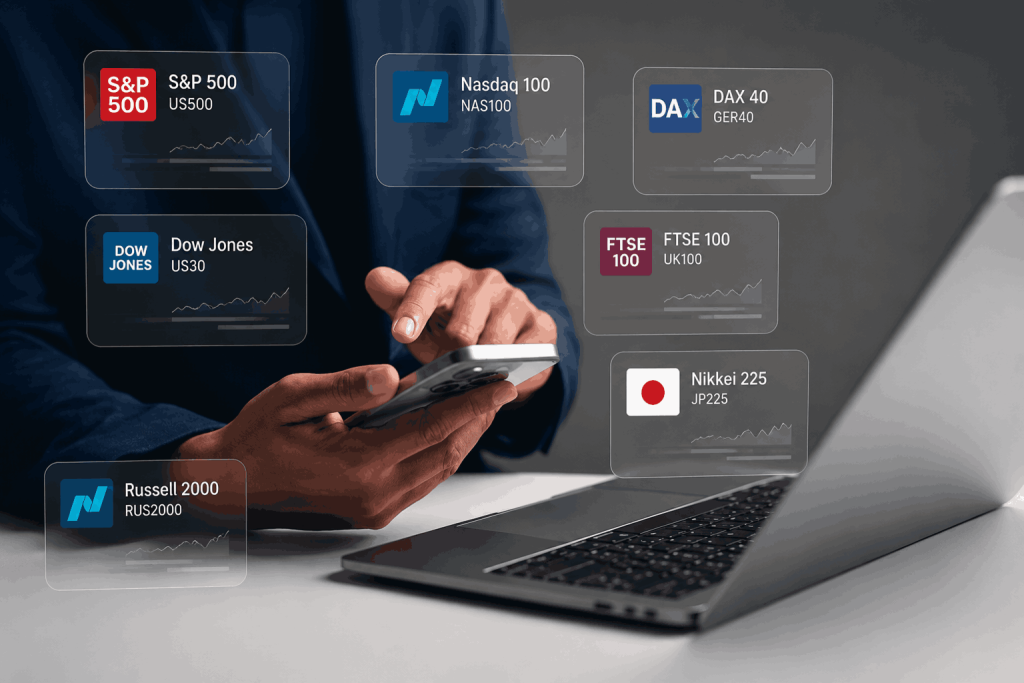
Discover the best indices to trade, including S&P 500, Nasdaq 100, Dow Jones, DAX 40 and more. Learn how to choose the correct indices for your strategy.
Stock indices are among the most widely followed markets in the financial world. Instead of focusing on the performance of a single company, traders can gain exposure to a group of businesses that represent a specific economy, sector, or region.
However, choosing the best indices to trade is not as simple as selecting the most popular market. Each index has its own characteristics, including volatility, liquidity, trading hours, and economic drivers. If you are new to this market, understanding what are indices and how they work can help you better understand why certain markets attract more trading activity than others.
Popular choices such as the S&P 500, Nasdaq 100, DAX 40, FTSE 100, and Nikkei 225 attract traders globally due to their liquidity and connection to major economies. Understanding how these indices behave can help traders identify markets that match their trading style.
Why Trade Stock Indices?
Many traders choose indices because they provide access to broader market movements rather than relying on individual companies. Some of the main reasons traders follow major indices include:
Diversified Market Exposure
Trading an index allows exposure to multiple companies at once. This can help traders follow broader market trends instead of relying on one company’s performance.
High Liquidity
Major global indices usually have strong trading activity, making them popular markets for both short-term and longer-term strategies.
Reaction to Economic Events
Indices often respond to important market events, including interest rate decisions, inflation reports, employment data, corporate earnings, and geopolitical developments.
Different Market Characteristics
Every index behaves differently. Some are influenced heavily by technology companies, while others are more connected to industrial activity, commodities, or currency movements.
Top Best Indices to Trade
Index
Market
Key Characteristics
S&P 500 (US500)
United States
Broad exposure to leading US companies
Nasdaq 100 (NAS100)
United States
Technology-focused with higher volatility
Dow Jones (US30)
United States
Large established companies
DAX 40 (GER40)
Germany
Active European index with industrial exposure
FTSE 100 (UK100)
United Kingdom
Global companies and commodity influence
Nikkei 225 (JP225)
Japan
Major Asian equity benchmark
S&P 500 (US500)
The S&P 500 is often considered one of the best indices to trade because it represents a broad section of the US stock market.
The index includes 500 large US companies from different industries, making it a widely followed benchmark for overall market performance. Its diverse composition means movements are not dependent on a single sector.
The S&P 500 is closely influenced by Federal Reserve policy, inflation trends, employment data, and corporate earnings. Traders who prefer a balanced market with strong liquidity often follow this index.
For beginners, the S&P 500 can be an attractive option because it provides exposure to a wide range of companies and has extensive market information available.
Nasdaq 100 (NAS100)
The Nasdaq 100 is one of the most popular indices among traders who look for stronger price movements.
The index includes many major technology and growth companies, including businesses involved in artificial intelligence, semiconductors, cloud computing, and digital services.
Because of its technology focus, the Nasdaq 100 can react strongly to changes in interest rate expectations, company earnings, and investor sentiment towards growth stocks.
For traders who prefer more active markets, the Nasdaq 100 is frequently considered one of the best indices to trade due to its volatility and liquidity.
Dow Jones (US30)
The Dow Jones Industrial Average tracks 30 major US companies across industries such as industrials, finance, healthcare, and consumer goods.
Unlike the S&P 500, which uses market capitalisation weighting, the Dow Jones is price-weighted. This means companies with higher share prices have a greater influence on index movements.
The Dow Jones is often followed by traders who prefer exposure to large, established companies and broader US economic conditions.
DAX 40 (GER40)
The DAX 40 represents 40 major companies listed on the Frankfurt Stock Exchange and is one of Europe’s most important stock indices.
The index has significant exposure to Germany’s manufacturing and export industries, meaning it can react to changes in European economic conditions, business confidence, and global trade trends.
Many traders follow the DAX 40 because of its active price movements during European trading hours. Its liquidity and frequent market activity make it a popular choice among traders looking for opportunities within European markets.
FTSE 100 (UK100)
The FTSE 100 tracks the 100 largest companies listed on the London Stock Exchange.
Although it represents the UK market, many companies in the index generate revenue internationally. This means the FTSE 100 can be influenced by global economic conditions, commodity prices, and currency movements.
The index includes companies from sectors such as energy, mining, banking, and consumer goods, giving traders exposure to a variety of industries.
Nikkei 225 (JP225)
The Nikkei 225 is Japan’s leading stock market index and tracks 225 major Japanese companies.
The index is influenced by factors such as Bank of Japan monetary policy, yen movements, global technology demand, and Asian economic trends.
For traders based in Asia, the Nikkei 225 can be an attractive option because its trading hours align with regional market sessions. Understanding local economic conditions can also help traders follow its movements.
Best Indices to Trade Based on Trading Style
There is no single index that is the best choice for every trader. The right market depends on trading strategy, risk preference, and preferred market conditions.
Best Indices for Beginners
The S&P 500 is often considered suitable for beginners because of its broad market exposure, strong liquidity, and availability of economic information.
A wider range of industries can make it easier for traders to understand how different factors influence market movements.
Best Indices for Day Trading
Day traders often look for markets with active sessions, strong liquidity, and sufficient price movement.
The Nasdaq 100 and DAX 40 are commonly followed by short-term traders because they can experience significant intraday movements. However, higher volatility also means traders should carefully manage risk.
Best Indices for Higher Volatility
Traders who prefer larger price swings often focus on indices such as the Nasdaq 100 and DAX 40.
The Nasdaq 100 is sensitive to technology and growth stock sentiment, while the DAX 40 can react strongly to European economic developments.
Best Indices for Longer-Term Trading
Traders with longer holding periods may prefer broader indices such as the S&P 500 because it represents a wider range of companies and reflects overall US market conditions.
Factors to Consider When Choosing an Index
Before deciding which index to trade, traders should consider several factors.
Liquidity and Trading Volume
Highly liquid indices generally have more active markets, which can make entering and exiting positions easier.
Volatility
Different indices have different levels of price movement. Traders should choose markets that match their strategy and risk approach.
Spread Compared With Price Movement
Traders should consider the relationship between trading costs and typical market movement. A wider spread may be less significant in a market with larger average price movements, while a small spread may still be challenging if the market has limited movement.
Trading Hours
Each index has its own most active trading session. Traders may prefer markets that match their available trading hours.
Economic Drivers
Understanding what influences each index is important:
Nasdaq 100: technology trends, interest rates, AI developments, earnings
S&P 500: Federal Reserve policy, inflation, US economic data
DAX 40: European growth, manufacturing, exports
FTSE 100: commodities, global markets, GBP movements
Nikkei 225: Japanese monetary policy and currency movements
Trading Indices Through CFDs
Many traders access global indices through Contracts for Difference (CFDs). Index CFDs allow traders to speculate on price movements without owning the underlying shares.
However, CFDs are leveraged products, meaning both potential gains and losses can be amplified. Traders should understand the risks involved and consider appropriate risk management strategies.
Conclusion
The best indices to trade depend on a trader’s individual goals, strategy, and market preferences.
The S&P 500 provides broad exposure to the US economy, the Nasdaq 100 offers technology-driven opportunities, while indices such as the DAX 40, FTSE 100, and Nikkei 225 provide access to European and Asian markets.
Rather than focusing on one “perfect” index, traders should understand how different markets behave and choose indices that align with their trading style, risk management approach, and market knowledge.
FAQs
What are the best indices to trade for beginners?
The S&P 500 is often considered suitable for beginners due to its broad exposure and high liquidity.
Which index is the most volatile?
The Nasdaq 100 is commonly viewed as one of the more volatile major indices because of its technology exposure.
What are the best indices for day trading?
Nasdaq 100, S&P 500, and DAX 40 are popular among day traders due to their liquidity and active trading sessions.
Share Now
Disclaimer:This content is provided for informational purposes only and does not constitute, and should not be construed as, financial, investment, or other professional advice. No statement or opinion contained herein should be considered a recommendation by Ultima Markets or the author regarding any specific investment product, strategy, or transaction. Readers are advised not to rely solely on this material when making investment decisions and should seek independent advice where appropriate.
Thank you for visiting the Ultima Markets website. Please note that this website is intended for individuals residing in jurisdictions where access is permitted by law. Ultima and its affiliated entities do not operate in your home jurisdiction.
By clicking ‘Acknowledge’, you confirm that you are entering this website solely on your own initiative and not as a result of any specific marketing outreach. You wish to obtain information from this website based on reverse solicitation principles, in accordance with the applicable laws of your home jurisdiction.