This website is managed by Ultima Markets’ international entities, and it’s important to emphasise that they are not subject to regulation by the FCA in the UK. Therefore, you must understand that you will not have the FCA’s protection when investing through this website – for example:
You will not be guaranteed Negative Balance Protection
You will not be protected by FCA’s leverage restrictions
You will not have the right to settle disputes via the Financial Ombudsman Service (FOS)
You will not be protected by Financial Services Compensation Scheme (FSCS)
Any monies deposited will not be afforded the protection required under the FCA Client Assets Sourcebook. The level of protection for your funds will be determined by the regulations of the relevant local regulator.
Note: UK clients are kindly invited to visit https://www.ultima-markets.co.uk/. Ultima Markets UK expects to begin onboarding UK clients in accordance with FCA regulatory requirements in 2026.
If you would like to proceed and visit this website, you acknowledge and confirm the following:
1.The website is owned by Ultima Markets’ international entities and not by Ultima Markets UK Ltd, which is regulated by the FCA.
2.Ultima Markets Limited, or any of the Ultima Markets international entities, are neither based in the UK nor licensed by the FCA.
3.You are accessing the website at your own initiative and have not been solicited by Ultima Markets Limited in any way.
4.Investing through this website does not grant you the protections provided by the FCA.
5.Should you choose to invest through this website or with any of the international Ultima Markets entities, you will be subject to the rules and regulations of the relevant international regulatory authorities, not the FCA.
Ultima Markets wants to make it clear that we are duly licensed and authorised to offer the services and financial derivative products listed on our website. Individuals accessing this website and registering a trading account do so entirely of their own volition and without prior solicitation.
By confirming your decision to proceed with entering the website, you hereby affirm that this decision was solely initiated by you, and no solicitation has been made by any Ultima Markets entity.
Ultima Markets does not have an establishment in Singapore and does not operate from Singapore.
Ultima Markets does not provide products or services to citizens or residents of Singapore, and account applications from Singapore citizens or residents will not be accepted.
If you are a citizen or resident of Singapore, please do not open an account or use Ultima Markets’ products or services.
By selecting “Acknowledge and Continue Browsing”, you confirm that you are accessing this website on your own initiative and that your access is not the result of any direct marketing, targeted advertising, solicitation, or promotional activity by Ultima Markets.
Nothing on this website constitutes an offer, solicitation, or promotion of products or services in any jurisdiction where such activity is prohibited. You are responsible for ensuring that your access to and use of this website complies with applicable local laws and regulations.
Explore the most inflated currency in the world, compare inflation rates and learn how rising prices affect purchasing power and currency values in 2026.
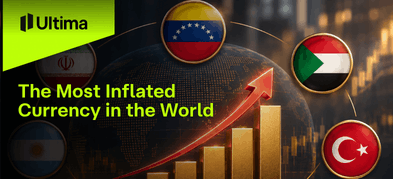
The most inflated currency in the world in 2026 is Venezuela’s bolívar, based on the highest available annual-average inflation projection in the IMF’s October 2026 World Economic Outlook. Venezuela’s consumer price inflation is forecast at 467.9% on this measure.
But what does that figure actually tell us? To understand it, we need to separate domestic purchasing power from exchange-rate value, then compare today’s figures with historical hyperinflation.
What Does an Inflated Currency Mean?
“Inflated currency” is an informal expression for money losing purchasing power as domestic prices rise. Consumer price inflation measures changes in the cost of a representative basket of goods and services, not the number printed on a banknote.
Imagine a shopping basket costs 100 currency units and rises to 200 a year later. Inflation is 100%, but the purchasing power of an unchanged cash balance has fallen by 50%. The original 100 units now buy only half the basket.
Currency depreciation is different: it means money has fallen in value relative to another currency. The two can interact, but they are not interchangeable measurements.
Which Currencies Face High Inflation in 2026?
Identifying the most inflated currency in the world requires comparing the same indicator. The table below uses annual-average consumer price inflation.
Country
Currency
2025
2026 forecast
Venezuela
Venezuelan bolívar
252.0%
467.9%
Iran
Iranian rial
50.6%
78.6%
Sudan
Sudanese pound
99.9%
41.3%
Argentina
Argentine peso
41.9%
32.5%
Türkiye
Turkish lira
34.9%
31.2%
Source: IMF, October 2026. Selected economies, not a comprehensive ranking. Historical figures may include estimates; country reporting periods can differ.
Venezuela and Iran show higher projected inflation than in 2025, while the other three show slower price growth. These forecasts compare average price levels across years. They are not monthly readings, December-to-December changes or predictions of exchange-rate losses.
Argentina illustrates why this matters. Its September 2026 release showed inflation of 1.9% over the month and 33.4% over the year. Both figures are valid, but neither measures the same thing as a full-year annual average.
What Is Changing in Venezuela?
On 14 October 2026, Venezuela’s economic adviser said the country was preparing a debt sustainability analysis and wanted to introduce an inflation-targeting framework over the medium term. These were policy intentions, not evidence that inflation had been brought under control.
Why Do Currencies Experience Extreme Inflation?
Persistent high inflation can develop when money creation outpaces the economy’s ability to produce goods and services. Supply disruptions can compound the problem by reducing available goods or increasing production costs.
Expectations also matter. When businesses anticipate rising costs, they may increase prices in advance. Workers seek higher wages, and contracts incorporate expected inflation. This can make price increases harder to contain.
For households, the consequence is straightforward: when wages, pensions or savings returns lag behind inflation, purchasing power falls. A larger cash balance does not necessarily buy more.
Which Currency Holds the Historical Hyperinflation Record?
The Hungarian pengő holds the historical record. According to the Hanke-Krus research, monthly inflation reached approximately 41.9 quadrillion per cent in July 1946, with prices doubling roughly every 15 hours.
Zimbabwe’s dollar experienced another extreme episode in November 2008. Its estimated peak monthly inflation reached approximately 79.6 billion per cent, with prices doubling every 24.7 hours. These are historical monthly estimates, so they should not be directly ranked against annual forecasts.
Zimbabwe subsequently introduced Zimbabwe Gold, or ZiG, in April 2024. Its 2008 crisis therefore needs a clear date and currency label, rather than being presented as a description of current conditions.
Is the Lowest-Valued Currency Also the Most Inflated?
Not necessarily. An exchange-rate level tells you how many units of one currency exchange for another. Inflation measures how quickly domestic prices change.
Consider two hypothetical currencies. One trades at 20,000 units per US dollar with annual inflation of 3%. Another trades at 100 units per dollar with inflation of 100%.
The first has a lower value per unit, but the second is losing domestic purchasing power much faster. A large exchange-rate number alone does not establish high inflation.
Does Removing Zeros Make a Currency Stronger?
Venezuela’s October 2021 redenomination removed six zeros from its currency, dividing monetary amounts by one million.
That kind of redenomination simplifies the numbers without automatically improving purchasing power. Suppose a salary of 10 million old units becomes 10 new units, while a basket costing 1 million becomes 1 new unit. The salary still buys ten baskets.
Smaller numbers are not the same as greater buying power.
What Does Inflation Mean for Forex Traders?
For traders, identifying the most inflated currency in the world is a starting point, not a trading signal.
Persistently higher inflation than in trading partners can put downward pressure on a currency over time. However, relatively higher interest rates can attract capital and support demand for that currency. Risk sentiment also influences shorter-term movements.
The practical lesson is to analyse inflation alongside the likely central bank response and wider market conditions. Do not assume that the highest inflation rate guarantees the largest immediate currency decline, or that a low exchange value makes a currency a bargain.
Conclusion
The answer to the most inflated currency in the world depends on the measurement and period. Venezuela’s bolívar leads the available 2026 IMF projections, while Hungary’s pengő holds the historical hyperinflation record.
The key is to compare like with like: domestic inflation, exchange-rate value and historical price increases answer different questions. Clear dates and consistent indicators matter more than dramatic banknote denominations.
FAQ
Which currency has the highest inflation in 2026?
Venezuela’s bolívar leads the available IMF annual-average inflation projections for 2026. This is a forecast, not a completed full-year result.
What qualifies as hyperinflation?
Under the widely used Cagan definition, hyperinflation begins when prices rise by at least 50% in a month.
Does lower inflation mean prices are falling?
No. If a basket rises from 100 to 200 units, then to 220, inflation slows from 100% to 10%, but prices remain higher.
Does removing zeros stop inflation?
No. Renaming 1 million old units as 1 new unit does not help when salaries and prices are divided by the same amount. Purchasing power is unchanged.
Share Now
Disclaimer:This content is provided for informational purposes only and does not constitute, and should not be construed as, financial, investment, or other professional advice. No statement or opinion contained herein should be considered a recommendation by Ultima Markets or the author regarding any specific investment product, strategy, or transaction. Readers are advised not to rely solely on this material when making investment decisions and should seek independent advice where appropriate.
Thank you for visiting the Ultima Markets website. Please note that this website is intended for individuals residing in jurisdictions where access is permitted by law. Ultima and its affiliated entities do not operate in your home jurisdiction.
By clicking ‘Acknowledge’, you confirm that you are entering this website solely on your own initiative and not as a result of any specific marketing outreach. You wish to obtain information from this website based on reverse solicitation principles, in accordance with the applicable laws of your home jurisdiction.