This website is managed by Ultima Markets’ international entities, and it’s important to emphasise that they are not subject to regulation by the FCA in the UK. Therefore, you must understand that you will not have the FCA’s protection when investing through this website – for example:
You will not be guaranteed Negative Balance Protection
You will not be protected by FCA’s leverage restrictions
You will not have the right to settle disputes via the Financial Ombudsman Service (FOS)
You will not be protected by Financial Services Compensation Scheme (FSCS)
Any monies deposited will not be afforded the protection required under the FCA Client Assets Sourcebook. The level of protection for your funds will be determined by the regulations of the relevant local regulator.
Note: UK clients are kindly invited to visit https://www.ultima-markets.co.uk/. Ultima Markets UK expects to begin onboarding UK clients in accordance with FCA regulatory requirements in 2026.
If you would like to proceed and visit this website, you acknowledge and confirm the following:
1.The website is owned by Ultima Markets’ international entities and not by Ultima Markets UK Ltd, which is regulated by the FCA.
2.Ultima Markets Limited, or any of the Ultima Markets international entities, are neither based in the UK nor licensed by the FCA.
3.You are accessing the website at your own initiative and have not been solicited by Ultima Markets Limited in any way.
4.Investing through this website does not grant you the protections provided by the FCA.
5.Should you choose to invest through this website or with any of the international Ultima Markets entities, you will be subject to the rules and regulations of the relevant international regulatory authorities, not the FCA.
Ultima Markets wants to make it clear that we are duly licensed and authorised to offer the services and financial derivative products listed on our website. Individuals accessing this website and registering a trading account do so entirely of their own volition and without prior solicitation.
By confirming your decision to proceed with entering the website, you hereby affirm that this decision was solely initiated by you, and no solicitation has been made by any Ultima Markets entity.
Ultima Markets does not have an establishment in Singapore and does not operate from Singapore.
Ultima Markets does not provide products or services to citizens or residents of Singapore, and account applications from Singapore citizens or residents will not be accepted.
If you are a citizen or resident of Singapore, please do not open an account or use Ultima Markets’ products or services.
By selecting “Acknowledge and Continue Browsing”, you confirm that you are accessing this website on your own initiative and that your access is not the result of any direct marketing, targeted advertising, solicitation, or promotional activity by Ultima Markets.
Nothing on this website constitutes an offer, solicitation, or promotion of products or services in any jurisdiction where such activity is prohibited. You are responsible for ensuring that your access to and use of this website complies with applicable local laws and regulations.
Nominal vs real GDP explained with clear formulas, practical examples and 2026 US data. Learn how inflation shapes economic growth and financial markets.
An economy can appear to be growing even when it is not producing significantly more goods or services. This happens because economic growth can reflect both changes in production and rising prices.
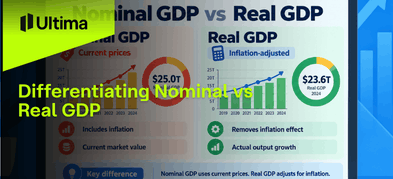
Understanding nominal vs real GDP helps explain this difference. Nominal GDP measures economic output using current market prices, while real GDP adjusts for inflation to show changes in actual production.
Both measures are important when analysing economic performance, but they serve different purposes. For investors and traders, knowing which figure to focus on can make economic reports easier to interpret.
What Is GDP and How Is It Calculated?
Gross Domestic Product (GDP) measures the total value of final goods and services produced within a country’s borders over a specific period, usually a quarter or a year.
One common way to calculate GDP is through the expenditure approach:
GDP = C + I + G + (X − M)
Where:
C: Consumer spending
I: Investment
G: Government spending
X: Exports
M: Imports
This calculation captures spending on domestically produced final goods and services. However, the resulting GDP figure can be expressed in nominal or real terms, depending on how changes in prices are treated.
What Is Nominal GDP?
Nominal GDP measures the value of goods and services produced in an economy using their current market prices, without adjusting for inflation.
This means nominal GDP can increase for two reasons: businesses produce more goods and services, or the prices of those goods and services rise.
For example, if a country produces the same quantity of goods as the previous year but prices increase by 10%, nominal GDP will also rise by 10%, even though production has not changed.
Nominal GDP is particularly useful for measuring the current monetary size of an economy. It is also commonly used when calculating economic ratios such as government debt relative to GDP.
However, because it includes price changes, nominal GDP alone cannot show whether an economy is genuinely producing more.
What Is Real GDP?
Real GDP measures economic output after adjusting for changes in prices. By removing the effect of inflation, it provides a clearer picture of whether an economy is producing more goods and services over time.
For example, if nominal GDP increases by 8% while prices rise substantially, real GDP growth may be considerably lower.
In simplified calculations, real GDP values production using prices from a reference year. Modern statistical agencies may also use chain-linked methods that account for changing prices and production patterns over time.
Real GDP is therefore widely used to measure economic growth, compare economic performance across different periods and identify changes in business activity.
Nominal vs Real GDP: Key Differences
The main difference between nominal vs real GDP is how inflation affects their calculations.
Comparison
Nominal GDP
Real GDP
Price measurement
Current market prices
Inflation-adjusted prices
Inflation adjustment
No
Yes
Reflects price increases
Yes
Removes their effect
Main purpose
Measures the current monetary size of an economy
Measures changes in actual economic output
Best used for
Current-value comparisons and economic ratios
Comparing economic growth over time
Although both measures describe the same economy, they can produce very different growth rates, particularly when inflation is high.
How to Calculate Nominal GDP and Real GDP
Consider a simplified economy that produces only coffee.
In the first year, the economy produces 10,000 cups of coffee at US$5 each. In the second year, production increased to 10,500 cups, but the price rose to US$6.
Measurement
Year 1
Year 2
Coffee produced
10,000 cups
10,500 cups
Price per cup
US$5
US$6
Nominal GDP
US$50,000
US$63,000
Real GDP (Year 1 prices)
US$50,000
US$52,500
Nominal GDP calculation:
Nominal GDP = Current Price × Current Quantity
Year 2: US$6 × 10,500 = US$63,000
Nominal GDP increased by 26%.
Real GDP calculation:
Real GDP = Reference-Year Price × Current Quantity
Year 2: US$5 × 10,500 = US$52,500
Real GDP increased by only 5%.
Although the monetary value of production increased considerably, the actual quantity of coffee produced rose by just 5%.
This example illustrates why economists rely on real GDP when measuring economic growth.
What Is the GDP Deflator?
The GDP deflator is a measure of price changes across goods and services produced domestically. It helps explain the relationship between nominal and real GDP.
The formula is:
GDP Deflator = (Nominal GDP ÷ Real GDP) × 100
Real GDP can also be calculated using:
Real GDP = (Nominal GDP ÷ GDP Deflator) × 100
For example, suppose an economy has nominal GDP of US$120 billion and a GDP deflator of 120.
Real GDP would be:
US$120 billion ÷ 120 × 100 = US$100 billion
This calculation shows how nominal GDP can be adjusted to remove the effect of price changes.
The GDP deflator differs from the Consumer Price Index (CPI). While CPI focuses on prices paid by consumers, the GDP deflator covers domestically produced goods and services, including exports but excluding imports.
Real-World Example: US Nominal vs Real GDP in 2026
A useful example comes from the US Bureau of Economic Analysis (BEA).
According to its third estimate released on 30 September 2026, US GDP recorded the following growth rates in the second quarter of 2026:
GDP measure
Q2 2026 growth
Nominal GDP
8.5%
Real GDP
2.2%
GDP price deflator
6.1%
The considerable difference between nominal and real GDP growth shows how rising prices contributed to the increase in the monetary value of economic output.
The BEA also revised its real GDP estimate upwards from 1.5% to 2.2%, demonstrating how GDP figures can change as more complete economic data becomes available.
Why Does Real GDP Matter to the Economy?
Real GDP provides an important indication of whether economic activity is expanding or contracting.
Governments and central banks use it alongside inflation, employment and other economic indicators to assess economic conditions.
It is also central to global growth forecasts. In its October 2026 World Economic Outlook, the International Monetary Fund projected global real GDP growth of 3.1% for 2026 and 3.4% for 2027.
However, GDP growth does not necessarily mean that everyone is becoming wealthier. Economists also examine real GDP per capita, which measures inflation-adjusted output per person, to better understand changes in economic performance relative to population size.
How Does GDP Affect Forex, Stocks and Gold?
GDP releases can influence financial markets because economic growth affects expectations about company earnings, interest rates and monetary policy.
In the forex market, stronger-than-expected real GDP growth may support a country’s currency if investors believe the central bank will maintain higher interest rates.
For stock markets, stronger economic growth may improve expectations for corporate earnings. However, if growth increases concerns about inflation and higher borrowing costs, stock valuations could come under pressure.
Gold prices may also respond to GDP figures. Strong economic growth that pushes bond yields and the US dollar higher can weigh on gold, while weaker growth and expectations of lower interest rates may support demand.
Nevertheless, GDP does not determine market direction on its own. Traders should also consider inflation, employment data, central bank guidance and whether the reported figures differ from market forecasts.
Nominal vs Real GDP: Which Is More Important?
Neither measure is universally better because each serves a different purpose.
Nominal GDP is useful when examining the current monetary size of an economy, government debt ratios and other figures expressed in current prices.
Real GDP is generally more useful when comparing economic growth across different periods because it removes the effect of inflation.
For traders and investors analysing the economic outlook, real GDP growth is often the more relevant indicator. However, examining nominal GDP alongside real GDP can provide additional insight into how price changes are affecting the economy.
Conclusion
Understanding nominal vs real GDP is essential for interpreting economic growth accurately.
Nominal GDP measures the value of economic output at current prices, while real GDP adjusts for inflation to show changes in actual production. Although nominal GDP can make an economy appear larger during periods of rising prices, real GDP provides a clearer view of underlying economic activity.
By analysing both measures alongside inflation and other economic indicators, investors and traders can better understand economic conditions and potential market developments.
FAQ
What is the difference between nominal and real GDP?
Nominal GDP measures economic output using current prices, while real GDP adjusts for inflation to reflect changes in actual production.
Why is real GDP better than nominal GDP?
Real GDP is generally better for measuring economic growth because it removes the effect of price changes, allowing more meaningful comparisons over time.
Can nominal GDP increase while real GDP decreases?
Yes. If prices rise enough to offset a decline in production, nominal GDP can increase even when real GDP falls.
Share Now
Disclaimer:This content is provided for informational purposes only and does not constitute, and should not be construed as, financial, investment, or other professional advice. No statement or opinion contained herein should be considered a recommendation by Ultima Markets or the author regarding any specific investment product, strategy, or transaction. Readers are advised not to rely solely on this material when making investment decisions and should seek independent advice where appropriate.
Thank you for visiting the Ultima Markets website. Please note that this website is intended for individuals residing in jurisdictions where access is permitted by law. Ultima and its affiliated entities do not operate in your home jurisdiction.
By clicking ‘Acknowledge’, you confirm that you are entering this website solely on your own initiative and not as a result of any specific marketing outreach. You wish to obtain information from this website based on reverse solicitation principles, in accordance with the applicable laws of your home jurisdiction.