This website is managed by Ultima Markets’ international entities, and it’s important to emphasise that they are not subject to regulation by the FCA in the UK. Therefore, you must understand that you will not have the FCA’s protection when investing through this website – for example:
You will not be guaranteed Negative Balance Protection
You will not be protected by FCA’s leverage restrictions
You will not have the right to settle disputes via the Financial Ombudsman Service (FOS)
You will not be protected by Financial Services Compensation Scheme (FSCS)
Any monies deposited will not be afforded the protection required under the FCA Client Assets Sourcebook. The level of protection for your funds will be determined by the regulations of the relevant local regulator.
Note: UK clients are kindly invited to visit https://www.ultima-markets.co.uk/. Ultima Markets UK expects to begin onboarding UK clients in accordance with FCA regulatory requirements in 2026.
If you would like to proceed and visit this website, you acknowledge and confirm the following:
1.The website is owned by Ultima Markets’ international entities and not by Ultima Markets UK Ltd, which is regulated by the FCA.
2.Ultima Markets Limited, or any of the Ultima Markets international entities, are neither based in the UK nor licensed by the FCA.
3.You are accessing the website at your own initiative and have not been solicited by Ultima Markets Limited in any way.
4.Investing through this website does not grant you the protections provided by the FCA.
5.Should you choose to invest through this website or with any of the international Ultima Markets entities, you will be subject to the rules and regulations of the relevant international regulatory authorities, not the FCA.
Ultima Markets wants to make it clear that we are duly licensed and authorised to offer the services and financial derivative products listed on our website. Individuals accessing this website and registering a trading account do so entirely of their own volition and without prior solicitation.
By confirming your decision to proceed with entering the website, you hereby affirm that this decision was solely initiated by you, and no solicitation has been made by any Ultima Markets entity.
Ultima Markets does not have an establishment in Singapore and does not operate from Singapore.
Ultima Markets does not provide products or services to citizens or residents of Singapore, and account applications from Singapore citizens or residents will not be accepted.
If you are a citizen or resident of Singapore, please do not open an account or use Ultima Markets’ products or services.
By selecting “Acknowledge and Continue Browsing”, you confirm that you are accessing this website on your own initiative and that your access is not the result of any direct marketing, targeted advertising, solicitation, or promotional activity by Ultima Markets.
Nothing on this website constitutes an offer, solicitation, or promotion of products or services in any jurisdiction where such activity is prohibited. You are responsible for ensuring that your access to and use of this website complies with applicable local laws and regulations.
Learn what a steepening yield curve means, how bull and bear steepener differ, and what changing bond yields can signal for markets and the economy now.
A steepening yield curve can reflect changing expectations for interest rates, inflation, and economic growth. However, it does not automatically mean the economy is strengthening. Falling short-term yields and rising long-term yields can both make the curve steeper, with very different implications.
For traders, the key question is not simply whether the curve is steepening, but which yields are moving and why.
What Does a Steepening Yield Curve Mean?
A yield curve plots the yields of comparable bonds against their maturities. The US Treasury curve, for example, compares government borrowing rates across periods ranging from a few months to several decades.
A steepening yield curve means the spread between longer-term and shorter-term yields is increasing. One common measure is the 10-year Treasury yield minus the 2-year Treasury yield, often called the 2s10s spread.
Yield spread = 10-year yield − 2-year yield
Suppose the 10-year yield is 4.50% and the 2-year yield is 4.00%. The spread is 0.50 percentage points, or 50 basis points. If that spread rises to 100 basis points, the curve has steepened.
Importantly, steepening describes a change, not a fixed shape. An inverted curve can steepen while remaining inverted. For example, a spread moving from −50 to −10 basis points has increased by 40 basis points, even though short-term yields remain higher.
Bear Steepener vs Bull Steepener
The distinction depends on whether steepening is primarily driven by rising long-term yields or falling short-term yields.
What Is a Bear Steepener?
A bear steepener occurs when long-term yields rise more than short-term yields. In a typical example, both increase, but the longer-term yield rises further.
It is called “bear” because rising yields mean falling prices for existing fixed-rate bonds. The term describes the bond-market move, not a guaranteed decline in shares.
What Is a Bull Steepener?
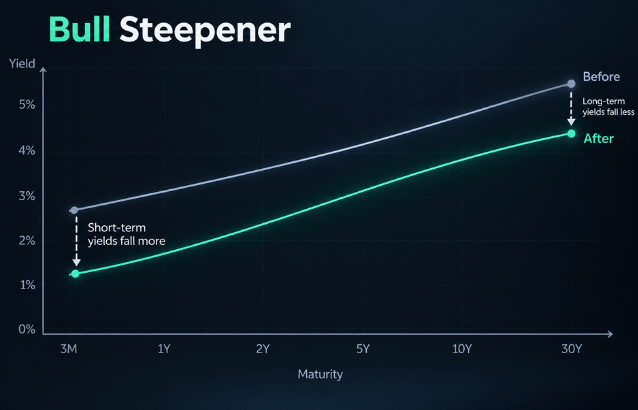
A bull steepener occurs when short-term yields fall more than long-term yields. In a typical example, both decline, but the shorter-term yield falls further.
Here, “bull” refers to rising bond prices as yields fall. It does not automatically mean investors are optimistic about the economy.
A Simple Comparison
The following figures are hypothetical, not current market yields.
Measure
Starting position
After a bear steepener
After a bull steepener
2-year yield
4.00%
4.25%
3.00%
10-year yield
4.50%
5.25%
4.00%
10-year minus 2-year spread
50 basis points
100 basis points
100 basis points
Both scenarios produce the same 50-basis-point steepening. However, yields rise in one and fall in the other.
What Causes the Yield Curve to Steepen?
Changing rate expectations can drive a bull steepener. When investors anticipate central bank rate cuts, shorter-term yields may fall sharply. This can reflect easing inflation, weaker growth, or concerns about a recession.
Stronger growth or higher inflation expectations can lift longer-term yields. However, steepening occurs only if those yields rise relative to shorter-term yields. Inflation news alone does not determine the curve’s direction.
A higher term premium can also contribute. This is the additional compensation investors require for the risks of holding longer-term bonds rather than rolling over shorter-term debt. Greater uncertainty or concerns about future government bond supply can increase that compensation.
Consequently, rising long-term yields do not necessarily mean markets expect stronger growth. They may instead reflect greater perceived risk.
How a Steepening Yield Curve Affects Markets
Bonds
A bear steepener can hurt existing long-term bond holdings as their yields rise. A bull steepener generally supports the prices of fixed-rate government bonds whose yields fall.
The size of any price change also depends on duration, a measure of sensitivity to yield movements. A larger yield decline does not automatically produce the largest percentage price gain.
Shares
Higher long-term yields can weigh on share valuations by reducing the present value of expected future earnings. Lower yields can support valuations, but weaker earnings expectations may offset that benefit.
This is why a bull steepener is not automatically bullish for the stock market.
Banks and Borrowers
A steeper curve can improve lending margins for banks that fund themselves at shorter-term rates and lend at longer-term rates. However, the effect depends on their funding and lending arrangements.
For borrowers, rising long-term yields can make new fixed-rate financing more expensive. The cause of steepening therefore matters as much as the shape.
How to Interpret a Steepening Yield Curve
Start by separating the level of yields from the spread between them. The comparison above shows why the same increase in the spread can accompany either rising or falling borrowing rates.
Next, identify the maturities being compared. The 10-year minus 2-year spread and the 10-year minus 3-month spread measure different parts of the curve and need not move identically.
Finally, examine the economic explanation. A curve steepening because investors expect emergency rate cuts sends a different message from one steepening because growth expectations are improving.
Steepening after an inversion does not prove recession risks have disappeared. Federal Reserve Bank of Chicago research emphasises that the economic implications depend on what is driving the change.
A useful approach is to compare the curve with inflation, employment, and central bank communications rather than treating it as a standalone buy or sell signal.
Conclusion
A steepening yield curve tells you that longer-term yields are rising relative to shorter-term yields, but not why. A bear steepener is driven by larger increases at the long end, while a bull steepener is driven by larger declines at the short end.
Understanding that distinction helps traders interpret bond-market headlines without assuming that steepening always signals growth or recession.
FAQ
Is a Steepening Yield Curve Good or Bad?
Neither automatically. It may reflect improving growth expectations, anticipated rate cuts, or greater inflation and interest-rate uncertainty. The underlying driver matters.
What Is the Difference Between Steepening and Flattening?
Steepening means the long-term yield minus the short-term yield increases. Flattening means that spread decreases.
Can the Yield Curve Steepen When Interest Rates Fall?
Yes. A bull steepener occurs when short-term yields fall more than long-term yields, increasing the spread even as both decline.
Can a Yield Curve Be Inverted and Steepening?
Yes. A negative spread can become less negative without turning positive. For example, a move from −50 to −10 basis points is steepening.
Why Is It Called a Bear Steepener?
“Bear” refers to falling bond prices as yields rise. In a bear steepener, longer-term yields increase more than shorter-term yields.
Share Now
Disclaimer:This content is provided for informational purposes only and does not constitute, and should not be construed as, financial, investment, or other professional advice. No statement or opinion contained herein should be considered a recommendation by Ultima Markets or the author regarding any specific investment product, strategy, or transaction. Readers are advised not to rely solely on this material when making investment decisions and should seek independent advice where appropriate.
Thank you for visiting the Ultima Markets website. Please note that this website is intended for individuals residing in jurisdictions where access is permitted by law. Ultima and its affiliated entities do not operate in your home jurisdiction.
By clicking ‘Acknowledge’, you confirm that you are entering this website solely on your own initiative and not as a result of any specific marketing outreach. You wish to obtain information from this website based on reverse solicitation principles, in accordance with the applicable laws of your home jurisdiction.