This website is managed by Ultima Markets’ international entities, and it’s important to emphasise that they are not subject to regulation by the FCA in the UK. Therefore, you must understand that you will not have the FCA’s protection when investing through this website – for example:
You will not be guaranteed Negative Balance Protection
You will not be protected by FCA’s leverage restrictions
You will not have the right to settle disputes via the Financial Ombudsman Service (FOS)
You will not be protected by Financial Services Compensation Scheme (FSCS)
Any monies deposited will not be afforded the protection required under the FCA Client Assets Sourcebook. The level of protection for your funds will be determined by the regulations of the relevant local regulator.
Note: UK clients are kindly invited to visit https://www.ultima-markets.co.uk/. Ultima Markets UK expects to begin onboarding UK clients in accordance with FCA regulatory requirements in 2026.
If you would like to proceed and visit this website, you acknowledge and confirm the following:
1.The website is owned by Ultima Markets’ international entities and not by Ultima Markets UK Ltd, which is regulated by the FCA.
2.Ultima Markets Limited, or any of the Ultima Markets international entities, are neither based in the UK nor licensed by the FCA.
3.You are accessing the website at your own initiative and have not been solicited by Ultima Markets Limited in any way.
4.Investing through this website does not grant you the protections provided by the FCA.
5.Should you choose to invest through this website or with any of the international Ultima Markets entities, you will be subject to the rules and regulations of the relevant international regulatory authorities, not the FCA.
Ultima Markets wants to make it clear that we are duly licensed and authorised to offer the services and financial derivative products listed on our website. Individuals accessing this website and registering a trading account do so entirely of their own volition and without prior solicitation.
By confirming your decision to proceed with entering the website, you hereby affirm that this decision was solely initiated by you, and no solicitation has been made by any Ultima Markets entity.
Starmer Steps Down: What’s Next for UK Financial Market
Starmer Steps Down: What’s Next for UK Financial Market
On Monday, June 22, 2026, British Prime Minister Keir Starmer announced his emotional resignation outside 10 Downing Street. This marked a sharp fall from grace less than two years after leading the Labour Party to a historic landslide victory in July 2024.
This brings up the question, what is the impact on the UK? Or more precisely, the impact on the Pound and the equities market? Let’s dive deep into the impact.
Brief Recap: Keir Starmer Resignation
Starmer succumbed to months of intense internal party pressure and an MP mutiny following crushing local election losses.
His leadership was heavily weighed down by prolonged economic stagnation, a worsening cost-of-living crisis, and deep domestic unpopularity (with approval ratings hitting -46%). Strategic missteps, including a controversial diplomatic appointment and growing pressure from insurgent parties like Reform UK and the Green Party, accelerated his departure under mounting pressure.
Starmer will remain as caretaker Prime Minister until a successor is officially selected. The Labour Party’s National Executive Committee opens leadership nominations on July 9, 2026, with the entire process set to conclude before Parliament returns from its summer recess on September 1, 2026.
What’s Next for UK Politics?
Former Mayor of Greater Manchester, Andy Burnham, is currently the definitive frontrunner to become the next Prime Minister.
His recent special election victory in the working-class constituency of Makerfield paved his direct return to Westminster.
A prolonged and divisive intraparty battle is highly likely to be avoided. Influential figures like former Health Secretary Wes Streeting have withdrawn potential bids to back Burnham in the interest of party unity.
If Burnham remains unchallenged, he could be formally confirmed as Labour Leader and invited by King Charles III to form a new government as early as mid-July (around July 17–18).
And this could prevent any uncertainty in UK politics that could bring a negative impact to the British Pound and of course the UK equities market.
Andy Burnham & What’s Next?
Who is Andy Burnham?
Andy Burnham (56), famously nicknamed the “King of the North”. Burnham has built a unique political identity by positioning himself as an approachable, plain-speaking “everyman” who champions working-class regions often felt ignored by Westminster.
His political background spans both central government and regional leadership:
Westminster Veteran: He spent 16 years in Parliament (2001–2017) and served in senior positions within Gordon Brown’s cabinet, including Health Secretary.
Metro Mayor Success: From 2017 to June 2026, he served as the highly popular Mayor of Greater Manchester. There, he gained national prominence for overseeing rapid urban regeneration, fighting for regional funding, and successfully bringing the city’s bus network under public control via the “Bee Network.”
The Comeback: In June 2026, he won a special by-election in the working-class constituency of Makerfield, completing his calculated return to Westminster to launch his leadership bid.
Potential Policy Directions
Burnham is pitching a signature brand of “Manchesterism” to the national stage—a political framework that blends pro-growth economic development with heavy state intervention to reduce the cost of living. Because he sits to the political left of Keir Starmer, his upcoming platform is expected to prioritize public provision over pure market forces.
Key Interventions to Watch:
Tax Adjustments: Intense pressure from trade unions (such as Unite) to halt the freeze on tax thresholds and reverse fiscal drag pulling workers into higher tax brackets.
Energy Costs: Immediate calls to overhaul or enforce stricter measures on the energy price cap to alleviate household bills.
Industrial Strategy: A heavy push toward swift public investment in jobs, infrastructure, and a major overhaul in national defense funding.
Impact to Watch for UK GBP & Equities Market
This brings us to the core focus: how will this shift impact the Pound and the wider UK markets? While the initial domestic market reaction has been relatively contained, we need to look closer at both the near-term and long-term implications.
GBPUSD: Dollar Driven Instead
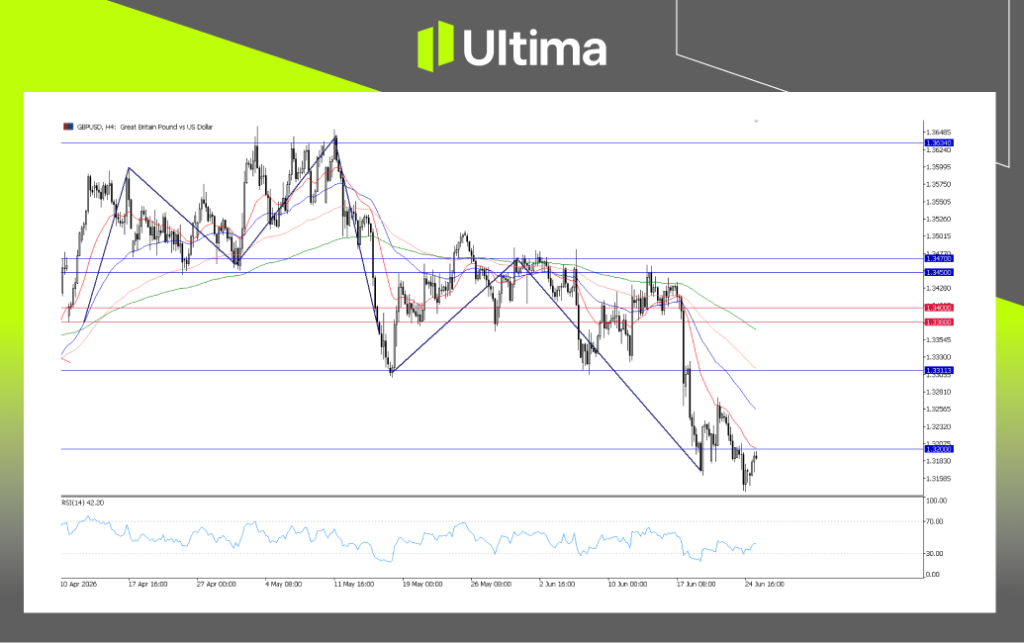
The initial political vacuum briefly forced the Pound down toward 1.3190. However, because Labour retains its massive parliamentary majority, there is near-zero risk of a snap General Election.
A smooth, uncontested transition to Burnham by mid-July will quickly remove this localized political risk premium and support Cable’s stability in the near term.
GBPUSD, H4 Chart | Ultima Markets MT5
In the near term, the pound-dollar movement remains heavily driven by the broader Federal Reserve outlook and overall US Dollar strength.
Over the medium to long term, however, if Burnham’s targeted spending packages keep inflation sticky, the Bank of England may be forced to keep interest rates higher for longer. This interest rate support could paradoxically underpin the Pound.
FTSE100: Remain Insulated
The large-cap index remains highly insulated from domestic Downing Street developments. Since roughly 75% to 80% of corporate revenues are generated overseas, its direction will continue to be driven by global commodity cycles and international central bank policy shifts rather than local politics.
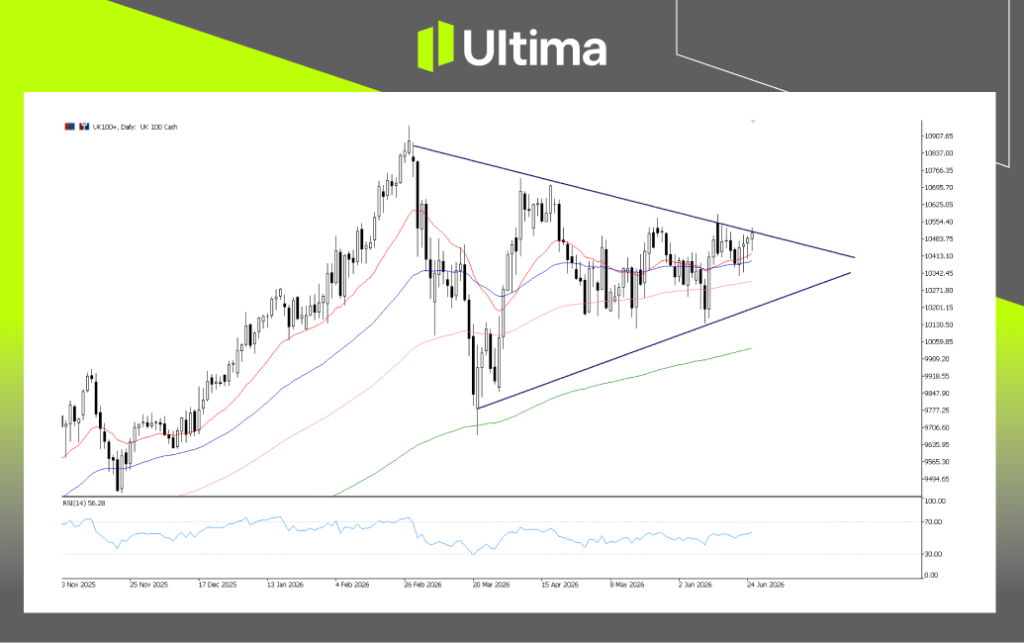
UK100, Daily Chart | Ultima Markets MT5
Technically, the UK100 remains locked in a broad consolidation pattern, with a recent converging triangle forming. Price action here is largely driven by the global macro picture.
If global equity markets—which have faced recent downward pressure—begin to stabilize, and the UK political transition passes without introducing volatility, the outlook is constructive.
Barring any unexpected disruption during the leadership transition that rattles investor confidence, the market backdrop should remain favorable for equities.
Summary
While the political shakeup initially introduced a layer of near-term uncertainty, the broader market impact remains highly limited.
Because the Labour party maintains its strong parliamentary majority, a smooth and uncontested leadership transition by mid-July will quickly dismantle the remaining localized political risk premium, paving the way for structural stability across both the British Pound and UK equity markets.
Thank you for visiting the Ultima Markets website. Please note that this website is intended for individuals residing in jurisdictions where access is permitted by law. Ultima and its affiliated entities do not operate in your home jurisdiction.
By clicking ‘Acknowledge’, you confirm that you are entering this website solely on your own initiative and not as a result of any specific marketing outreach. You wish to obtain information from this website based on reverse solicitation principles, in accordance with the applicable laws of your home jurisdiction.