This website is managed by Ultima Markets’ international entities, and it’s important to emphasise that they are not subject to regulation by the FCA in the UK. Therefore, you must understand that you will not have the FCA’s protection when investing through this website – for example:
You will not be guaranteed Negative Balance Protection
You will not be protected by FCA’s leverage restrictions
You will not have the right to settle disputes via the Financial Ombudsman Service (FOS)
You will not be protected by Financial Services Compensation Scheme (FSCS)
Any monies deposited will not be afforded the protection required under the FCA Client Assets Sourcebook. The level of protection for your funds will be determined by the regulations of the relevant local regulator.
Note: UK clients are kindly invited to visit https://www.ultima-markets.co.uk/. Ultima Markets UK expects to begin onboarding UK clients in accordance with FCA regulatory requirements in 2026.
If you would like to proceed and visit this website, you acknowledge and confirm the following:
1.The website is owned by Ultima Markets’ international entities and not by Ultima Markets UK Ltd, which is regulated by the FCA.
2.Ultima Markets Limited, or any of the Ultima Markets international entities, are neither based in the UK nor licensed by the FCA.
3.You are accessing the website at your own initiative and have not been solicited by Ultima Markets Limited in any way.
4.Investing through this website does not grant you the protections provided by the FCA.
5.Should you choose to invest through this website or with any of the international Ultima Markets entities, you will be subject to the rules and regulations of the relevant international regulatory authorities, not the FCA.
Ultima Markets wants to make it clear that we are duly licensed and authorised to offer the services and financial derivative products listed on our website. Individuals accessing this website and registering a trading account do so entirely of their own volition and without prior solicitation.
By confirming your decision to proceed with entering the website, you hereby affirm that this decision was solely initiated by you, and no solicitation has been made by any Ultima Markets entity.
Crude Oil for July: Risk Premium Returns, But Peak Frenzy Unlikely
Crude Oil for July: Risk Premium Returns, But Peak Frenzy Unlikely
The global crude oil market is once again reacting to sudden political shifts in the Middle East. Only a few weeks ago, a temporary ceasefire agreement between the United States and Iran brought strong optimism to global markets.
As worries over shipping lanes faded, the geopolitical risk premium quickly disappeared. Crude oil prices, which had hit historic highs during the peak of the fighting, dropped all the way back to their pre-war levels.
The Breakup of Ceasefire
However, this market relief did not last long. Earlier this week, the fragile calm broke as the US-Iran conflict escalated sharply. Following a series of new US military strikes on Iranian targets, official statements confirmed that the ceasefire is completely off. The market reaction was fast and aggressive, with crude oil prices jumping nearly 10% in just two days.
This sudden turn of events puts energy traders and institutional investors in a difficult position. The big questions for the market right now are: Where do oil prices go from here? Are we looking at a major, long-term rally that will push prices back to their old peaks, or is this sharp price jump just a short-term reaction?
How Risk Premium Moves the Price Previously
To understand where oil prices are going, we need to look closely at what was actually driving them: the geopolitical risk premium and sudden shock. When the US-Iran war first started earlier this year, crude oil benchmarks quickly climbed past $100 a barrel.
This rally did not happen because of an actual physical shortage of oil, but because of fear.
The market added a high premium to the price due to the threat of supply disruptions, especially the risk of a total blockade of the Strait of Hormuz—a vital shipping lane where about one-fifth of the world’s daily oil supply passes through.
This risk premium acts like an insurance cost that traders pay when the chances of shipping disruptions go up. When the ceasefire was announced, that risk dropped significantly.
The main takeaway is that standard supply and demand factors, like OPEC+ production capacity or non-OPEC output have temporarily taken a back seat. Geopolitical risk is the main force driving oil price volatility back then and also for now.
However, because oil supply and demand are hard to adjust quickly in the short term, any news threatening a major trade route like Hormuz causes a big spike in prices, completely overshadowing broader macro impact.
The Next Phase: Key Factors Watching the Escalation
With the US-Iran war heating up again, oil prices have naturally rebounded as traders price the risk premium back into the market. However, whether oil will skyrocket back to its previous peak depends on three major variables, but most likely unlikely for now.
1. The Scale of the Military Conflict
The absolute ceiling for oil prices depends heavily on how far the actual fighting goes. If the situation escalates further with direct, ongoing attacks on oil fields, major refineries, or commercial tankers in the Persian Gulf, oil prices will certainly continue to surge. If the conflict shifts from political tension into direct damage to energy infrastructure, we could easily see prices head up.
2. Likelihood of Keeping the Conflict Contained
While another short-term price spike is highly possible, a return to the extreme panic we saw during the peak in March is less likely right now. Back when the war first started, uncertainty was at its absolute highest. Today, the situation is a bit different.
Neither the US nor Iran wants a total, unmanageable regional war that would severely damage the global economy.
On top of that, international mediators have a huge incentive to keep things from getting out of hand.
Diplomatic talks through mediators are still happening, and there will be constant efforts to put boundaries on the fighting, which should help cap the worst of the market panic.
3. Investor Fatigue and Changing Expectations
Crucially, large institutional traders and commercial oil buyers are unlikely to react as wildly to this risk premium as they did the first time.
The first price spike to record highs was driven by pure, unknown fear. Markets hate uncertainty, and back in March, no one knew how far either country would go, or how long a blockade of the Strait of Hormuz could actually last.
By now, the market has built up some tolerance to the bad news. Even though the Hormuz blockade is still a real risk, oil prices had actually dropped significantly before this week’s escalation. This shows that the market had previously over-priced the geopolitical risk.
Institutional investors now see that oil shipments are being rerouted, strategic reserves are available, and a permanent, total shutdown of global supply is less likely than initially feared. Buyers are getting tired of chasing the panic, meaning it now takes much bigger or more destructive news to push prices up to the same extreme levels.
Expect a Rally, But Not a Frenzy Rally
Looking at these dynamics, we can set a realistic expectation for oil prices in the coming weeks. Since prices already tested and hit pre-war levels during the short ceasefire, this new wave of supply fears creates a strong floor for the market.
We expect crude oil to trade on the higher side, staying well above pre-war levels in the near term. The baseline price has shifted higher because the safety net of the ceasefire is gone.
However, because of buyer fatigue, awareness that the market overreacted before, and the likelihood that the conflict will be somewhat contained, oil is unlikely to break past its previous major peaks.
Expect a choppy, elevated trading range where prices are kept up by anxiety but held back by investors who are hesitant to chase the momentum blindly.
Technical Analysis: Key Levels and Trends
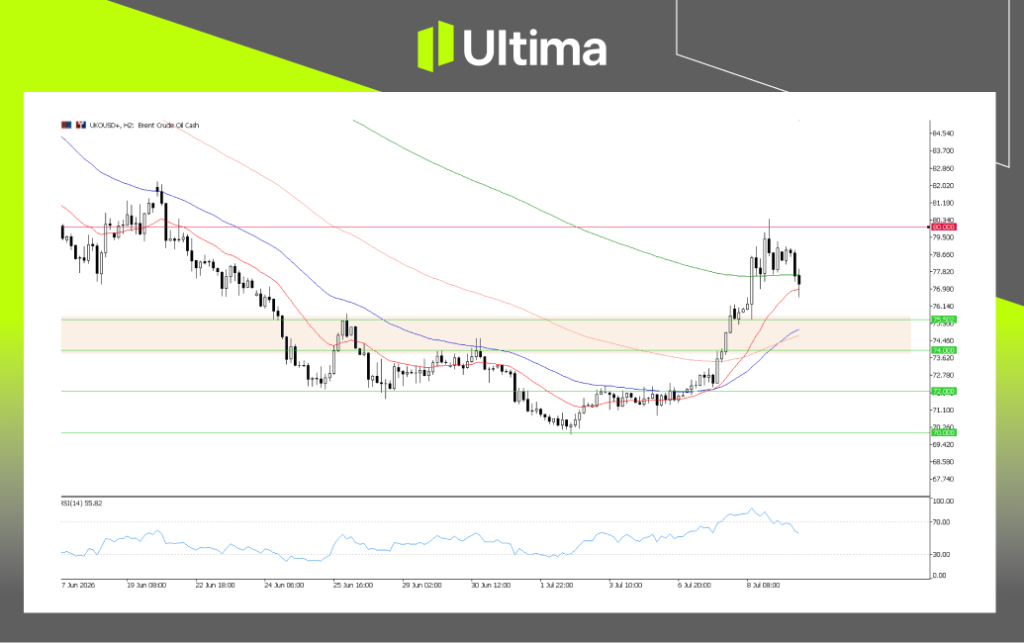
From a technical viewpoint, the recent 10% jump has changed the short-term chart setup. Crude oil (UKOUSD) has broken cleanly out of the downward trend channel that formed during the ceasefire.
UKOUSD, H2 Chart | Ultima Markets MT5
On the 2-hour short-term chart, this sharp rebound pushed prices back above key short-term moving averages, turning old resistance levels into new support lines.
In the near term, we can recognize that crude oil could enter a significant shift in trend, where a short-term bullish bias is likely. The structural floor for Brent crude now sits near the $70 – $75 levels.
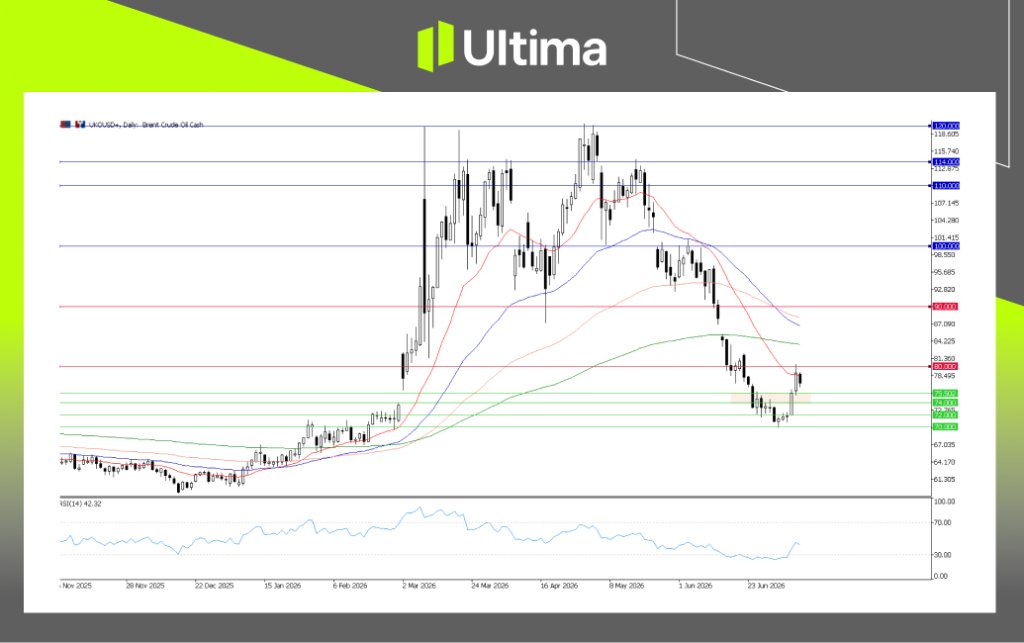
UKOUSD, Daily Chart | Ultima Markets MT5
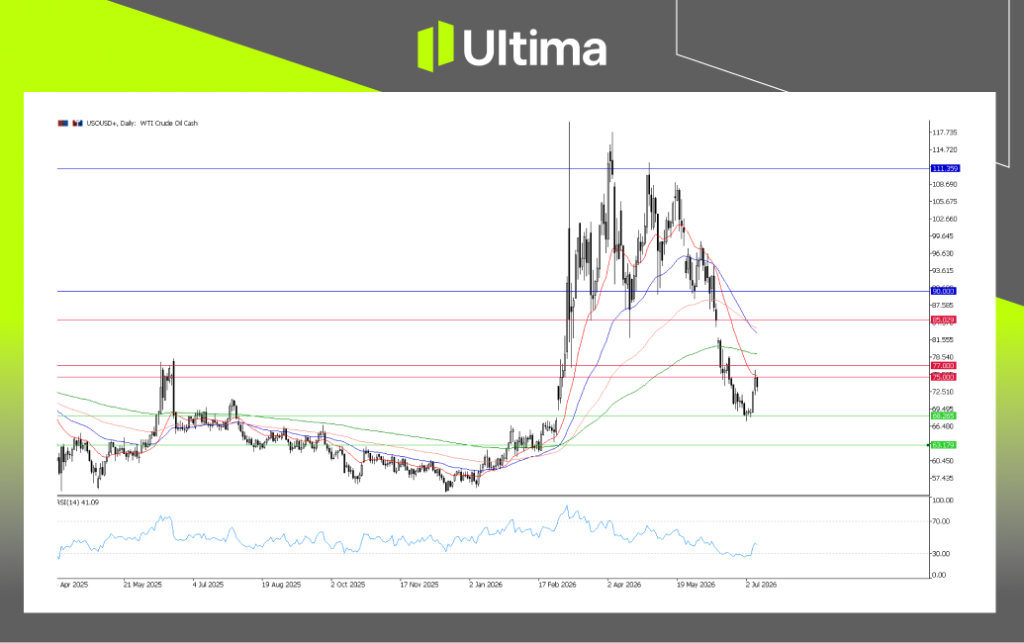
USOUSD, Daily Chart | Ultima Markets MT5
Meanwhile, looking at the Daily chart for both the Brent (UKOUSD) and WTI (USOUSD) , we can map out the potential price action by dividing the market into three distinct zones:
The Structural Support Zone (Green Zone): This represents the pre-war level. It now serves as a strong baseline floor for the market if geopolitical escalation temporarily slows down or pauses.
The Near-Term Bulls Zone (Red Zone): This is the risk-premium-driven area. This is where the oil price is most likely to trade if the conflict continues to escalate over the coming weeks.
The Frenzy Zone (Blue Zone): This marks the previous peak panic level. It is currently less likely to be reached unless we see massive, widespread supply disruptions or a major expansion of the war across the wider Middle East.
Summary
The sudden collapse of the US-Iran ceasefire has brought back the geopolitical risk premium, pushing crude oil prices up by 10%.
While near-term prices will likely stay elevated above pre-war levels due to renewed supply fears around the Strait of Hormuz, a return to previous peak panic levels is unlikely. Market fatigue, alternative shipping routes, and a mutual desire to avoid a full-scale war will keep the rally contained.
Technically, Brent crude has established a new short-term floor around $70–$75, setting the stage for a volatile and short-term bullish setup, but capped below the “frenzy zone” that we seen in Q2 of 2026.
Disclaimer
Comments, news, research, analysis, price, and all information contained in the article only serve as general information for readers and do not suggest any advice. Ultima Markets has taken reasonable measures to provide up-to-date information, but cannot guarantee accuracy, and may modify without notice. Ultima Markets will not be responsible for any loss incurred due to the application of the information provided.
Thank you for visiting the Ultima Markets website. Please note that this website is intended for individuals residing in jurisdictions where access is permitted by law. Ultima and its affiliated entities do not operate in your home jurisdiction.
By clicking ‘Acknowledge’, you confirm that you are entering this website solely on your own initiative and not as a result of any specific marketing outreach. You wish to obtain information from this website based on reverse solicitation principles, in accordance with the applicable laws of your home jurisdiction.