This website is managed by Ultima Markets’ international entities, and it’s important to emphasise that they are not subject to regulation by the FCA in the UK. Therefore, you must understand that you will not have the FCA’s protection when investing through this website – for example:
You will not be guaranteed Negative Balance Protection
You will not be protected by FCA’s leverage restrictions
You will not have the right to settle disputes via the Financial Ombudsman Service (FOS)
You will not be protected by Financial Services Compensation Scheme (FSCS)
Any monies deposited will not be afforded the protection required under the FCA Client Assets Sourcebook. The level of protection for your funds will be determined by the regulations of the relevant local regulator.
Note: UK clients are kindly invited to visit https://www.ultima-markets.co.uk/. Ultima Markets UK expects to begin onboarding UK clients in accordance with FCA regulatory requirements in 2026.
If you would like to proceed and visit this website, you acknowledge and confirm the following:
1.The website is owned by Ultima Markets’ international entities and not by Ultima Markets UK Ltd, which is regulated by the FCA.
2.Ultima Markets Limited, or any of the Ultima Markets international entities, are neither based in the UK nor licensed by the FCA.
3.You are accessing the website at your own initiative and have not been solicited by Ultima Markets Limited in any way.
4.Investing through this website does not grant you the protections provided by the FCA.
5.Should you choose to invest through this website or with any of the international Ultima Markets entities, you will be subject to the rules and regulations of the relevant international regulatory authorities, not the FCA.
Ultima Markets wants to make it clear that we are duly licensed and authorised to offer the services and financial derivative products listed on our website. Individuals accessing this website and registering a trading account do so entirely of their own volition and without prior solicitation.
By confirming your decision to proceed with entering the website, you hereby affirm that this decision was solely initiated by you, and no solicitation has been made by any Ultima Markets entity.
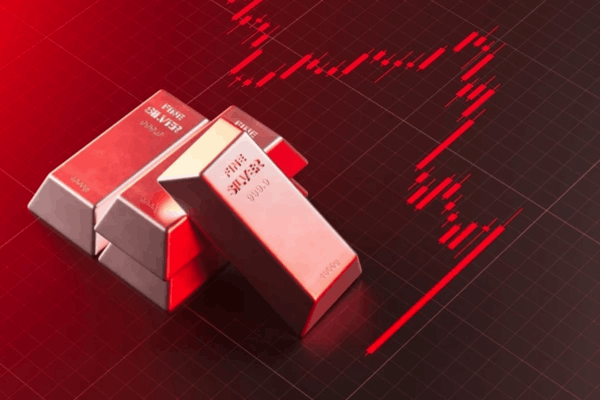
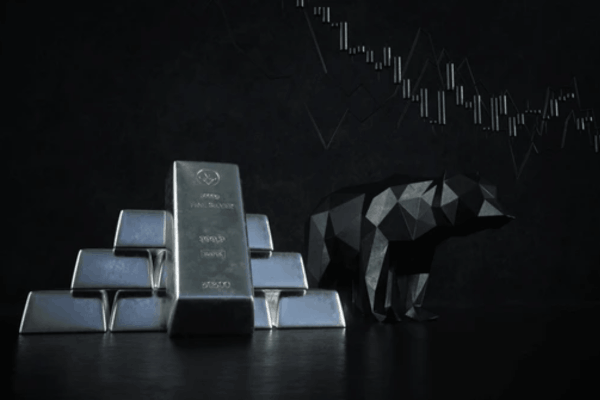
Discover why silver is falling. Here's what traders need to know from Fed hawkishness, rising Treasury yields to a stagflation trap and even liquidation.
Silver had one of the most remarkable bull runs in commodity market history, surging 135% through 2025 to an all-time high of $121.60 per ounce. Fast forward to March 2026, and the picture looks very different.
Traders everywhere are asking why silver is falling, and the answer is not a single event. It is a collision of monetary policy, rising Treasury yields, an energy-driven stagflation trap, and the painful unwinding of speculative excess, all hitting at the same time.
On 23rd March 2026, silver touched $60 per ounce, its lowest point of the year and a decline of more than 50% from its January peak in under three months. To understand where silver goes next, you first need to understand exactly how it got here.
The Day Silver Broke: January 30th, 2026
The current sell-off has a clear starting point. On 30th January 2026, two events collided that the market was completely unprepared for.
President Trump nominated Kevin Warsh as the next Federal Reserve chair, a move markets immediately read as deeply hawkish. Warsh, known for his views on price stability over market liquidity, triggered a sharp surge in the US dollar and caused rate-cut expectations to collapse almost instantly.
On the very same day, CME Group raised margin requirements on silver futures contracts, forcing a wave of leveraged positions into liquidation simultaneously.
The result was silver’s worst single-day decline since the 1980s, a fall of roughly 33% in one session. For traders who had positioned for a move toward $150, it was a devastating and immediate reset that set the tone for everything that followed.
The Fed: Rates Are Staying Higher for Longer
Of all the forces behind why silver is falling, the Federal Reserve’s policy stance is the most persistent. Two key developments from the March 18th meeting made this clear.
The Dot Plot Shift
At the March meeting, the Fed held rates at 3.50% to 3.75%. The bigger shock, however, came from the dot plot. The median projection for year-end 2026 moved to 3.4%, up from 2.9% in December 2025. Markets had previously priced in at least three rate cuts for the year.
That expectation has now almost entirely evaporated, and with one policymaker already pencilling in a rate hike for 2027, the message from the Fed is unambiguous: easy money is not coming back soon.
The Yield Effect
The Fed also revised its core PCE inflation forecast higher to 2.7%, which sent bond markets into motion. The 10-year Treasury yield climbed to 4.37% as of 24th March 2026, its highest level of the year. For a non-yielding asset like silver, this is a direct headwind. When investors can earn over 4% risk-free in Treasuries, the argument for holding silver in a downtrend becomes very hard to make.
The Stagflation Trap
This is the angle that much of the mainstream commentary has overlooked, and it is arguably the most important dynamic of 2026.
Why Oil Is Making Things Worse
Traditionally, rising oil prices support precious metals by stoking inflation concerns. In 2026, the mechanism has broken down entirely. The closure of the Strait of Hormuz and subsequent strikes on Iranian energy infrastructure pushed Brent crude above $126 per barrel, sending
European natural gas prices 35% higher. Rather than acting as a tailwind for silver, this energy shock has deepened a stagflation trap that keeps the Fed from cutting rates.
The sequence looks like this:
Higher oil pushes consumer inflation higher
Elevated inflation forces the Fed to hold or tighten further
A hawkish Fed strengthens the US dollar
A stronger dollar makes silver more expensive for global buyers
Demand weakens and prices fall
The brief geopolitical spike that pushed silver back toward $96 in early March was fully erased within 48 hours. Without lasting demand to back it, a war premium built on panic simply cannot hold. The energy crisis has trapped policymakers and, in turn, trapped silver.
Dollar Strength and the Squeeze on Global Demand
The US Dollar Index has climbed back above 100 in 2026, and this matters for silver in a very direct way. Because silver is priced in US dollars, a stronger greenback raises the cost of the metal for buyers outside the United States.
This is particularly significant for silver given how much of its physical demand originates in Asia. Chinese solar panel manufacturers, electronics firms, and industrial buyers are among the largest consumers of silver globally.
When the price rises in local currency terms, purchasing activity slows. That softening in demand adds another layer of selling pressure on top of the macro backdrop, and it is one reason why silver is falling even as the structural supply story remains intact.
Hot Money Exits Fast
A significant part of silver’s 2026 collapse traces back to the nature of the rally that preceded it. Much of the 2025 surge was driven not just by genuine demand, but by speculative capital chasing a parabolic move. That same hot money exits fast.
CFTC Commitments of Traders data as of 10th March showed large speculator longs already falling by 920 contracts to 33,306, signalling that institutional positioning was being trimmed before the sharpest leg of the sell-off even began.
Once those large leveraged positions started to unwind, a cascading effect took hold. Retail investors who had bought silver between $80 and $90 became forced sellers, amplifying the downward move with no natural floor to absorb the volume.
Why Silver Gets Hit Harder Than Gold
It also helps to understand why silver is falling more sharply than gold. The comparison below illustrates the key difference in how each metal behaves during risk-off episodes:
Factor
Silver
Gold
Industrial demand share
~60% of total demand
Minimal
Monetary/safe-haven role
Partial
Primary
Volatility profile
High
Moderate
Impact during slowdowns
Hit from both industrial and investment side
Cushioned by institutional buying
2026 performance vs Jan peak
Down ~50%
Down ~12%
Silver sits between two asset classes. In good times, this amplifies gains. In risk-off conditions, it removes the natural buyers that would otherwise provide support.
What the Charts Are Saying
The $60 Support Zone
From a technical standpoint, the most critical level of 2026 is $60 per ounce. This level aligns closely with the 0.618 Fibonacci extension of the move from January’s peak through the February low, one of the most widely respected support zones in technical analysis. Silver has responded to it so far, but traders are watching closely for any sign of a confirmed break.
A 12-hour close below $60 would likely open a path toward $51, a further decline of around 15% from current levels.
Recovery Targets If Support Holds
If $60 holds and conditions begin to shift, the recovery roadmap looks like this:
First target: $74 (0.382 Fibonacci retracement)
Second target: $82 (0.236 Fibonacci retracement)
Full mean reversion: $96
Three conditions would need to align to confirm a genuine bottom: the $60 level holds on a closing basis, the weekly COT report shows managed money longs returning, and the Dollar Index breaks back below 98.48.
Where Analysts See Silver Going
Despite the scale of the correction, most institutional forecasts remain constructive on a longer-term view. The table below summarises the key targets currently in circulation:
Institution / Analyst
2026 Silver Target
Reuters Poll (consensus)
$79.50/oz average
J.P. Morgan Global Research
$81/oz average
UBS
$85/oz
Commerzbank (mid-year)
$92/oz
Bank of America (Widmer)
$135 to $309/oz
GoldSilver (Hibbard)
$175+/oz
Underpinning the more bullish views is the Silver Institute’s projection of a sixth consecutive structural supply deficit in 2026, estimated at 67 million ounces. Mining supply is also tightening, with Fresnillo cutting its 2026 guidance by 9% and First Majestic revising approximately 11% lower, partly due to elevated all-in sustaining costs from high oil prices.
The long-term fundamentals have not changed. What has changed is the macro environment, and in the short term, that is firmly in the driving seat.
Conclusion
The reason why silver is falling comes down to a perfect storm of forces that have converged with unusual intensity. A hawkish Federal Reserve, Treasury yields at their highest point of the year, a surging US dollar, a stagflation trap born from the Middle East energy crisis, and the violent unwind of speculative positioning have all struck simultaneously.
Silver’s dual identity as both an industrial commodity and a monetary metal means it has fewer natural buyers stepping in to cushion the fall when sentiment turns negative.
Monitor the weekly COT report for signs of stabilisation in positioning, watch the 10-year Treasury yield for any pullback below 4.2%, and track any shift in the Fed’s language around inflation. If those conditions begin to align, silver’s recovery could be just as sharp as its fall. Until they do, caution remains the appropriate stance.
FAQs
Why is silver falling faster than gold?
Silver has a much larger industrial demand base than gold, accounting for around 60% of total demand. When the macro environment deteriorates, silver loses both investment and industrial demand simultaneously, making it far more vulnerable to sharp declines.
What price level do traders need to watch on silver right now?
The $60 level is the critical support zone for 2026, aligning with the 0.618 Fibonacci extension from January’s peak. A confirmed close below it opens the path toward $51, while a hold sets up a potential recovery toward $74 to $82.
Will silver recover in 2026?
Institutional forecasts remain broadly bullish on a longer-term view, with J.P. Morgan at $81 and Bank of America targeting $135 to $309. The Silver Institute also projects a sixth consecutive annual supply deficit. A Fed pivot or sustained dollar weakness could trigger a sharp recovery from current oversold levels.
Disclaimer: This content is provided for informational purposes only and does not constitute, and should not be construed as, financial, investment, or other professional advice. No statement or opinion contained here in should be considered a recommendation by Ultima Markets or the author regarding any specific investment product, strategy, or transaction. Readers are advised not to rely solely on this material when making investment decisions and should seek independent advice where appropriate.
Thank you for visiting the Ultima Markets website. Please note that this website is intended for individuals residing in jurisdictions where access is permitted by law. Ultima and its affiliated entities do not operate in your home jurisdiction.
By clicking ‘Acknowledge’, you confirm that you are entering this website solely on your own initiative and not as a result of any specific marketing outreach. You wish to obtain information from this website based on reverse solicitation principles, in accordance with the applicable laws of your home jurisdiction.