This website is managed by Ultima Markets’ international entities, and it’s important to emphasise that they are not subject to regulation by the FCA in the UK. Therefore, you must understand that you will not have the FCA’s protection when investing through this website – for example:
You will not be guaranteed Negative Balance Protection
You will not be protected by FCA’s leverage restrictions
You will not have the right to settle disputes via the Financial Ombudsman Service (FOS)
You will not be protected by Financial Services Compensation Scheme (FSCS)
Any monies deposited will not be afforded the protection required under the FCA Client Assets Sourcebook. The level of protection for your funds will be determined by the regulations of the relevant local regulator.
Note: UK clients are kindly invited to visit https://www.ultima-markets.co.uk/. Ultima Markets UK expects to begin onboarding UK clients in accordance with FCA regulatory requirements in 2026.
If you would like to proceed and visit this website, you acknowledge and confirm the following:
1.The website is owned by Ultima Markets’ international entities and not by Ultima Markets UK Ltd, which is regulated by the FCA.
2.Ultima Markets Limited, or any of the Ultima Markets international entities, are neither based in the UK nor licensed by the FCA.
3.You are accessing the website at your own initiative and have not been solicited by Ultima Markets Limited in any way.
4.Investing through this website does not grant you the protections provided by the FCA.
5.Should you choose to invest through this website or with any of the international Ultima Markets entities, you will be subject to the rules and regulations of the relevant international regulatory authorities, not the FCA.
Ultima Markets wants to make it clear that we are duly licensed and authorised to offer the services and financial derivative products listed on our website. Individuals accessing this website and registering a trading account do so entirely of their own volition and without prior solicitation.
By confirming your decision to proceed with entering the website, you hereby affirm that this decision was solely initiated by you, and no solicitation has been made by any Ultima Markets entity.
Learn the break and retest strategy, how traders identify breakout signals, confirm support and resistance levels, and manage trading risks effectively.
A break and retest strategy is one of the most widely used price action approaches for identifying potential trading opportunities after a market breakout. Instead of entering immediately when price moves beyond a key support or resistance level, traders wait for the market to return and test that level again before considering an entry.
This approach helps traders avoid chasing sudden price movements and provides a clearer view of whether a breakout has genuine momentum or is simply a false signal. In this article, Ultima Markets explains how the break and retest strategy works, the key signals traders watch, and how to apply proper risk management when using this setup.
What Is a Break and Retest Strategy?
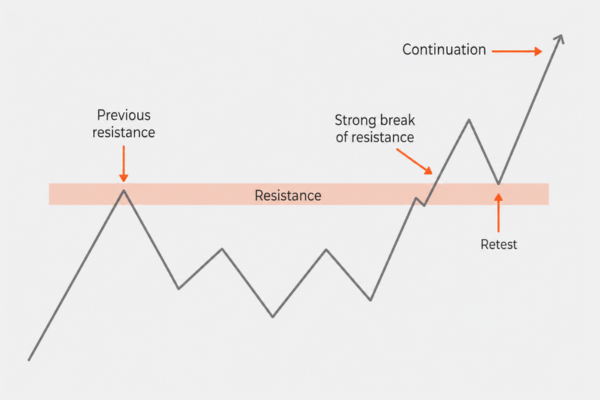
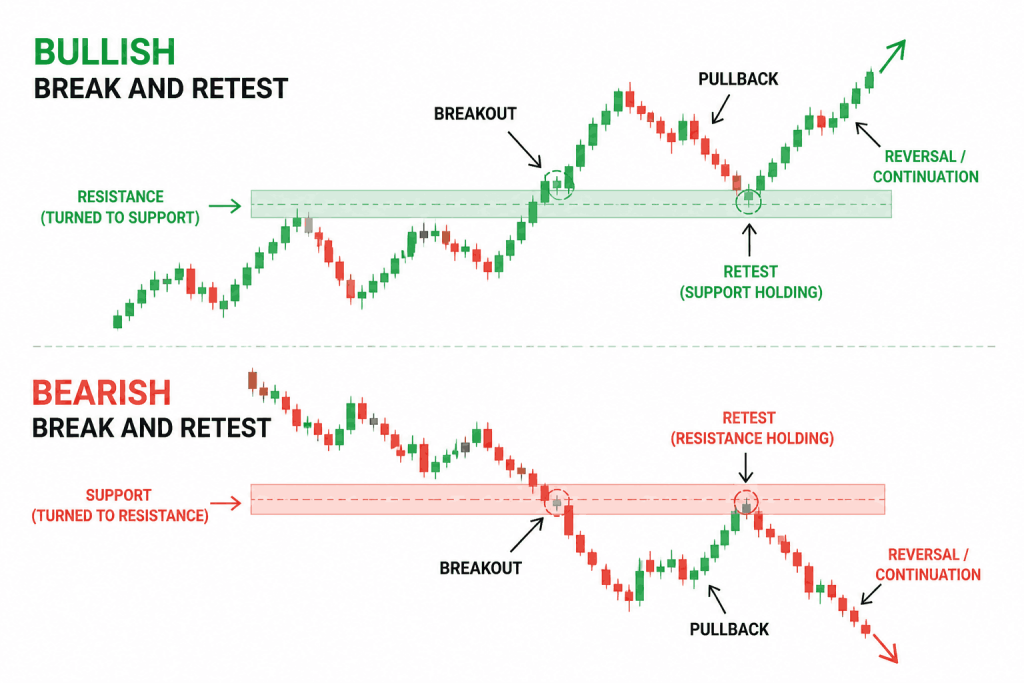
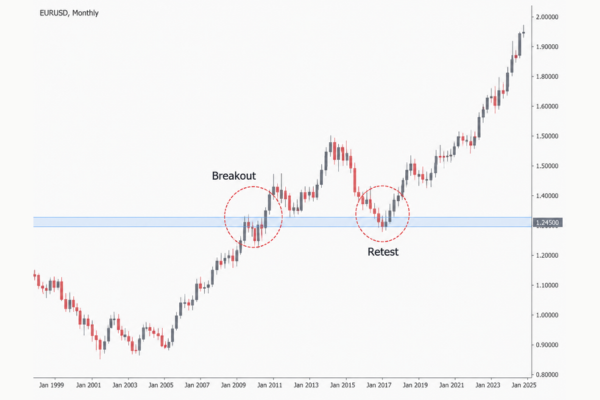
A break and retest occurs when the price breaks through an important support or resistance level, then moves back to test that same area before continuing in the breakout direction.
The idea behind this strategy comes from market psychology. When a resistance level is broken, sellers who previously defended that area may exit their positions, while new buyers enter as they expect further upside. As a result, the previous resistance level can become a new support zone.
The opposite can also happen in a bearish market. When price breaks below support, that previous support level may become a new resistance area as sellers regain control.
A typical break and retest setup includes three stages:
Breakout: Price moves beyond a key support or resistance level.
Retest: Price returns to test the broken level.
Confirmation: Traders look for signs that the level is holding before entering.
How Does the Break and Retest Strategy Work?
The first step is identifying important price levels. These can be found using previous highs and lows, trendlines, chart patterns, moving averages, or psychological price levels.
For example, if a stock repeatedly fails to move above $100, that level becomes a significant resistance area. If the stock eventually breaks above $100, traders may wait for a pullback towards this price before entering.
A successful break and retest strategy does not rely on the breakout alone. The retest is important because it shows whether buyers or sellers are willing to defend the new price zone.
Bullish Break and Retest Example
A bullish setup usually follows this pattern:
Stage
Price Action
Resistance
Price struggles to move above a key level
Breakout
Price closes above resistance
Retest
Price returns to test the previous resistance
Confirmation
Buyers defend the level and price moves higher
For example, if EUR/USD has been trading below 1.1000 for several weeks, a move above 1.1000 may signal a potential bullish breakout. However, traders may wait for the price to return near 1.1000 and look for confirmation before entering.
Bearish Break and Retest Example
A bearish setup works in the opposite way:
Stage
Price Action
Support
Price repeatedly holds above a key level
Breakdown
Price falls below support
Retest
Price returns towards the previous support
Confirmation
Sellers reject the level and price continues lower
This approach allows traders to identify potential entries with a clearer invalidation point.
How to Confirm a Break and Retest Setup
Not every breakout leads to a successful continuation. Some price movements are false breakouts, where the market briefly moves beyond a level before reversing.
Traders often use additional confirmation signals to improve their analysis.
Volume Confirmation
Volume can provide clues about the strength of a breakout. A breakout supported by increasing volume may indicate stronger market participation, while a breakout with weak volume could suggest limited momentum.
A common pattern traders look for is:
Strong volume during the breakout
Lower volume during the retest
Increased activity when price resumes the trend
Candlestick Confirmation
Price action signals can also help confirm whether a retest is successful.
Common confirmation candles include:
Hammer candles during bullish retests
Bullish engulfing patterns after support holds
Bearish engulfing patterns after resistance rejection
Pin bars showing strong rejection of a level
These signals suggest that buyers or sellers are defending the area.
When Does the Break and Retest Strategy Work Best?
The break and retest strategy is generally more effective when used alongside broader market conditions.
Strong Trending Markets
Breakouts that follow an existing trend often have stronger momentum. For example, a bullish breakout in a market already forming higher highs and higher lows may have a higher chance of continuation.
After Long Consolidation Periods
When price moves sideways for an extended period, pressure can build between buyers and sellers. A breakout from this range may create a stronger move, especially if supported by increased participation.
Around Important Market Levels
Not all support and resistance levels are equally valuable. Stronger levels usually have:
Multiple previous reactions
Clear price rejection
Higher timeframe importance
A break and retest around a major daily or weekly level is often considered more significant than one occurring on a shorter timeframe.
Common Mistakes When Trading Break and Retest
Although the strategy is straightforward, traders often make mistakes when applying it.
Entering Immediately After the Breakout
One of the biggest mistakes is buying or selling as soon as price breaks a level. The market may reverse quickly if the breakout lacks enough support.
Waiting for the retest can provide a more controlled entry point.
Ignoring False Breakouts
A breakout does not always mean a new trend has started. Warning signs of a possible false breakout include:
Weak breakout momentum
Low trading volume
Price quickly returning inside the previous range
Failure to hold the retested level
Using Weak Support and Resistance Levels
A level that has only been tested once may not have enough significance. Traders should focus on areas where the market has shown repeated reactions.
Break and Retest vs Trading Breakouts
Both approaches aim to capture market movements after a key level is broken, but the entry timing is different.
Strategy
Entry Point
Main Advantage
Main Risk
Breakout Trading
Enter when price breaks the level
Captures moves early
Higher chance of false signals
Break and Retest
Enter after price confirms the broken level
Better entry confirmation
Price may continue without retesting
The break and retest approach may suit traders who prefer confirmation before entering, while breakout traders may prioritise getting into the move earlier.
How to Manage Risk When Using Break and Retest
Even a high-quality setup can fail, which makes risk management essential.
Traders may consider:
Setting stop losses beyond the invalidation point
Avoiding oversized positions
Combining multiple confirmation signals
Maintaining a consistent trading plan
For a bullish setup, traders may place a stop loss below the new support area. For a bearish setup, a stop loss may be placed above the new resistance zone.
The goal is not to avoid every losing trade, but to manage potential losses when market conditions change.
Conclusion
The break and retest strategy remains popular among traders because it provides a structured way to approach market breakouts.
By waiting for price to confirm a new support or resistance level, traders can avoid some common breakout traps and potentially improve their entry timing.
However, no trading strategy works in every market condition. Successful trading requires combining technical analysis, confirmation signals, and disciplined risk management.
For traders learning price action, the break and retest approach offers a practical framework for analysing opportunities across markets including forex, stocks, commodities, and indices.
FAQs
What is a break and retest strategy?
It is a trading method where price breaks a key level, returns to test it, and continues in the breakout direction after confirmation.
Is break and retest good for beginners?
Yes. It is easy to understand, but beginners should practise identifying strong levels and managing risk.
What indicators can be used with break and retest?
Traders often combine it with volume, moving averages, trendlines, and candlestick patterns.
Share Now
Disclaimer:This content is provided for informational purposes only and does not constitute, and should not be construed as, financial, investment, or other professional advice. No statement or opinion contained herein should be considered a recommendation by Ultima Markets or the author regarding any specific investment product, strategy, or transaction. Readers are advised not to rely solely on this material when making investment decisions and should seek independent advice where appropriate.
Thank you for visiting the Ultima Markets website. Please note that this website is intended for individuals residing in jurisdictions where access is permitted by law. Ultima and its affiliated entities do not operate in your home jurisdiction.
By clicking ‘Acknowledge’, you confirm that you are entering this website solely on your own initiative and not as a result of any specific marketing outreach. You wish to obtain information from this website based on reverse solicitation principles, in accordance with the applicable laws of your home jurisdiction.