This website is managed by Ultima Markets’ international entities, and it’s important to emphasise that they are not subject to regulation by the FCA in the UK. Therefore, you must understand that you will not have the FCA’s protection when investing through this website – for example:
You will not be guaranteed Negative Balance Protection
You will not be protected by FCA’s leverage restrictions
You will not have the right to settle disputes via the Financial Ombudsman Service (FOS)
You will not be protected by Financial Services Compensation Scheme (FSCS)
Any monies deposited will not be afforded the protection required under the FCA Client Assets Sourcebook. The level of protection for your funds will be determined by the regulations of the relevant local regulator.
Note: UK clients are kindly invited to visit https://www.ultima-markets.co.uk/. Ultima Markets UK expects to begin onboarding UK clients in accordance with FCA regulatory requirements in 2026.
If you would like to proceed and visit this website, you acknowledge and confirm the following:
1.The website is owned by Ultima Markets’ international entities and not by Ultima Markets UK Ltd, which is regulated by the FCA.
2.Ultima Markets Limited, or any of the Ultima Markets international entities, are neither based in the UK nor licensed by the FCA.
3.You are accessing the website at your own initiative and have not been solicited by Ultima Markets Limited in any way.
4.Investing through this website does not grant you the protections provided by the FCA.
5.Should you choose to invest through this website or with any of the international Ultima Markets entities, you will be subject to the rules and regulations of the relevant international regulatory authorities, not the FCA.
Ultima Markets wants to make it clear that we are duly licensed and authorised to offer the services and financial derivative products listed on our website. Individuals accessing this website and registering a trading account do so entirely of their own volition and without prior solicitation.
By confirming your decision to proceed with entering the website, you hereby affirm that this decision was solely initiated by you, and no solicitation has been made by any Ultima Markets entity.
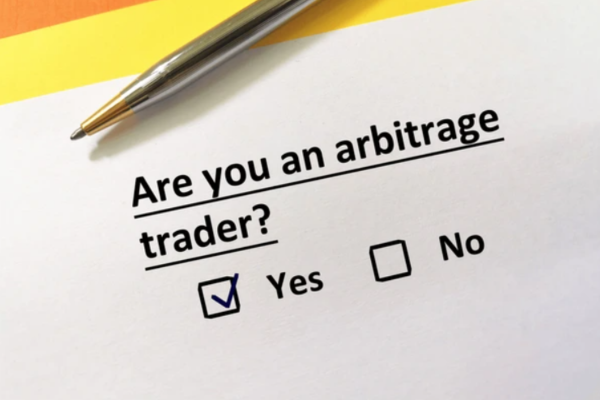
Learn what arbitrage is. Explore how traders can profit from price discrepancies. Explore different types of arbitrage and its role in market efficiency.
Arbitrage is a popular strategy in the financial markets, often associated with institutional traders. It involves capitalising on price discrepancies between different markets.
In simple terms, arbitrage allows traders to buy an asset at a lower price in one market and simultaneously sell it at a higher price in another, pocketing the difference.
In this article, we will explore what is arbitrage, how it works, the different types of arbitrage, and the risks involved.
How Does Arbitrage Work?
Arbitrage relies on the principle that identical or nearly identical assets should be priced the same across different markets. When price discrepancies occur, traders can profit by exploiting these differences.
For example:
Stock X is trading at $50 on Exchange A and $50.50 on Exchange B.
A trader can buy it on Exchange A and sell it on Exchange B, making a $0.50 profit.
The key to successful arbitrage is executing the buy and sell orders simultaneously to avoid exposure to market risk. This fast-paced nature of arbitrage means the opportunity to profit can be brief, and execution speed is critical.
Why Arbitrage Is Important for Market Efficiency
Arbitrage plays a crucial role in maintaining market efficiency by ensuring that prices for the same or similar assets remain aligned across different markets.
Key Benefits of Arbitrage:
Price Convergence: Arbitrage helps close price gaps between different markets, ensuring the same asset has the same price across exchanges.
Liquidity: By increasing the number of trades and transactions, arbitrage boosts liquidity, leading to more stable and efficient markets.
Market Stability: Arbitrage opportunities are quickly capitalised on, which helps reduce market inefficiencies and extreme price fluctuations.
In essence, arbitrage helps ensure that prices reflect their true value, which contributes to a fairer and more efficient market environment.
Types of Arbitrage
Arbitrage comes in several forms, and each has its own characteristics. Below are some of the most common types of arbitrage:
1. Spatial (Geographical) Arbitrage
This is the most basic form of arbitrage, where a trader buys an asset in one market (where the price is lower) and sells it in another (where the price is higher). For instance, a trader might buy gold at a lower price in London and sell it at a higher price in New York, profiting from the price difference.
2. Triangular Arbitrage (Forex)
Triangular arbitrage is unique to the foreign exchange market. Traders take advantage of discrepancies between three currencies. For example, a trader might convert USD to EUR, then convert EUR to GBP, and finally convert GBP back to USD. If exchange rates are misaligned, the trader can make a profit by completing the cycle.
3. Statistical Arbitrage
Statistical arbitrage uses advanced algorithms and statistical models to predict market inefficiencies. By analysing historical data and market patterns, traders can predict and profit from price movements before they occur. This method is often used by quantitative hedge funds and in high-frequency trading.
4. Merger Arbitrage (Risk Arbitrage)
Risk arbitrage involves buying the stock of a company being acquired and short-selling the stock of the acquiring company. Traders make profits by capitalising on the difference in stock prices during mergers or acquisitions.
For example, if a company’s stock is undervalued compared to the buyout price, traders can buy the stock in anticipation of a price increase.
5. Latency Arbitrage
Latency arbitrage exploits delays in price updates between different exchanges. It is most commonly used in high-frequency trading, where even a small delay in price updates can present a profit opportunity.
Risks Involved in Arbitrage
While arbitrage is considered a low-risk strategy, there are still several challenges and risks that traders need to be aware of.
1. Execution Risk
Arbitrage opportunities can be fleeting. If a trader cannot execute the buy and sell orders simultaneously, the price discrepancy may disappear before the transaction is completed, resulting in a loss.
2. Transaction Costs
Arbitrage typically involves multiple trades, and each trade incurs transaction costs, such as commissions, fees, and the bid-ask spread. These costs can quickly erode profits, especially in markets with thin margins.
3. Liquidity Risk
If a market lacks liquidity, it may be difficult to complete both sides of the arbitrage trade at the desired price. In illiquid markets, traders may not be able to buy or sell the asset at the price they expected, leading to lower profits or losses.
4. Regulatory Risks
Changes in regulation can impact the viability of arbitrage strategies. For example, recent regulatory changes in India have forced banks to unwind currency arbitrage positions due to new foreign exchange rules.
5. Currency Risk
When engaging in cross-border arbitrage, currency fluctuations can impact profits. A trader may experience a loss if the exchange rate moves unfavourably between the time the arbitrage opportunity is identified and the trades are executed.
Arbitrage in the Modern Era: Crypto and Beyond
Arbitrage is not limited to traditional financial markets. It has expanded into other areas such as cryptocurrency markets and sports betting.
Crypto Arbitrage: Traders can exploit price differences between cryptocurrency exchanges to buy low on one platform and sell high on another.
Sports Arbitrage: This form of arbitrage takes advantage of differing odds from multiple bookmakers, ensuring a risk-free profit regardless of the outcome of the event.
With the rise of digital currencies and online platforms, the opportunities for arbitrage are growing and evolving, offering new avenues for traders to profit.
Conclusion
Arbitrage remains a powerful tool in the financial world, helping to ensure that prices reflect their true value and contributing to market efficiency. Whether it is through spatial arbitrage, triangular arbitrage, or statistical arbitrage, traders can capitalise on price discrepancies across different markets.
However, it is important to be aware of the risks involved, such as execution delays, transaction costs, and liquidity issues.
As technology continues to advance, the opportunities for arbitrage will continue to grow, with new methods emerging in areas like cryptocurrency and sports betting. Understanding the mechanics of arbitrage and its risks is essential for traders looking to explore this strategy.
FAQs
Is arbitrage risk-free?
Arbitrage can seem risk-free, but execution delays, transaction costs, and regulatory changes can all affect profitability.
Can retail traders use arbitrage?
Yes, retail traders can engage in arbitrage, especially in cryptocurrency markets or with the help of digital trading platforms. However, the profit margins tend to be smaller.
Why did arbitrage become a hot topic recently?
In 2026, India’s Reserve Bank imposed restrictions on foreign exchange arbitrage, which led to major market shifts and regulatory scrutiny.
Share Now
Disclaimer:This content is provided for informational purposes only and does not constitute, and should not be construed as, financial, investment, or other professional advice. No statement or opinion contained herein should be considered a recommendation by Ultima Markets or the author regarding any specific investment product, strategy, or transaction. Readers are advised not to rely solely on this material when making investment decisions and should seek independent advice where appropriate.
Thank you for visiting the Ultima Markets website. Please note that this website is intended for individuals residing in jurisdictions where access is permitted by law. Ultima and its affiliated entities do not operate in your home jurisdiction.
By clicking ‘Acknowledge’, you confirm that you are entering this website solely on your own initiative and not as a result of any specific marketing outreach. You wish to obtain information from this website based on reverse solicitation principles, in accordance with the applicable laws of your home jurisdiction.