This website is managed by Ultima Markets’ international entities, and it’s important to emphasise that they are not subject to regulation by the FCA in the UK. Therefore, you must understand that you will not have the FCA’s protection when investing through this website – for example:
You will not be guaranteed Negative Balance Protection
You will not be protected by FCA’s leverage restrictions
You will not have the right to settle disputes via the Financial Ombudsman Service (FOS)
You will not be protected by Financial Services Compensation Scheme (FSCS)
Any monies deposited will not be afforded the protection required under the FCA Client Assets Sourcebook. The level of protection for your funds will be determined by the regulations of the relevant local regulator.
Note: UK clients are kindly invited to visit https://www.ultima-markets.co.uk/. Ultima Markets UK expects to begin onboarding UK clients in accordance with FCA regulatory requirements in 2026.
If you would like to proceed and visit this website, you acknowledge and confirm the following:
1.The website is owned by Ultima Markets’ international entities and not by Ultima Markets UK Ltd, which is regulated by the FCA.
2.Ultima Markets Limited, or any of the Ultima Markets international entities, are neither based in the UK nor licensed by the FCA.
3.You are accessing the website at your own initiative and have not been solicited by Ultima Markets Limited in any way.
4.Investing through this website does not grant you the protections provided by the FCA.
5.Should you choose to invest through this website or with any of the international Ultima Markets entities, you will be subject to the rules and regulations of the relevant international regulatory authorities, not the FCA.
Ultima Markets wants to make it clear that we are duly licensed and authorised to offer the services and financial derivative products listed on our website. Individuals accessing this website and registering a trading account do so entirely of their own volition and without prior solicitation.
By confirming your decision to proceed with entering the website, you hereby affirm that this decision was solely initiated by you, and no solicitation has been made by any Ultima Markets entity.
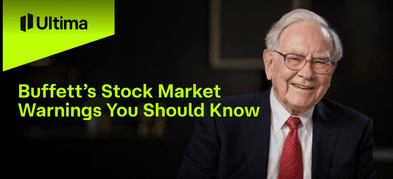
Discover what Warren Buffett stock market warnings mean for investors. Learn the mistakes he has warned against and how to avoid costly investing errors.
The latest Warren Buffett stock market warning has attracted attention from investors wondering whether the legendary investor expects a major market decline. However, Buffett’s message has rarely been about predicting the exact timing of a crash. Instead, his warnings focus on the mistakes investors repeatedly make when markets become expensive, emotional or driven by speculation.
As Berkshire Hathaway became more selective with investments and built a significant cash position, many investors viewed the move as a sign of caution.
However, Buffett’s approach has always been about discipline rather than fear. His investment philosophy centres on buying quality businesses at reasonable prices, staying patient and avoiding decisions driven by market excitement.
The key lesson behind the Warren Buffett stock market warning is simple: investors often lose money not because they choose the wrong market, but because they make poor decisions during uncertain conditions.
Why Warren Buffett’s Cash Position Raised Market Concerns
One reason the Warren Buffett stock market warning gained attention was Berkshire Hathaway’s growing cash reserves.
When Buffett holds more cash instead of aggressively buying stocks, investors often interpret it as a sign that he believes valuations are becoming less attractive. Berkshire has historically maintained large liquidity reserves so it can take advantage of opportunities when prices become more favourable.
However, a large cash position does not necessarily mean Buffett expects stocks to collapse. It reflects his preference for waiting rather than forcing investments when opportunities do not meet his standards.
This is one of Buffett’s most important lessons: sometimes the best investment decision is having the patience to do nothing.
1. Buying Stocks Without Understanding the Business
One of Buffett’s most repeated warnings is that investors should understand what they own.
Many investors buy stocks because of headlines, social media trends or recent price movements without studying the company behind the share price. Buffett views stock ownership differently. To him, buying a stock means becoming a partial owner of a business.
Investors should consider questions such as:
Does the company have a strong competitive advantage?
Is revenue growth sustainable?
Does management allocate capital effectively?
Is the current valuation reasonable?
This principle explains why Buffett avoided many popular investments during periods of market excitement. He focuses on business fundamentals rather than short-term popularity.
2. Paying Too Much for Great Companies
Another major lesson behind Buffett’s investing philosophy is that even excellent companies can become poor investments if investors pay too much.
A strong brand, rapid growth and innovative products can attract investor enthusiasm, but the price paid still matters. When expectations become unrealistic, even companies with strong fundamentals may struggle to deliver future returns.
The Buffett Indicator, which compares the total market capitalisation of stocks with the size of the economy, is often used as a broad measure of market valuation. Buffett has previously highlighted this ratio as a useful way to judge whether the market appears expensive compared with historical levels.
However, the indicator is not designed to predict short-term market movements. Instead, it reinforces Buffett’s broader message: investors should be careful when optimism pushes valuations far beyond reasonable expectations.
3. Chasing Market Trends and Investment Hype
A common mistake Buffett has warned against is following the crowd.
During periods of strong market performance, investors often become attracted to the latest trends. This can create situations where excitement grows faster than actual business performance.
The technology and artificial intelligence sectors provide a recent example. AI companies have attracted significant investor interest due to the potential growth of AI infrastructure, cloud computing and automation. However, Buffett’s approach suggests investors should separate genuine business potential from unrealistic expectations.
Buffett is not against innovation. Berkshire Hathaway’s investments have included technology companies, showing that he recognises the importance of long-term business transformation. His warning is about paying any price simply because a trend is popular.
4. Letting Emotions Control Investment Decisions
One of Buffett’s most famous lessons is that successful investing requires emotional discipline.
Many investors make decisions based on fear and greed. They buy after prices rise because they worry about missing opportunities, then sell during market declines because they fear further losses.
Historical investor behaviour studies have shown that poor timing decisions can significantly reduce long-term returns. Investors often enter markets after strong rallies and exit after downturns, which can damage the benefits of long-term compounding.
Buffett’s approach is different. He believes market volatility is normal and that investors should focus on the value of businesses rather than short-term price movements.
5. Ignoring the Power of Long-Term Compounding
Buffett’s success has been built on patience.
Over several decades, Berkshire Hathaway has demonstrated how consistent returns and reinvested capital can create significant wealth. Buffett often highlights that investors do not need to make hundreds of successful decisions. They need to avoid major mistakes and allow time to work.
Many investors search for quick profits, but frequent trading and constant strategy changes can interrupt the compounding process.
The biggest advantage available to investors is often time, not prediction.
6. Using Too Much Debt and Leverage
Another important Warren Buffett stock market warning involves excessive borrowing.
Leverage can increase returns when markets move favourably, but it can also magnify losses during downturns. Investors using borrowed money may be forced to sell assets at unfavourable prices when volatility increases.
Buffett has consistently valued financial strength and flexibility. Berkshire Hathaway maintains significant liquidity because having available capital allows the company to act when opportunities appear.
Avoiding unnecessary financial pressure gives investors more control over their decisions.
What Investors Can Learn From Warren Buffett’s Warning
The real message behind the Warren Buffett stock market warning is not that investors should avoid stocks. It is that investors should try to avoid mistakes.
Buffett’s philosophy focuses on several timeless principles:
Understand the businesses you invest in
Avoid paying unrealistic prices
Do not follow market hype blindly
Stay disciplined during volatility
Think long term
Protect your capital
Markets will always experience periods of optimism and fear. While nobody can predict every market movement, investors can improve their chances of success by avoiding the behavioural mistakes Buffett has warned about for decades.
FAQs
Is Warren Buffett predicting a stock market crash?
No. Buffett’s warnings focus on valuations, investor behaviour and risk management rather than predicting a specific market crash.
Why is Warren Buffett holding more cash?
Buffett often holds cash when he cannot find investments that meet his valuation standards. Cash provides flexibility for future opportunities.
What is Warren Buffett’s biggest investing rule?
Buffett’s main principle is to invest in understandable businesses with strong fundamentals and avoid paying too much for them.
Share Now
Disclaimer:This content is provided for informational purposes only and does not constitute, and should not be construed as, financial, investment, or other professional advice. No statement or opinion contained herein should be considered a recommendation by Ultima Markets or the author regarding any specific investment product, strategy, or transaction. Readers are advised not to rely solely on this material when making investment decisions and should seek independent advice where appropriate.
Thank you for visiting the Ultima Markets website. Please note that this website is intended for individuals residing in jurisdictions where access is permitted by law. Ultima and its affiliated entities do not operate in your home jurisdiction.
By clicking ‘Acknowledge’, you confirm that you are entering this website solely on your own initiative and not as a result of any specific marketing outreach. You wish to obtain information from this website based on reverse solicitation principles, in accordance with the applicable laws of your home jurisdiction.