This website is managed by Ultima Markets’ international entities, and it’s important to emphasise that they are not subject to regulation by the FCA in the UK. Therefore, you must understand that you will not have the FCA’s protection when investing through this website – for example:
You will not be guaranteed Negative Balance Protection
You will not be protected by FCA’s leverage restrictions
You will not have the right to settle disputes via the Financial Ombudsman Service (FOS)
You will not be protected by Financial Services Compensation Scheme (FSCS)
Any monies deposited will not be afforded the protection required under the FCA Client Assets Sourcebook. The level of protection for your funds will be determined by the regulations of the relevant local regulator.
Note: UK clients are kindly invited to visit https://www.ultima-markets.co.uk/. Ultima Markets UK expects to begin onboarding UK clients in accordance with FCA regulatory requirements in 2026.
If you would like to proceed and visit this website, you acknowledge and confirm the following:
1.The website is owned by Ultima Markets’ international entities and not by Ultima Markets UK Ltd, which is regulated by the FCA.
2.Ultima Markets Limited, or any of the Ultima Markets international entities, are neither based in the UK nor licensed by the FCA.
3.You are accessing the website at your own initiative and have not been solicited by Ultima Markets Limited in any way.
4.Investing through this website does not grant you the protections provided by the FCA.
5.Should you choose to invest through this website or with any of the international Ultima Markets entities, you will be subject to the rules and regulations of the relevant international regulatory authorities, not the FCA.
Ultima Markets wants to make it clear that we are duly licensed and authorised to offer the services and financial derivative products listed on our website. Individuals accessing this website and registering a trading account do so entirely of their own volition and without prior solicitation.
By confirming your decision to proceed with entering the website, you hereby affirm that this decision was solely initiated by you, and no solicitation has been made by any Ultima Markets entity.
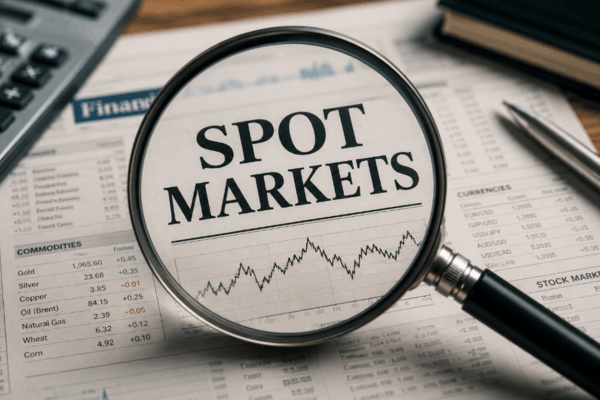
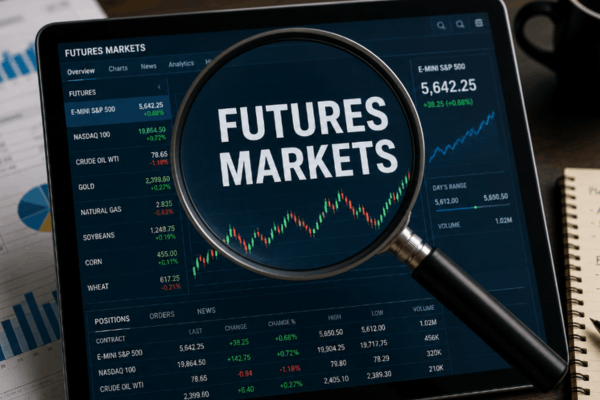
Discover the difference between spot markets vs futures markets. Learn the differences in pricing, ownership, settlement, leverage, hedging and risks.
Understanding spot markets vs futures markets is important if you trade, invest or manage business price risk. A spot market is where an asset is bought or sold at the current market price, usually for immediate or near-immediate settlement. A futures market is where buyers and sellers trade contracts based on the price of an asset at a future date.
The difference sounds simple, but it affects ownership, pricing, settlement, leverage, expiry dates and risk. In short, spot markets vs futures markets comes down to whether you want exposure to an asset now or want to manage price risk for later.
What Is a Spot Market?
A spot market, also called a cash market, is where an asset is traded at today’s market price. If you buy gold at the current price, exchange one currency for another, or purchase cryptocurrency to hold directly, you are using a spot market.
Spot does not always mean instant settlement
The word “spot” can sound like everything happens instantly, but that is not always the case. In many electronic markets, the trade price is agreed immediately, while the final transfer of cash and assets settles later.
For example, applicable US securities transactions moved to a T+1 settlement cycle from 28 May 2024, meaning settlement generally happens one business day after the trade date.
Why spot markets matter
Spot markets are important because they reflect current supply and demand. They are used by investors, businesses, importers, exporters, consumers and traders who want direct exposure to an asset.
Foreign exchange is one of the clearest examples. In April 2025, global OTC foreign exchange turnover reached $9.6 trillion per day, with FX spot transactions accounting for $3 trillion per day, or 31% of total global FX turnover.
What Is a Futures Market?
A futures market is where traders buy and sell standardised contracts. These contracts set a price for an underlying asset for a future delivery or settlement date. The asset could be oil, wheat, gold, a stock index, a currency or cryptocurrency.
When you buy a futures contract, you usually do not take immediate ownership of the asset. Instead, you are trading a contract whose value is linked to that asset.
Why futures markets matter
Futures markets are widely used for hedging, speculation and price discovery. A business may use futures to reduce the risk of rising costs, while a trader may use futures to take a view on where prices could move next.
Futures markets are also large and liquid. CME Group reported record annual average daily volume of 28.1 million contracts in 2025, up 6% year on year.
Spot Markets vs Futures Markets: Key Differences
The main difference in spot markets vs futures markets is timing. Spot markets focus on the price now. Futures markets focus on an agreed price for a later date.
Feature
Spot Market
Futures Market
Main purpose
Buy or sell the asset now
Trade a contract for future settlement
Price used
Current spot price
Futures price for a contract month
Ownership
Often direct ownership
Usually contract exposure
Settlement
Immediate or near-immediate
Future settlement or expiry
Expiry
Usually no contract expiry
Contracts normally expire
Common users
Investors, businesses and consumers
Hedgers, institutions and traders
Main risk
Asset price falls after purchase
Leverage, margin calls and expiry risk
A simple way to remember it is this: spot markets are usually about owning or exchanging the asset, while futures markets are usually about managing exposure to a future price.
How Pricing Works
Spot and futures prices are connected, but they are not always the same.
Spot prices
Spot prices are driven by current supply and demand. If demand rises while supply is limited, the spot price may increase. If supply is strong and demand weakens, the spot price may fall.
For physical commodities, local conditions can also matter. Transport, storage, product quality and location may all affect the actual spot price paid by a buyer.
Futures prices
Futures prices may reflect expectations about future supply and demand, but they are not guaranteed forecasts. They can also include carrying costs such as storage, insurance, financing and interest rates.
For example, a futures price for gold or oil may be higher than the spot price because it includes the cost of holding that asset until a future date.
Basis and basis risk
The gap between the spot price and the futures price is called the basis. In commodity markets, basis is often calculated as the local cash price minus the nearby futures price.
This matters because a hedge may not work perfectly if the spot price and futures price do not move together. The CFTC defines basis risk as the risk that this gap unexpectedly widens or narrows between the time a hedge is created and the time it is lifted.
Contango and backwardation
When futures prices are above spot prices, the market is often described as being in contango. When futures prices are below spot prices, it is called backwardation.
These terms are useful because they help explain why a futures contract can trade at a different price from the asset available in the spot market today.
Uses and Risks
Both markets can be useful, but they suit different goals.
When spot markets are useful
Spot markets may be suitable when you want:
Direct ownership of the asset
A simple price based on today’s market
No futures expiry date
Immediate or near-immediate use of the asset
For example, a jewellery maker may buy spot gold for production. A traveller may buy foreign currency before a trip. A crypto investor may buy Bitcoin in the spot market because they want to hold the coin directly.
When futures markets are useful
Futures markets may be suitable when you want:
To hedge a future purchase or sale
To manage price exposure without owning the asset
To go long or short more easily
To use margin for capital efficiency
For example, a farmer may sell wheat futures before harvest to protect against falling prices. An airline may use fuel-related futures to manage the risk of higher fuel costs. A portfolio manager may use stock index futures to adjust market exposure without buying or selling every individual share.
Key risks to know
The main spot market risk is price movement after purchase. If you buy an asset and its price falls, you take the loss. Physical assets may also involve storage, transport and insurance costs.
The biggest futures risk is leverage. Futures are commonly traded on margin, which means a trader can control a larger contract value with less upfront capital. This can magnify gains, but it can also magnify losses.
Futures positions are also typically marked to market, meaning gains and losses are recognised during the life of the contract. CME Group describes daily mark-to-market as a distinctive feature of futures markets.
A recent crypto example
Crypto has made the spot markets vs futures markets comparison more relevant. Many crypto investors use spot markets to own coins directly, while others use futures or perpetual futures for leveraged exposure.
Reuters reported that perpetual futures trading volume reached $61.7 trillion in 2025, showing how important derivatives have become in digital asset markets.
Conclusion
Spot markets vs futures markets differ mainly in timing, ownership and risk. Spot markets focus on today’s price and often involve direct ownership. Futures markets use contracts to manage exposure to a future price.
For beginners, spot markets are usually easier to understand. For businesses, institutions and experienced traders, futures markets can be powerful tools for hedging, speculation and price discovery.
The best way to compare spot markets vs futures markets is to ask one question: do you want to buy or sell the asset now, or are you trying to manage price exposure for the future?
FAQs
What is the main difference between spot and futures markets?
Spot markets trade assets at today’s price. Futures markets trade contracts for future settlement.
Is a futures price a prediction?
Not always. It may reflect expectations, carrying costs and market conditions.
Are futures riskier than spot markets?
They can be. Futures often involve leverage, margin and expiry dates.
Share Now
Disclaimer:This content is provided for informational purposes only and does not constitute, and should not be construed as, financial, investment, or other professional advice. No statement or opinion contained herein should be considered a recommendation by Ultima Markets or the author regarding any specific investment product, strategy, or transaction. Readers are advised not to rely solely on this material when making investment decisions and should seek independent advice where appropriate.
Thank you for visiting the Ultima Markets website. Please note that this website is intended for individuals residing in jurisdictions where access is permitted by law. Ultima and its affiliated entities do not operate in your home jurisdiction.
By clicking ‘Acknowledge’, you confirm that you are entering this website solely on your own initiative and not as a result of any specific marketing outreach. You wish to obtain information from this website based on reverse solicitation principles, in accordance with the applicable laws of your home jurisdiction.