This website is managed by Ultima Markets’ international entities, and it’s important to emphasise that they are not subject to regulation by the FCA in the UK. Therefore, you must understand that you will not have the FCA’s protection when investing through this website – for example:
You will not be guaranteed Negative Balance Protection
You will not be protected by FCA’s leverage restrictions
You will not have the right to settle disputes via the Financial Ombudsman Service (FOS)
You will not be protected by Financial Services Compensation Scheme (FSCS)
Any monies deposited will not be afforded the protection required under the FCA Client Assets Sourcebook. The level of protection for your funds will be determined by the regulations of the relevant local regulator.
Note: UK clients are kindly invited to visit https://www.ultima-markets.co.uk/. Ultima Markets UK expects to begin onboarding UK clients in accordance with FCA regulatory requirements in 2026.
If you would like to proceed and visit this website, you acknowledge and confirm the following:
1.The website is owned by Ultima Markets’ international entities and not by Ultima Markets UK Ltd, which is regulated by the FCA.
2.Ultima Markets Limited, or any of the Ultima Markets international entities, are neither based in the UK nor licensed by the FCA.
3.You are accessing the website at your own initiative and have not been solicited by Ultima Markets Limited in any way.
4.Investing through this website does not grant you the protections provided by the FCA.
5.Should you choose to invest through this website or with any of the international Ultima Markets entities, you will be subject to the rules and regulations of the relevant international regulatory authorities, not the FCA.
Ultima Markets wants to make it clear that we are duly licensed and authorised to offer the services and financial derivative products listed on our website. Individuals accessing this website and registering a trading account do so entirely of their own volition and without prior solicitation.
By confirming your decision to proceed with entering the website, you hereby affirm that this decision was solely initiated by you, and no solicitation has been made by any Ultima Markets entity.
The Inside Bar pattern shows consolidation in the market. Learn how to use it for breakout, trend continuation, and reversal strategies in your trading.
How to Trade the Inside Bar Candle?
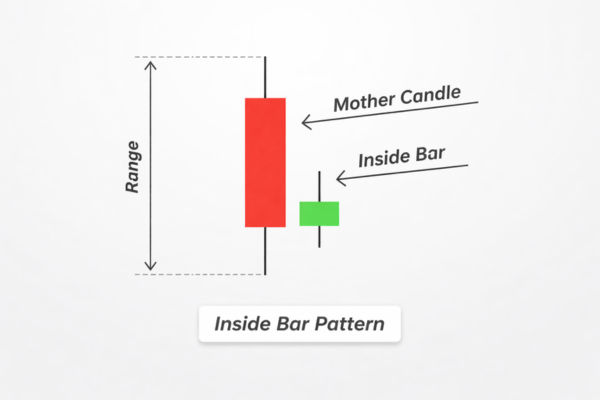
The inside bar candle is a highly regarded pattern in technical analysis, commonly used by traders to spot consolidation periods and potential breakouts in the market. The inside bar occurs when the price action of a smaller candlestick (the inside bar) is fully contained within the range of the previous, larger candlestick (the mother bar).
This pattern is essential for traders who focus on price action strategies, as it can signal either a continuation or reversal of the prevailing market trend.
In this article, we will dive deep into what an inside bar candle is, how it forms, and how traders use this powerful pattern to make informed decisions in their trading strategies.
What Is An Inside Bar Candle
The first, larger candle is known as the mother bar.
The second, smaller candle is the inside bar.
An inside bar is a two-candle formation:
For an inside bar to be valid, the high and low of the inside bar must be fully contained within the high and low of the mother bar. This setup suggests that price is consolidating within a specific range, creating a period of indecision. The market is in a balance between buyers and sellers, and a breakout from this range could lead to a significant price move.
Why Traders Use Inside Bar Candles
The inside bar pattern is commonly used by traders for the following reasons:
Market consolidation: Inside bars indicate a period of low volatility where the market is taking a pause after a previous move.
Potential breakout: Since the inside bar represents a pause in price action, traders anticipate that a breakout from the inside bar range could lead to a strong directional move.
Trend continuation or reversal: Inside bars can signal either a continuation of the current trend or a reversal, depending on where the pattern forms in relation to the overall market trend.
How to Trade with Inside Bar Candles
There are several ways to incorporate inside bar candles into trading strategies. The most popular methods include breakout strategies, trend continuation setups, and reversal trades. Let’s explore each of these approaches in more detail.
1. Breakout Strategy
One of the most widely used strategies for trading inside bars is the breakout strategy. This involves entering a trade once the price breaks above or below the high/low of the mother bar. The idea is that once price breaks the range of the inside bar, it could lead to a strong move in the breakout direction. Here’s how you can execute the strategy:
Buy stop order: Place a buy stop order just above the high of the mother bar.
Sell stop order: Place a sell stop order just below the low of the mother bar.
Once the breakout occurs, traders enter the market and aim to ride the momentum. A 3:1 risk-reward ratio is recommended, meaning the potential reward should be at least three times the amount risked in the trade.
2. Trend Continuation
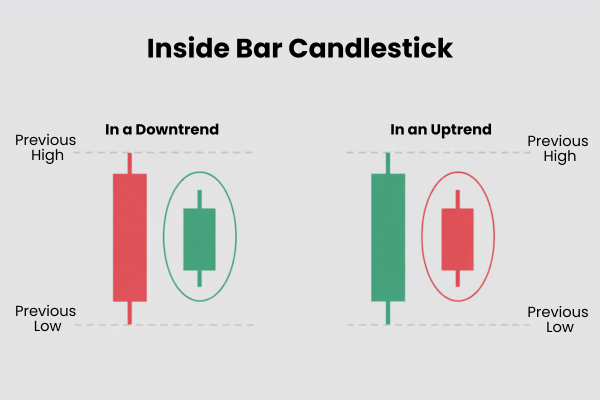
Inside bars are particularly effective when used in trending markets. After a strong move in the market, an inside bar suggests a brief pause or consolidation before the trend continues. Here’s how to use the inside bar pattern in trending markets:
In an uptrend: A break above the high of the mother bar signals that the uptrend is likely to continue.
In a downtrend: A break below the low of the mother bar indicates the continuation of the downtrend.
This strategy works best when the market is clearly trending, as the inside bar provides a high-probability entry point during a temporary pause.
3. Reversal Setup
Inside bars can also signal potential market reversals, especially when they form at key support or resistance levels. When an inside bar breaks in the opposite direction of the prevailing trend, it may indicate that the market is reversing. For example:
After a strong uptrend, if an inside bar forms near resistance and breaks below the range, it suggests the market could reverse downward.
After a downtrend, if an inside bar forms near support and breaks above the range, it suggests a potential reversal to the upside.
Reversal setups require careful analysis of the market structure, as inside bars are more effective when combined with other confirmation tools such as trend lines or key price levels.
4. Combining Inside Bars with Exponential Moving Averages (EMAs)
For traders looking for additional confirmation, combining the inside bar pattern with Exponential Moving Averages (EMAs) can improve the reliability of the trade. Using EMAs helps confirm the direction of the trend, ensuring the breakout aligns with the broader market movement. Here’s how to use EMAs with inside bars:
Uptrend confirmation: When the price breaks above the inside bar and the EMAs confirm an uptrend (e.g., the 20-period EMA is above the 50-period EMA), traders can enter a long position.
Downtrend confirmation: When the price breaks below the inside bar and the EMAs confirm a downtrend (e.g., the 50-period EMA is above the 20-period EMA), traders can enter a short position.
By using this strategy, traders add an extra layer of validation, increasing the likelihood of a successful breakout.
When Not to Trade Inside Bars
While the inside bar pattern can be very powerful, it is essential to avoid trading it in certain market conditions:
Quiet markets or heavy consolidation: Inside bars in sideways or range-bound markets are often unreliable and may lead to false breakouts. Look for inside bars that form during periods of strong trends.
Low volatility: Inside bars that form during periods of low volatility may not result in meaningful breakouts. Focus on inside bars that form after significant price movements for higher-probability setups.
Timeframe Considerations
The video also emphasized that higher timeframes (such as the daily or 4-hour charts) are best for trading inside bars. Inside bars on lower timeframes (e.g., 5-minute or 15-minute charts) can lead to frequent false breakouts. For more reliable signals, focus on higher timeframes where the inside bar patterns tend to indicate stronger breakout potential.
Common Mistakes to Avoid
Misidentifying the Pattern: Ensure that both the high and low of the inside bar are fully contained within the range of the mother bar. If not, it’s not a valid inside bar.
Trading in sideways markets: Avoid trading inside bars in range-bound markets, as they are less likely to lead to significant price movement.
Overtrading: Inside bars appear frequently on charts, but not all setups are high-quality. Filter for inside bars that align with strong trends or key support/resistance levels.
Conclusion
The inside bar candle is an essential pattern in technical analysis that can provide traders with valuable insights into market conditions. Whether used for breakout strategies, trend continuation, or reversals, the inside bar offers clear entry signals and a manageable risk profile.
By understanding the broader market context and using additional confirmation tools like EMAs, traders can enhance their ability to trade inside bars effectively.
As always, risk management is key. By incorporating inside bars into a comprehensive trading plan and carefully considering market structure, traders can leverage this powerful pattern for more reliable and profitable trades.
FAQs
What is the inside bar pattern in trading?
The inside bar pattern consists of two candles: the first (mother bar) is larger, and the second (inside bar) is entirely contained within the range of the mother bar. This pattern indicates consolidation and suggests a potential breakout when the price moves beyond the inside bar’s range.
How do I trade the inside bar pattern?
Traders typically use a breakout strategy to trade inside bars. Place a buy stop order above the high of the mother bar and a sell stop order below the low. A 3:1 risk-reward ratio is recommended for maximizing profitability.
Can inside bar patterns be used in any market condition?
Inside bars are most effective in trending markets. Avoid trading them in sideways or choppy markets where breakouts are less reliable. Focus on high-probability setups that form during clear trends or at key support/resistance levels.
Share Now
Disclaimer:This content is provided for informational purposes only and does not constitute, and should not be construed as, financial, investment, or other professional advice. No statement or opinion contained herein should be considered a recommendation by Ultima Markets or the author regarding any specific investment product, strategy, or transaction. Readers are advised not to rely solely on this material when making investment decisions and should seek independent advice where appropriate.
Thank you for visiting the Ultima Markets website. Please note that this website is intended for individuals residing in jurisdictions where access is permitted by law. Ultima and its affiliated entities do not operate in your home jurisdiction.
By clicking ‘Acknowledge’, you confirm that you are entering this website solely on your own initiative and not as a result of any specific marketing outreach. You wish to obtain information from this website based on reverse solicitation principles, in accordance with the applicable laws of your home jurisdiction.