This website is managed by Ultima Markets’ international entities, and it’s important to emphasise that they are not subject to regulation by the FCA in the UK. Therefore, you must understand that you will not have the FCA’s protection when investing through this website – for example:
You will not be guaranteed Negative Balance Protection
You will not be protected by FCA’s leverage restrictions
You will not have the right to settle disputes via the Financial Ombudsman Service (FOS)
You will not be protected by Financial Services Compensation Scheme (FSCS)
Any monies deposited will not be afforded the protection required under the FCA Client Assets Sourcebook. The level of protection for your funds will be determined by the regulations of the relevant local regulator.
Note: UK clients are kindly invited to visit https://www.ultima-markets.co.uk/. Ultima Markets UK expects to begin onboarding UK clients in accordance with FCA regulatory requirements in 2026.
If you would like to proceed and visit this website, you acknowledge and confirm the following:
1.The website is owned by Ultima Markets’ international entities and not by Ultima Markets UK Ltd, which is regulated by the FCA.
2.Ultima Markets Limited, or any of the Ultima Markets international entities, are neither based in the UK nor licensed by the FCA.
3.You are accessing the website at your own initiative and have not been solicited by Ultima Markets Limited in any way.
4.Investing through this website does not grant you the protections provided by the FCA.
5.Should you choose to invest through this website or with any of the international Ultima Markets entities, you will be subject to the rules and regulations of the relevant international regulatory authorities, not the FCA.
Ultima Markets wants to make it clear that we are duly licensed and authorised to offer the services and financial derivative products listed on our website. Individuals accessing this website and registering a trading account do so entirely of their own volition and without prior solicitation.
By confirming your decision to proceed with entering the website, you hereby affirm that this decision was solely initiated by you, and no solicitation has been made by any Ultima Markets entity.
Discover how much money is there in the world today. Explore the current global money supply, why it matters, and how it impacts the economy and markets.
So, how much money is in the world?
The latest estimate suggests that there is approximately $144 trillion in global broad money as of December 2025. This includes physical currency, bank deposits and other liquid financial instruments used across economies worldwide.
However, most of this money does not exist as physical cash. Only around $8 trillion to $9 trillion is estimated to be in the form of banknotes and coins, while the majority exists digitally as deposits recorded by commercial banks.
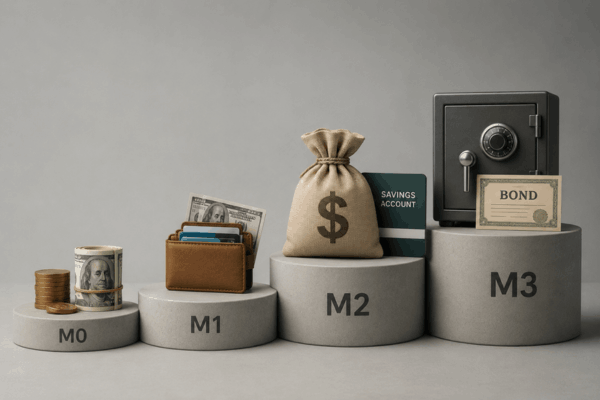
The total amount depends on how money is measured. Economists use different categories such as M0, M1, M2 and M3 to track different levels of liquidity within the financial system.
How Much Money Is in the World in USD?
When people ask how much money exists in the world, the answer depends on what counts as “money”.
A narrow definition would only include physical cash, while a broader definition includes bank deposits and other highly liquid financial assets.
Measurement
Estimated value
What it includes
Physical currency
~$8–9 trillion
Banknotes and coins
Global broad money
~$144 trillion
Currency, deposits and liquid monetary assets
Global wealth
~$570 trillion
Property, stocks, bonds and other assets
The estimated $144 trillion global money supply represents broad money across countries. However, there is no official global M3 figure because each country defines monetary categories differently.
For example, the United States, euro area and China all use different monetary measurement systems. Therefore, global money supply estimates combine comparable national data rather than using one universal definition.
It is also important to separate money from wealth. Global wealth includes assets such as homes, companies, shares and commodities. These assets have value but are not considered money because they cannot be immediately used for payments.
How Much Money Is There per Person?
With the global population reaching approximately 8.3 billion people in 2026, dividing global broad money equally would give:
$144 trillion ÷ 8.3 billion people = around $17,350 per person
However, this does not mean every person has $17,350 available.
Money distribution is highly unequal. Some individuals and institutions hold significantly larger amounts of financial assets, while others have limited access to banking services and capital.
Physical cash alone would represent roughly:
$8–9 trillion ÷ 8.3 billion people = around $1,000 per person
Again, this is only a mathematical average and does not represent actual ownership.
What Does Global Money Supply Mean?
The global money supply refers to the total amount of money available within the financial system.
It includes:
Physical cash used for transactions
Money held in current accounts
Savings deposits
Certain short-term financial instruments
Economists measure money supply based on liquidity, meaning how quickly money can be used for spending.
The easier money is to access, the narrower the money category. As more types of deposits and financial instruments are included, the measurement becomes broader.
This is where terms such as M0, M1, M2 and M3 are used.
What Are M0, M1, M2 and M3 Money Supply?
The definitions of M0, M1, M2 and M3 vary slightly between countries, but the general idea is the same: each level represents a wider measurement of money.
M0: Physical Currency and Monetary Base
M0 represents the most basic form of money.
It generally includes:
Banknotes
Coins
Certain central bank reserves
It is the closest measurement to physical money, but it does not represent all money circulating in the economy.
M1: The Most Liquid Money
M1 includes money that can be spent almost immediately.
Typically, it includes:
Physical currency
Checking accounts
Demand deposits
This represents money households and businesses can use for everyday payments.
M2: Broad Money Used by Consumers and Businesses
M2 includes everything in M1 plus less liquid deposits.
Usually includes:
Savings accounts
Small time deposits
Money market deposits
M2 is one of the most commonly followed money supply indicators because it provides a broader view of liquidity available in an economy.
M3: The Broadest Money Supply Measure
M3 generally includes M2 plus larger institutional financial instruments.
It may include:
Large time deposits
Institutional money market funds
Other wholesale financial assets
M3 provides a wider view of money flowing through the financial system, especially among banks, corporations and large institutions.
However, not every country publishes M3 data. For example, the Federal Reserve stopped publishing US M3 data in 2006.
What Is the Difference Between M1, M2 and M3?
Money Supply
Includes
Liquidity
M1
Cash + checking deposits
Highest
M2
M1 + savings accounts and small deposits
Medium
M3
M2 + large deposits and institutional funds
Lowest
The easiest way to understand the difference:
M1 is money you can spend today
M2 is money you can access easily
M3 includes broader financial liquidity used across markets
Central banks monitor these measurements because changes in money supply can influence inflation, interest rates and economic growth.
What Happens When Money Supply Increases?
An increase in money supply does not automatically create inflation or economic growth. The impact depends on how the money enters the economy and whether production grows alongside it.
Short-Term Effect: Economic Growth
A growing money supply can support economic activity by:
Making borrowing easier
Encouraging business investment
Increasing consumer spending
Supporting employment
During economic downturns, central banks may lower interest rates or introduce stimulus measures to increase liquidity and encourage spending.
Medium-Term Effect: Inflation Risk
If money supply grows faster than the economy’s ability to produce goods and services, inflation pressure may increase.
This can happen because:
Consumers have more money to spend
Demand rises faster than supply
Businesses increase prices
However, inflation is affected by many factors beyond money supply, including energy prices, wages, supply chains and government policy.
Long-Term Effect: Currency and Asset Impact
Persistent excessive money growth may affect:
Currency purchasing power
Savings value
Asset prices
When more liquidity enters financial markets, investors may allocate capital into assets such as:
Stocks
Real estate
Gold
Bonds
Cryptocurrencies
However, increasing money supply alone does not guarantee asset prices will rise. Market valuations, economic conditions and investor sentiment remain important factors.
Why Do Investors Track Money Supply?
Money supply is an important indicator because it provides insight into liquidity conditions in financial markets.
Investors and traders often monitor:
Inflation Expectations
Rapid money supply growth may increase inflation concerns, which can influence interest rate expectations.
Central Bank Policy
Changes in monetary policy, such as interest rate adjustments or balance sheet expansion, can affect liquidity conditions.
Market Liquidity
When liquidity increases, investors may become more willing to take risks, potentially supporting asset markets.
Currency Movements
Differences in money supply growth between countries can influence currency strength, especially when combined with interest rate expectations.
For example, a faster increase in one country’s money supply compared with another may affect investor confidence in that currency.
Money Supply vs Global Wealth: What’s the Difference?
Money and wealth are often confused, but they measure different things.
Money refers to assets that can be used for transactions, such as cash and bank deposits.
Wealth refers to the total value of assets owned by individuals and institutions.
Examples of wealth include:
Houses
Company shares
Bonds
Land
Commodities
Global wealth is estimated to be several times larger than global money supply because assets can store value without functioning as money.
For example, a house worth $500,000 increases someone’s wealth, but that house is not counted as $500,000 in the global money supply.
Conclusion
So, how much money is in the world?
The latest estimate puts global broad money at approximately $144 trillion in 2026, while physical cash accounts for only around $8 trillion to $9 trillion.
Most money today exists digitally through bank deposits rather than physical currency. Economists use measurements such as M0, M1, M2 and M3 to understand different levels of liquidity within the global financial system.
For investors and traders, tracking money supply can provide valuable insight into inflation trends, central bank policies and market liquidity. However, money supply should always be analysed together with interest rates, economic growth, inflation and broader market conditions.
Understanding how money is created and distributed is an important step toward understanding how global financial markets move.
FAQs
How much physical money is in the world?
Approximately $8 trillion to $9 trillion is estimated to exist as physical banknotes and coins. The remainder of the world’s broad money supply exists mainly as electronic bank deposits.
Which country has the largest money supply?
In the September 2025 global aggregation, China had the largest broad-money total at approximately $47.1 trillion, representing about one-third of the global estimate.
How much money is in the world per person?
Dividing $144 trillion by the projected 2026 population gives approximately $17,350 per person. This is only a mathematical average and does not reflect the actual distribution of money or wealth.
Share Now
Disclaimer:This content is provided for informational purposes only and does not constitute, and should not be construed as, financial, investment, or other professional advice. No statement or opinion contained herein should be considered a recommendation by Ultima Markets or the author regarding any specific investment product, strategy, or transaction. Readers are advised not to rely solely on this material when making investment decisions and should seek independent advice where appropriate.
Thank you for visiting the Ultima Markets website. Please note that this website is intended for individuals residing in jurisdictions where access is permitted by law. Ultima and its affiliated entities do not operate in your home jurisdiction.
By clicking ‘Acknowledge’, you confirm that you are entering this website solely on your own initiative and not as a result of any specific marketing outreach. You wish to obtain information from this website based on reverse solicitation principles, in accordance with the applicable laws of your home jurisdiction.