This website is managed by Ultima Markets’ international entities, and it’s important to emphasise that they are not subject to regulation by the FCA in the UK. Therefore, you must understand that you will not have the FCA’s protection when investing through this website – for example:
You will not be guaranteed Negative Balance Protection
You will not be protected by FCA’s leverage restrictions
You will not have the right to settle disputes via the Financial Ombudsman Service (FOS)
You will not be protected by Financial Services Compensation Scheme (FSCS)
Any monies deposited will not be afforded the protection required under the FCA Client Assets Sourcebook. The level of protection for your funds will be determined by the regulations of the relevant local regulator.
Note: UK clients are kindly invited to visit https://www.ultima-markets.co.uk/. Ultima Markets UK expects to begin onboarding UK clients in accordance with FCA regulatory requirements in 2026.
If you would like to proceed and visit this website, you acknowledge and confirm the following:
1.The website is owned by Ultima Markets’ international entities and not by Ultima Markets UK Ltd, which is regulated by the FCA.
2.Ultima Markets Limited, or any of the Ultima Markets international entities, are neither based in the UK nor licensed by the FCA.
3.You are accessing the website at your own initiative and have not been solicited by Ultima Markets Limited in any way.
4.Investing through this website does not grant you the protections provided by the FCA.
5.Should you choose to invest through this website or with any of the international Ultima Markets entities, you will be subject to the rules and regulations of the relevant international regulatory authorities, not the FCA.
Ultima Markets wants to make it clear that we are duly licensed and authorised to offer the services and financial derivative products listed on our website. Individuals accessing this website and registering a trading account do so entirely of their own volition and without prior solicitation.
By confirming your decision to proceed with entering the website, you hereby affirm that this decision was solely initiated by you, and no solicitation has been made by any Ultima Markets entity.
Ultima Markets does not have an establishment in Singapore and does not operate from Singapore.
Ultima Markets does not provide products or services to citizens or residents of Singapore, and account applications from Singapore citizens or residents will not be accepted.
If you are a citizen or resident of Singapore, please do not open an account or use Ultima Markets’ products or services.
By selecting “Acknowledge and Continue Browsing”, you confirm that you are accessing this website on your own initiative and that your access is not the result of any direct marketing, targeted advertising, solicitation, or promotional activity by Ultima Markets.
Nothing on this website constitutes an offer, solicitation, or promotion of products or services in any jurisdiction where such activity is prohibited. You are responsible for ensuring that your access to and use of this website complies with applicable local laws and regulations.
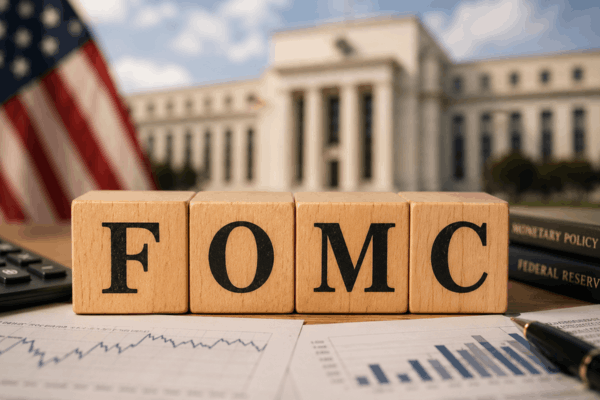
Discover when is the next Fed meeting in 2026. Read about the upcoming FOMC dates, rate decisions, and key factors that could impact financial markets.
The next Fed meeting is scheduled for July 28–29, 2026, when the Federal Open Market Committee (FOMC) will review the latest economic data and decide the future direction of U.S. monetary policy.
The Federal Reserve will announce its interest-rate decision on July 29 at 2:00 p.m. Eastern Time, followed by the Fed Chair’s press conference at 2:30 p.m. ET. With inflation remaining above target and financial markets closely watching future rate expectations, the upcoming meeting could create significant volatility across the U.S. dollar, stocks, bonds, gold and other major assets.
For traders and investors, understanding the next Fed meeting is essential because the Fed’s decision and communication often influence market trends well beyond the announcement day.
Key Details for the Next Fed Meeting
Details
Information
Next Fed meeting date
July 28–29, 2026
Interest-rate decision
July 29, 2026 at 2:00 p.m. ET
Press conference
July 29, 2026 at 2:30 p.m. ET
Current federal funds rate
3.50%–3.75%
Fed Chair
Kevin Warsh
Economic projections
No
Next dot plot meeting
September 15–16, 2026
Unlike projection meetings in March, June, September and December, the July meeting will not include an updated Summary of Economic Projections (SEP) or dot plot. This means markets will pay closer attention to the Fed statement, voting split and Chair’s comments for clues about future policy direction.
What Is the Federal Reserve Meeting (FOMC)?
The Federal Reserve meeting, officially known as the Federal Open Market Committee (FOMC) meeting, is where policymakers decide how to manage U.S. monetary policy.
The FOMC has 2 main responsibilities:
Maintaining price stability by controlling inflation
Supporting maximum employment
During each meeting, policymakers analyse economic conditions, including inflation trends, labour-market data, economic growth and financial stability risks.
The outcome can affect borrowing costs, currency values, investment decisions and market sentiment globally.
Why Is FOMC Important for Markets?
The next Fed meeting is one of the most closely watched economic events because interest-rate expectations influence almost every major financial market.
Interest Rates Influence Market Direction
The federal funds rate affects borrowing costs across the economy, including:
Consumer loans and mortgages
Corporate financing costs
Bond yields
Investment decisions
A more hawkish Fed stance, such as higher-for-longer rates, can support the U.S. dollar and Treasury yields. A more dovish approach may weaken the dollar while supporting risk assets.
The Fed Shapes U.S. Dollar Trends
The U.S. dollar often reacts strongly to changes in Fed expectations.
Higher interest-rate expectations can increase demand for the dollar as investors seek higher returns from U.S. assets. Conversely, expectations of rate cuts may reduce dollar demand.
Currency pairs such as EUR/USD, GBP/USD and USD/JPY often experience increased volatility around the next Fed meeting.
Forward Guidance Can Matter More Than the Rate Decision
Markets do not only focus on whether the Fed changes interest rates.
The language used in the policy statement and press conference can provide important clues about:
Future rate decisions
Inflation concerns
Labour-market risks
Economic outlook
Even when rates remain unchanged, a shift in tone can trigger major market movements.
FOMC Meetings Increase Market Volatility
Fed announcements can create sharp price movements due to changing expectations.
Assets commonly affected include:
U.S. dollar pairs
Gold
U.S. stock indices
Treasury yields
Cryptocurrency markets
Traders often prepare for wider price swings and increased uncertainty around the announcement.
Latest Economic Data Before the Next Fed Meeting
The Fed’s decision will depend heavily on incoming inflation, employment and growth data.
Economic Indicator
Latest Reading
June headline CPI
-0.4% month-on-month
June CPI inflation
3.5% year-on-year
June core CPI
2.6% year-on-year
May headline PCE inflation
4.1% year-on-year
May core PCE inflation
3.4% year-on-year
June nonfarm payrolls
+57,000
June unemployment rate
4.2%
Q1 GDP growth
2.1% annualised
Recent data show a mixed economic picture.
June CPI suggested inflation pressures were easing, with core CPI slowing to 2.6% year-on-year. However, PCE inflation, which is the Fed’s preferred inflation measure, remained significantly above the Fed’s 2% target.
The labour market has also shown signs of moderation, with slower job growth but a relatively stable unemployment rate.
This combination creates uncertainty for policymakers. The Fed must balance the risk of keeping rates restrictive for too long against the possibility that inflation could remain persistent.
Will the Fed Raise Rates at the Next Meeting?
A rate hold remains the market’s base expectation, but the possibility of a rate increase has gained attention.
Market pricing showed increased expectations for a potential 25-basis-point hike before the July meeting, reflecting concerns that inflation remains above target.
However, economists have generally expected the Fed to remain cautious and assess additional economic data before making a major policy adjustment.
The possible outcomes include:
Scenario
Possible Market Reaction
Hold rates with neutral guidance
Limited reaction if already priced in
Hold with hawkish comments
USD and yields may strengthen
Rate increase
Potential USD strength and pressure on risk assets
Hold with dovish guidance
Possible support for stocks and gold
The market reaction will depend not only on the decision but also on whether the Fed’s message is more hawkish or dovish than investors expected.
FOMC Meeting Calendar 2026
Meeting Date
Economic Projections
January 27–28, 2026
No
March 17–18, 2026
Yes
April 28–29, 2026
No
June 16–17, 2026
Yes
July 28–29, 2026
No
September 15–16, 2026
Yes
October 27–28, 2026
No
December 8–9, 2026
Yes
The meetings with economic projections usually attract greater attention because they provide updated forecasts for:
Inflation
GDP growth
Employment
Future interest rates
The September and December meetings may become particularly important as markets assess the Fed’s policy direction heading into 2027.
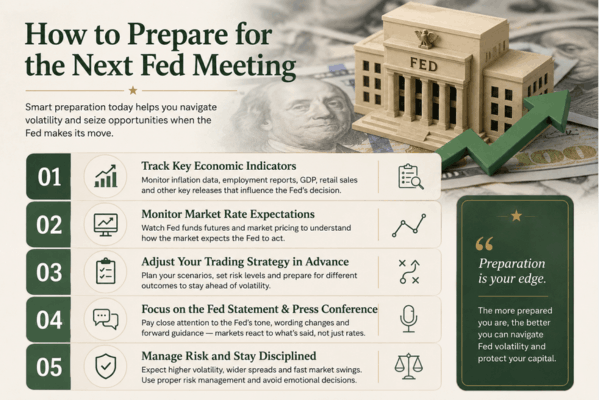
How to Prepare for the Next Fed Meeting
Preparing before a Fed announcement can help traders manage uncertainty and volatility.
Monitor Key Economic Indicators
Important data points include:
CPI and Core PCE inflation
Nonfarm Payrolls
GDP growth
Retail sales
ISM manufacturing data
These indicators shape expectations before the Fed makes its decision.
Track Market Expectations
Interest-rate futures and market pricing can provide insight into how investors expect the Fed to act.
However, expectations can change quickly after major economic releases, so traders should avoid relying on outdated forecasts.
Prepare for Volatility
Fed announcements can lead to:
Rapid price movements
Wider spreads
False breakouts
Increased execution risks
Risk management is especially important during major macroeconomic events.
Watch the Press Conference
The Fed Chair’s comments can be just as important as the rate decision.
Markets often react strongly to changes in wording, especially around inflation risks and future policy expectations.
Conclusion
The next Fed meeting will take place on July 28–29, 2026, with the interest-rate decision scheduled for July 29 at 2:00 p.m. ET.
While markets currently expect the Fed to maintain its current policy stance, inflation trends, labour-market conditions and future rate expectations remain key factors to watch.
For traders, the most important signals will come from the Fed’s policy statement, voting decision and press conference. Understanding how monetary policy affects the U.S. dollar, gold, equities and other markets can help traders better prepare for periods of increased volatility.
Follow Ultima Markets’ economic calendar and market analysis for updates on major central-bank decisions. Trading leveraged products involves significant risk and may not be suitable for all investors.
FAQs
When is the next Fed meeting?
The next Fed meeting is scheduled for July 28–29, 2026.
What time is the next Fed rate decision?
The Fed will announce its decision on July 29 at 2:00 p.m. ET.
What is the current Fed interest rate?
The current federal funds target range is 3.50%–3.75%.
Will the Fed cut rates in 2026?
Future rate decisions will depend on inflation, employment and economic conditions.
Does the Fed meeting affect gold prices?
Yes. Gold can react to changes in interest-rate expectations, real yields and U.S. dollar movements.
Share Now
Disclaimer:This content is provided for informational purposes only and does not constitute, and should not be construed as, financial, investment, or other professional advice. No statement or opinion contained herein should be considered a recommendation by Ultima Markets or the author regarding any specific investment product, strategy, or transaction. Readers are advised not to rely solely on this material when making investment decisions and should seek independent advice where appropriate.
Thank you for visiting the Ultima Markets website. Please note that this website is intended for individuals residing in jurisdictions where access is permitted by law. Ultima and its affiliated entities do not operate in your home jurisdiction.
By clicking ‘Acknowledge’, you confirm that you are entering this website solely on your own initiative and not as a result of any specific marketing outreach. You wish to obtain information from this website based on reverse solicitation principles, in accordance with the applicable laws of your home jurisdiction.