This website is managed by Ultima Markets’ international entities, and it’s important to emphasise that they are not subject to regulation by the FCA in the UK. Therefore, you must understand that you will not have the FCA’s protection when investing through this website – for example:
You will not be guaranteed Negative Balance Protection
You will not be protected by FCA’s leverage restrictions
You will not have the right to settle disputes via the Financial Ombudsman Service (FOS)
You will not be protected by Financial Services Compensation Scheme (FSCS)
Any monies deposited will not be afforded the protection required under the FCA Client Assets Sourcebook. The level of protection for your funds will be determined by the regulations of the relevant local regulator.
Note: UK clients are kindly invited to visit https://www.ultima-markets.co.uk/. Ultima Markets UK expects to begin onboarding UK clients in accordance with FCA regulatory requirements in 2026.
If you would like to proceed and visit this website, you acknowledge and confirm the following:
1.The website is owned by Ultima Markets’ international entities and not by Ultima Markets UK Ltd, which is regulated by the FCA.
2.Ultima Markets Limited, or any of the Ultima Markets international entities, are neither based in the UK nor licensed by the FCA.
3.You are accessing the website at your own initiative and have not been solicited by Ultima Markets Limited in any way.
4.Investing through this website does not grant you the protections provided by the FCA.
5.Should you choose to invest through this website or with any of the international Ultima Markets entities, you will be subject to the rules and regulations of the relevant international regulatory authorities, not the FCA.
Ultima Markets wants to make it clear that we are duly licensed and authorised to offer the services and financial derivative products listed on our website. Individuals accessing this website and registering a trading account do so entirely of their own volition and without prior solicitation.
By confirming your decision to proceed with entering the website, you hereby affirm that this decision was solely initiated by you, and no solicitation has been made by any Ultima Markets entity.
Learn what bearer bonds are. See how they work and understand why they disappeared. Learn about their risks and how to check old certificates for value.
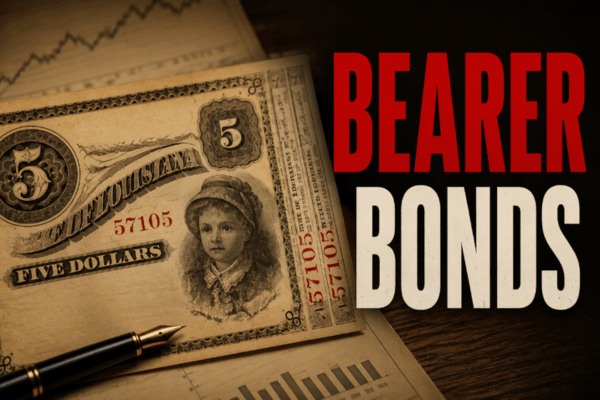
Bearer bonds were once a simple and private way to hold debt. Instead of recording the investor’s name in an ownership register, the issuer generally treated the person holding the certificate as entitled to collect interest and receive the principal at maturity.
That easy transferability was convenient, but it created major risks. A lost or stolen certificate could be extremely difficult to replace, while limited ownership records made tax enforcement and financial crime prevention harder. Today, classic paper instruments are rare, although old certificates still appear in estates, safes and private collections.
What Are Bearer Bonds?
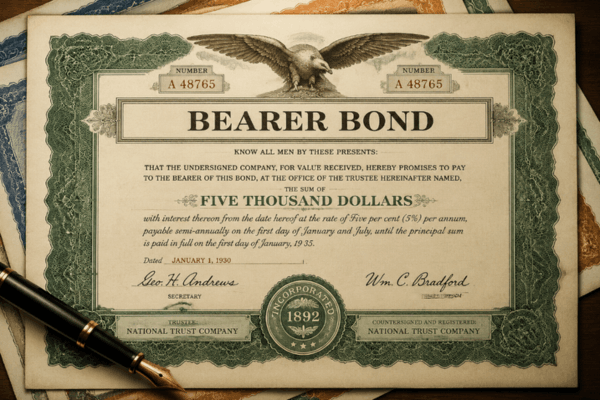
A bearer bond is a debt security that is not registered in the owner’s name. Like other bonds, it represents money lent to a government, company or other issuer. In return, the issuer agrees to pay interest and repay the face value on a stated maturity date.
Traditional certificates often included detachable coupons. The holder presented a coupon whenever interest became due, then surrendered the main certificate to collect the principal at maturity.
Bearer bonds are sometimes confused with coupon bonds, but the terms are not identical. “Bearer” describes how ownership is recorded and transferred. “Coupon” describes how interest is paid. A registered bond can also pay a coupon.
How Do They Work?
Suppose a bond has a face value of £10,000, a 5 per cent annual coupon and a ten-year term. It would pay £500 in interest each year. If payments were made twice yearly, the holder would normally present two coupons worth £250 each.
Ownership could be transferred by delivering the certificate to another person. The issuer did not need to update a conventional register, so secure storage was essential.
Registered bonds work differently. Their owner is identified through the issuer, a transfer agent, a broker or a book-entry system. Transfers are recorded, payments can be automated, and ownership can usually be confirmed even if a document is lost.
Why Did They Disappear?
Their main advantages also became their biggest weaknesses. Physical possession created a serious risk of theft or accidental loss. Limited traceability made it harder to identify who received interest, confirm tax reporting and prevent misuse. Electronic book-entry systems offered a safer, more efficient alternative.
In the United States, the Treasury stopped offering bearer securities on original issue after 31 December 1982. A 1999 Treasury rule showed how quickly demand had declined: reissues fell from about 4,900 certificates in 1989 to only 66 in 1998, issued for three investors.
Are Bearer Bonds Legal in the United States?
It is more accurate to say that classic bearer instruments were effectively phased out than to claim that every one is illegal.
US tax law strongly favours registered debt. Interest deductions are generally denied on registration-required obligations that are not in registered form. Certain non-registered issues can also trigger an excise tax based on the principal and years to maturity, making most new public bearer debt commercially unattractive.
Valid historical certificates can still exist. The US Treasury continues to provide instructions for submitting old bearer bonds and coupons for payment. It also states that every remaining paper Treasury marketable security has matured and is no longer earning interest.
Rules vary between countries and types of security, so professional advice may be necessary where significant value is involved.
What Are the Main Risks?
Loss and theft are the clearest concerns. An old bond may also be counterfeit, cancelled, already redeemed or missing coupons. The issuer may have failed, merged or changed its name, making the instrument difficult to research.
Liquidity can be limited because many modern brokers do not routinely accept physical certificates. Tax obligations also remain. IRS guidance says coupon interest is generally reported on Form 1099-INT, while redemption of certain long-term bearer instruments can involve Form 1099-OID. Backup withholding of 24 per cent may apply in specified circumstances, but it is not a universal tax rate on the income.
What Should You Do If You Find an Old Certificate?
Do not assume the printed face value is the amount you can collect. Photograph both sides and record the issuer, issue date, maturity date, face value, interest rate, serial number, paying agent and any cancellation marks. Do not clean, cut, laminate or remove attached coupons.
Next, identify the security. A Treasury bond is different from a US savings bond, while corporate and municipal certificates require their own research. For a company bond, the transfer agent printed on the certificate is often the best starting point.
If the agent no longer exists, a state incorporation agency or broker may help trace mergers and name changes. A certificate with no investment value may still have collectible value.
For old US Treasury marketable securities, check the latest TreasuryDirect instructions before sending an original. TreasuryDirect currently asks holders to use insured registered mail and include the bonds and coupons, payment instructions and a completed Form W-9.
Watch for Historical Bond Scams
Be cautious when someone demands an advance activation or redemption fee, claims a certificate is secretly backed by gold, or promises access to a private high-yield trading programme.
The US Treasury’s inspector general says no government-sanctioned historical bond trading programmes exist. It has documented fraudsters asking as much as $150,000 for bonds that regularly traded as collectibles for about $25.
In December 2024, the US Securities and Exchange Commission alleged that one scheme had raised more than $3.85 million from at least 85 investors. Promoters allegedly claimed a $250,000 advance payment could produce up to $15 million, although no bonds were redeemed through the supposed process.
Are Digital Versions Making a Comeback?
Digital bond technology is developing, but it should not be confused with anonymous paper certificates.
In March 2026, DZ BANK and KfW completed a legally binding tokenised security pilot under Germany’s electronic securities framework. Five smart contracts connected six market participants, with issuance settlement completed in under 40 minutes.
Modern digital securities use regulated registers, identifiable participants and traceable settlement. They are an evolution in bond administration, not a return to certificates carried like cash.
Conclusion
These bonds show both the convenience and danger of linking financial rights to physical possession. Easy transfer and privacy made them useful, but the same features increased the risks of loss, tax abuse and fraud.
Anyone who finds an old certificate should protect the original, verify the issuer and paying agent, and separate genuine redemption value from collectible appeal. Independent research is far safer than relying on the printed denomination or promises of a secret payout.
FAQs
Can you still buy bearer bonds?
Classic paper issues are extremely rare. Most investors now use registered bonds or bond funds.
Do bearer bonds expire?
They mature on the date stated in their terms, although some can be called earlier and stop earning interest.
Can a lost bearer bond certificate be replaced?
Possibly, but replacement can be difficult and depends on the issuer, evidence and applicable law.
Share Now
Disclaimer:This content is provided for informational purposes only and does not constitute, and should not be construed as, financial, investment, or other professional advice. No statement or opinion contained herein should be considered a recommendation by Ultima Markets or the author regarding any specific investment product, strategy, or transaction. Readers are advised not to rely solely on this material when making investment decisions and should seek independent advice where appropriate.
Thank you for visiting the Ultima Markets website. Please note that this website is intended for individuals residing in jurisdictions where access is permitted by law. Ultima and its affiliated entities do not operate in your home jurisdiction.
By clicking ‘Acknowledge’, you confirm that you are entering this website solely on your own initiative and not as a result of any specific marketing outreach. You wish to obtain information from this website based on reverse solicitation principles, in accordance with the applicable laws of your home jurisdiction.