This website is managed by Ultima Markets’ international entities, and it’s important to emphasise that they are not subject to regulation by the FCA in the UK. Therefore, you must understand that you will not have the FCA’s protection when investing through this website – for example:
You will not be guaranteed Negative Balance Protection
You will not be protected by FCA’s leverage restrictions
You will not have the right to settle disputes via the Financial Ombudsman Service (FOS)
You will not be protected by Financial Services Compensation Scheme (FSCS)
Any monies deposited will not be afforded the protection required under the FCA Client Assets Sourcebook. The level of protection for your funds will be determined by the regulations of the relevant local regulator.
Note: UK clients are kindly invited to visit https://www.ultima-markets.co.uk/. Ultima Markets UK expects to begin onboarding UK clients in accordance with FCA regulatory requirements in 2026.
If you would like to proceed and visit this website, you acknowledge and confirm the following:
1.The website is owned by Ultima Markets’ international entities and not by Ultima Markets UK Ltd, which is regulated by the FCA.
2.Ultima Markets Limited, or any of the Ultima Markets international entities, are neither based in the UK nor licensed by the FCA.
3.You are accessing the website at your own initiative and have not been solicited by Ultima Markets Limited in any way.
4.Investing through this website does not grant you the protections provided by the FCA.
5.Should you choose to invest through this website or with any of the international Ultima Markets entities, you will be subject to the rules and regulations of the relevant international regulatory authorities, not the FCA.
Ultima Markets wants to make it clear that we are duly licensed and authorised to offer the services and financial derivative products listed on our website. Individuals accessing this website and registering a trading account do so entirely of their own volition and without prior solicitation.
By confirming your decision to proceed with entering the website, you hereby affirm that this decision was solely initiated by you, and no solicitation has been made by any Ultima Markets entity.
Learn how the iron butterfly option strategy works, with its payoff pattern, breakevens, maximum profit, maximum loss, Greeks and main risks for traders.
An iron butterfly option is a four-leg spread for traders who expect an underlying asset to finish near a chosen price at expiry. The iron butterfly strategy collects premium while limiting risk, and the iron butterfly pattern shows a narrow profit peak at the centre strike.
This guide covers its construction, calculations, Greeks and practical risks.
What Is an Iron Butterfly Option?
A standard credit iron butterfly combines a short straddle with two protective options. The trader sells a call and a put at the same middle strike, buys a lower-strike put and buys a higher-strike call. All four options have the same expiry date.
The short call and put form the body, while the long options form the wings. In a symmetrical iron butterfly strategy, each wing is the same distance from the middle strike. The position is normally opened for a net credit.
What Does the Iron Butterfly Pattern Look Like?
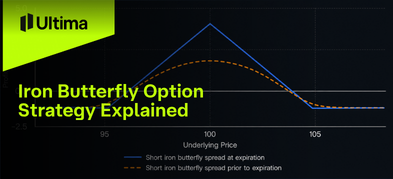
The iron butterfly pattern refers to the position’s profit-and-loss shape at expiry. It is not a candlestick formation or technical chart signal.
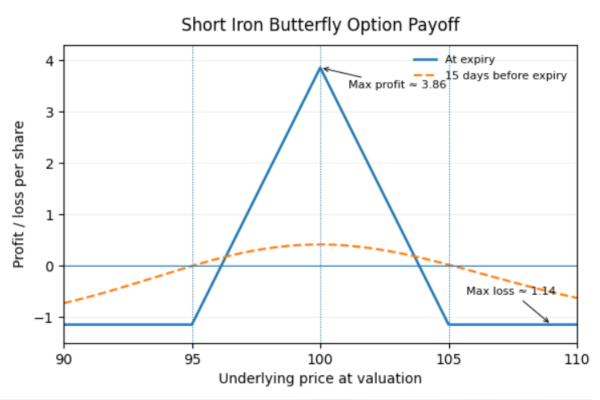
Maximum profit occurs at the middle strike. Profit declines on either side until the underlying reaches a breakeven price. Beyond the protective wings, the loss stops increasing.
This structure is a defined-risk alternative to an uncovered short straddle. The wings cap the theoretical loss, but they also reduce the premium received.
Maximum Profit, Maximum Loss and Breakevens
For a symmetrical credit iron butterfly:
Maximum profit = net credit received
Maximum loss = wing width − net credit received
Lower breakeven = middle strike − net credit
Upper breakeven = middle strike + net credit
The wing width is the distance from the middle strike to either outer strike.
One standard equity options contract usually represents 100 shares, although adjusted contracts can have different deliverables.
Iron Butterfly Option Example
Assume a share is trading near $100:
Trade
Premium
Buy one $95 put
Pay $1.20
Sell one $100 put
Receive $3.20
Sell one $100 call
Receive $3.30
Buy one $105 call
Pay $1.40
The net credit is $3.90 and the wing width is $5.
Maximum profit: $3.90 × 100 = $390
Maximum loss: ($5 − $3.90) × 100 = $110
Lower breakeven: $100 − $3.90 = $96.10
Upper breakeven: $100 + $3.90 = $103.90
The full $390 is earned only if the share finishes exactly at $100 at expiry. The position remains profitable between $96.10 and $103.90 at expiry, but profit falls as the price moves away from the centre.
The large theoretical return relative to the maximum loss is not the expected return. It depends on a precise expiry price, while a move outside either breakeven produces a loss.
Time Decay and Implied Volatility
A credit iron butterfly option generally benefits from time decay while the underlying remains within its intended range. As expiry approaches, the short options may lose time value, allowing the spread to be closed for less than the original credit.
Time decay does not guarantee a profit. A large price move can outweigh it, and theta may become unfavourable after the underlying moves outside the wings.
Implied volatility and actual price movement should also be considered separately. Higher implied volatility at entry may increase the premium collected. A later fall in implied volatility can help the position, provided the underlying remains contained.
However, high implied volatility may signal earnings, economic data or another event capable of pushing the price beyond the breakevens. Short iron butterflies generally have negative vega, meaning an increase in implied volatility tends to work against the position after entry.
Delta and Gamma Risk
A symmetrical iron butterfly strategy opened near the current market price often starts with a net delta close to zero. Its directional exposure can still change quickly.
A credit iron butterfly is generally negative gamma. As expiry approaches, a small move away from the centre strike can rapidly reduce profit or create a loss. This makes the maximum-profit point difficult to capture in practice.
Can You Trade a 0DTE Iron Butterfly?
A 0DTE iron butterfly uses options that expire on the same trading day. Rapid time decay may help the position, but gamma and execution risk are also high.
With little time remaining, small price changes can sharply affect the short options. Bid-ask spreads, order timing and settlement rules therefore become particularly important. Defined loss does not make a 0DTE trade low risk.
Interest in these products is substantial. Cboe reported a record monthly average daily volume of 3.3 million SPX 0DTE contracts in June 2026. This shows how prominent same-day options have become, but high trading volume does not prove that a 0DTE iron butterfly has a reliable profit advantage.
Stock Options Versus Index Options
Settlement and assignment vary by product.
Individual-share and many ETF options are American-style and physically settled. A short option may be assigned before expiry, potentially leaving the trader long or short shares.
Certain index options, including SPX options, are European-style and cash-settled. They cannot be exercised early and do not deliver shares, although their settlement value, expiry time and multiplier still matter.
Always check the specifications of the exact contract rather than assuming that every share, ETF or index option works in the same way.
Iron Butterfly Versus Iron Condor
Both strategies use four options and have limited risk. An iron butterfly sells the call and put at the same strike. An iron condor uses separate short strikes, creating a wider maximum-profit range.
The iron butterfly may collect more premium but requires greater price precision. The iron condor usually offers a broader profit plateau, often for a smaller credit.
Key Risks to Consider
Important risks include a narrow maximum-profit point, large price moves, negative gamma, four-leg trading costs, early assignment and event risk. Expiry can also create uncertainty when the underlying is close to the middle strike, particularly with physically settled options.
Where supported, the position can be entered as one multi-leg order with a specified net credit. Entering each leg separately can temporarily create an uncovered or directional position.
Before trading, decide the desired profit, acceptable loss and point at which the original forecast is no longer valid.
Conclusion
The iron butterfly option offers defined risk and a clear payoff, but it is not a simple income trade. Volatility, gamma, costs and settlement rules can materially affect the result.
A sound iron butterfly strategy starts with realistic breakevens and a clear maximum loss. Understanding the iron butterfly pattern highlights the central trade-off: an attractive potential credit in exchange for a narrow ideal outcome.
FAQs
Is the iron butterfly strategy bullish or bearish?
It is usually neutral, although the middle strike can reflect a modest directional view.
Is the iron butterfly pattern a chart pattern?
No. The iron butterfly pattern describes the expiry payoff shape.
Is an iron butterfly different from an iron condor?
An iron butterfly has one shared short strike. An iron condor has two.
Share Now
Disclaimer:This content is provided for informational purposes only and does not constitute, and should not be construed as, financial, investment, or other professional advice. No statement or opinion contained herein should be considered a recommendation by Ultima Markets or the author regarding any specific investment product, strategy, or transaction. Readers are advised not to rely solely on this material when making investment decisions and should seek independent advice where appropriate.
Thank you for visiting the Ultima Markets website. Please note that this website is intended for individuals residing in jurisdictions where access is permitted by law. Ultima and its affiliated entities do not operate in your home jurisdiction.
By clicking ‘Acknowledge’, you confirm that you are entering this website solely on your own initiative and not as a result of any specific marketing outreach. You wish to obtain information from this website based on reverse solicitation principles, in accordance with the applicable laws of your home jurisdiction.