This website is managed by Ultima Markets’ international entities, and it’s important to emphasise that they are not subject to regulation by the FCA in the UK. Therefore, you must understand that you will not have the FCA’s protection when investing through this website – for example:
You will not be guaranteed Negative Balance Protection
You will not be protected by FCA’s leverage restrictions
You will not have the right to settle disputes via the Financial Ombudsman Service (FOS)
You will not be protected by Financial Services Compensation Scheme (FSCS)
Any monies deposited will not be afforded the protection required under the FCA Client Assets Sourcebook. The level of protection for your funds will be determined by the regulations of the relevant local regulator.
Note: UK clients are kindly invited to visit https://www.ultima-markets.co.uk/. Ultima Markets UK expects to begin onboarding UK clients in accordance with FCA regulatory requirements in 2026.
If you would like to proceed and visit this website, you acknowledge and confirm the following:
1.The website is owned by Ultima Markets’ international entities and not by Ultima Markets UK Ltd, which is regulated by the FCA.
2.Ultima Markets Limited, or any of the Ultima Markets international entities, are neither based in the UK nor licensed by the FCA.
3.You are accessing the website at your own initiative and have not been solicited by Ultima Markets Limited in any way.
4.Investing through this website does not grant you the protections provided by the FCA.
5.Should you choose to invest through this website or with any of the international Ultima Markets entities, you will be subject to the rules and regulations of the relevant international regulatory authorities, not the FCA.
Ultima Markets wants to make it clear that we are duly licensed and authorised to offer the services and financial derivative products listed on our website. Individuals accessing this website and registering a trading account do so entirely of their own volition and without prior solicitation.
By confirming your decision to proceed with entering the website, you hereby affirm that this decision was solely initiated by you, and no solicitation has been made by any Ultima Markets entity.
Discover what a descending channel is. Learn how to identify this bearish chart pattern in trading and see how to use breakouts for technical analysis.
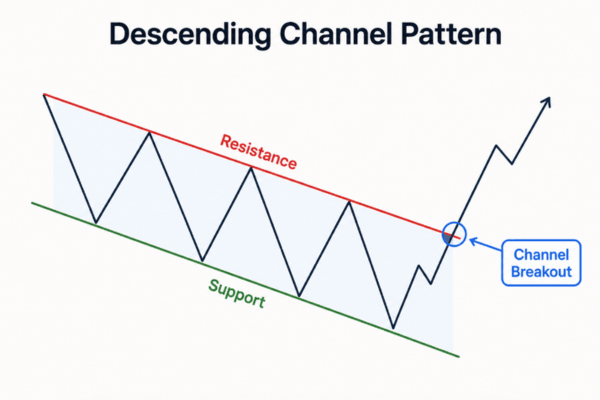
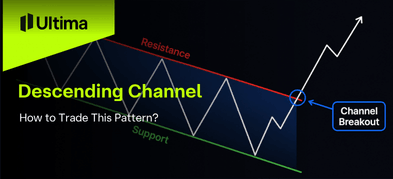
A descending channel is a technical analysis pattern that shows price moving lower between two parallel downward-sloping trendlines. Also known as a falling channel or channel down pattern, it forms when the market creates a series of lower highs and lower lows, indicating that sellers are generally controlling price movement.
While a descending channel is often associated with bearish trends, it does not always mean that prices will continue falling. A breakout above the upper boundary can signal weakening selling pressure and a possible trend reversal, while a breakdown below support may confirm further downside momentum.
Understanding how to identify and trade this pattern can help traders better interpret market structure and potential opportunities.
What Is a Descending Channel?
A descending channel is a chart pattern created by drawing two parallel trendlines around a falling price movement.
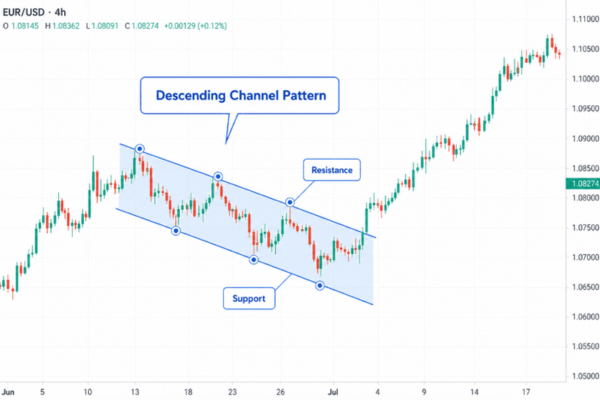
The upper trendline connects a series of lower highs, representing a resistance area where sellers repeatedly enter the market. The lower trendline connects lower lows, forming a support area where buyers attempt to prevent further declines.
When price continues moving between these two boundaries, it creates a downward channel. The pattern shows that although sellers remain dominant, buyers are still providing temporary support at certain levels.
A valid descending channel usually has multiple price reactions at both trendlines. The more times price respects these levels, the more significant the channel may become.
How to Identify a Descending Channel Pattern
Identifying a descending channel requires traders to look for clear price structure and repeated reactions around support and resistance levels.
1. Look for lower highs and lower lows
The first sign of a descending channel is a consistent downward trend. Each price peak should be lower than the previous peak, while each new low should fall below the previous low.
This structure shows that sellers are gradually pushing the market lower.
2. Draw two parallel trendlines
The upper trendline should connect the lower highs, while the lower trendline should connect the lower lows. These two lines should move in a similar direction and contain most of the price movement.
A channel with only a few price touches may not be reliable, while a pattern with repeated reactions provides stronger confirmation.
3. Observe trading momentum
A descending channel often appears when market sentiment becomes increasingly negative. However, traders should also monitor whether selling pressure is weakening, as this may provide early signs of a potential breakout.
How to Trade a Descending Channel
There are several ways traders approach a descending channel depending on their strategy and market conditions.
Trading price movements within the channel
Some traders attempt to trade the range by watching how price reacts near the channel boundaries.
When price approaches the lower support trendline, traders may look for signs that buyers are returning, such as bullish candlestick patterns or improving momentum.
When price reaches the upper resistance trendline, traders may watch for signs of renewed selling pressure.
However, trendlines should not be treated as guaranteed support or resistance levels. Market conditions can change quickly, causing price to break through these areas unexpectedly.
Trading a descending channel breakout
A descending channel breakout occurs when price moves outside the established trendlines.
A bullish breakout happens when price rises above the upper resistance line. This may indicate that sellers are losing control and buyers are gaining strength. Some traders consider this a possible early signal of a trend reversal, especially when supported by stronger volume or positive market momentum.
A bearish breakdown occurs when price falls below the lower support line. This suggests that selling pressure has increased and the existing downtrend may continue.
Because false breakouts are common, many traders wait for confirmation before entering a position.
Is a Descending Channel a Continuation or Reversal Pattern?
A descending channel can act as both a continuation and reversal pattern depending on the direction of the breakout.
In many cases, a descending channel is a continuation pattern because it develops during an existing downtrend. Price moves lower while remaining within the channel before eventually continuing in the same direction.
However, if price breaks above the upper boundary, the pattern may signal that bearish momentum is weakening. A strong breakout may indicate a potential shift in market sentiment from sellers to buyers.
The breakout direction is therefore more important than the pattern itself. Traders usually combine the descending channel with other technical indicators to confirm the strength of a possible move.
Descending Channel vs Falling Wedge
A descending channel and falling wedge can appear similar because both involve downward price movement. However, their structures and signals are different.
Feature
Descending Channel
Falling Wedge
Structure
Two parallel downward trendlines
Two converging trendlines
Price movement
Moves within a consistent range
Trading range gradually narrows
Typical signal
Continuation or breakout
Often viewed as a potential bullish reversal
Market behaviour
Shows controlled selling pressure
Suggests bearish momentum may be weakening
The key difference is that a descending channel maintains a relatively stable distance between support and resistance, while a falling wedge becomes narrower as price moves lower.
Common Mistakes
Although the descending channel is a useful technical tool, traders should avoid relying on it alone.
One common mistake is entering a trade immediately after price touches a trendline. A support or resistance level can fail, particularly during periods of high volatility or when major economic events affect market sentiment.
Another mistake is assuming every breakout will lead to a major trend reversal. Some breakouts are temporary moves that quickly return inside the channel.
To improve decision-making, traders often combine the pattern with other forms of technical analysis, such as volume analysis, moving averages, or momentum indicators. Proper risk management is also important because no chart pattern can predict future price movements with certainty.
Why Is the Descending Channel Important?
The descending channel helps traders understand market direction and identify important price levels.
Instead of viewing a downtrend as a straight decline, the pattern shows how price moves between areas of buying and selling pressure. This allows traders to monitor possible entry points, breakout opportunities, and changes in market momentum.
For example, a stock, currency pair, or cryptocurrency may remain inside a descending channel during a period of uncertainty before a major catalyst changes market sentiment. Events such as economic data releases, company earnings, or changes in investor confidence can influence whether price breaks higher or continues lower.
Conclusion
A descending channel is a valuable chart pattern for understanding how price behaves during a downtrend. By identifying lower highs, lower lows, and key support and resistance areas, traders can better analyse market structure and potential trading opportunities.
However, the pattern should not be used as a standalone signal. Combining a descending channel with confirmation tools and effective risk management can help traders make more informed decisions in different market conditions.
FAQs
Is a descending channel bullish or bearish?
A descending channel is usually considered bearish, but a breakout above resistance can signal a possible bullish reversal.
How many touches confirm a descending channel?
There is no fixed number, but traders usually look for multiple reactions from both trendlines before considering the pattern reliable.
What is the difference between a descending channel and a falling wedge?
A descending channel has parallel trendlines, while a falling wedge has converging trendlines and often signals weakening bearish momentum.
Share Now
Disclaimer:This content is provided for informational purposes only and does not constitute, and should not be construed as, financial, investment, or other professional advice. No statement or opinion contained herein should be considered a recommendation by Ultima Markets or the author regarding any specific investment product, strategy, or transaction. Readers are advised not to rely solely on this material when making investment decisions and should seek independent advice where appropriate.
Thank you for visiting the Ultima Markets website. Please note that this website is intended for individuals residing in jurisdictions where access is permitted by law. Ultima and its affiliated entities do not operate in your home jurisdiction.
By clicking ‘Acknowledge’, you confirm that you are entering this website solely on your own initiative and not as a result of any specific marketing outreach. You wish to obtain information from this website based on reverse solicitation principles, in accordance with the applicable laws of your home jurisdiction.