This website is managed by Ultima Markets’ international entities, and it’s important to emphasise that they are not subject to regulation by the FCA in the UK. Therefore, you must understand that you will not have the FCA’s protection when investing through this website – for example:
You will not be guaranteed Negative Balance Protection
You will not be protected by FCA’s leverage restrictions
You will not have the right to settle disputes via the Financial Ombudsman Service (FOS)
You will not be protected by Financial Services Compensation Scheme (FSCS)
Any monies deposited will not be afforded the protection required under the FCA Client Assets Sourcebook. The level of protection for your funds will be determined by the regulations of the relevant local regulator.
Note: UK clients are kindly invited to visit https://www.ultima-markets.co.uk/. Ultima Markets UK expects to begin onboarding UK clients in accordance with FCA regulatory requirements in 2026.
If you would like to proceed and visit this website, you acknowledge and confirm the following:
1.The website is owned by Ultima Markets’ international entities and not by Ultima Markets UK Ltd, which is regulated by the FCA.
2.Ultima Markets Limited, or any of the Ultima Markets international entities, are neither based in the UK nor licensed by the FCA.
3.You are accessing the website at your own initiative and have not been solicited by Ultima Markets Limited in any way.
4.Investing through this website does not grant you the protections provided by the FCA.
5.Should you choose to invest through this website or with any of the international Ultima Markets entities, you will be subject to the rules and regulations of the relevant international regulatory authorities, not the FCA.
Ultima Markets wants to make it clear that we are duly licensed and authorised to offer the services and financial derivative products listed on our website. Individuals accessing this website and registering a trading account do so entirely of their own volition and without prior solicitation.
By confirming your decision to proceed with entering the website, you hereby affirm that this decision was solely initiated by you, and no solicitation has been made by any Ultima Markets entity.
Explore the Schwab ETF list to see how SCHB, SCHD and SCHA can enhance your portfolio with broad exposure, income and growth. Expand your opportunities.
When structuring a long‑term investment portfolio, reviewing a schwab etf list is a practical first step. Schwab’s suite of exchange‑traded funds offers low‑cost access to broad market exposure, dividend income and small‑cap growth.
Among these, the Schwab U.S. Broad Market ETF (SCHB) often prompts the question “is SCHB a good investment?” alongside complementary funds like the schwab dividend etf (SCHD) and the small cap etf (SCHA), which serve income and growth roles respectively.
In this article we break down the characteristics, recent performance and suitable use cases for these funds, helping you decide how they might fit into your own investing strategy.
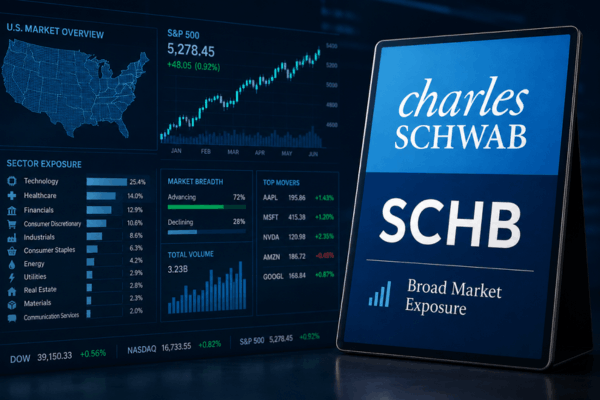
SCHB: Broad Market Exposure
The Schwab U.S. Broad Market ETF (SCHB) tracks the Dow Jones U.S. Broad Stock Market Index, offering exposure to roughly 2,400 U.S. companies across large, mid and small capitalisations.
Its broad coverage makes it a typical choice as a core holding for diversified stock market exposure.
Key Features
Expense Ratio: 0.03%, among the lowest available for broad market funds.
Dividend Yield: Approximately 1.05%, paid quarterly.
Holdings: Over 2,400 U.S. stocks spanning all major sectors.
Assets Under Management: Around $42 billion, with high daily trading volume.
Top Sector Weightings: Technology (~34%), Financials (~12%), Communication Services (~10%).
Recent Performance
SCHB has delivered strong recent returns, with around +31 per cent over the trailing 12 months (as of April 2026). Its historical annualised return over 10 years sits above 14 per cent, reflecting broad market growth over time.
Why Investors Use SCHB
Core Market Exposure: It captures performance across most publicly traded U.S. stocks.
Low Cost: Its ultra‑low fees mean more of your capital remains invested over long periods.
Comparable to Vanguard and iShares: SCHB performs nearly identically to Vanguard’s broad market ETFs at similar cost, making it a competitive alternative.
Because it mirrors the overall U.S. market, SCHB tends to rise and fall with market trends, making it suitable for long‑term, buy‑and‑hold investors rather than those seeking short‑term gains.
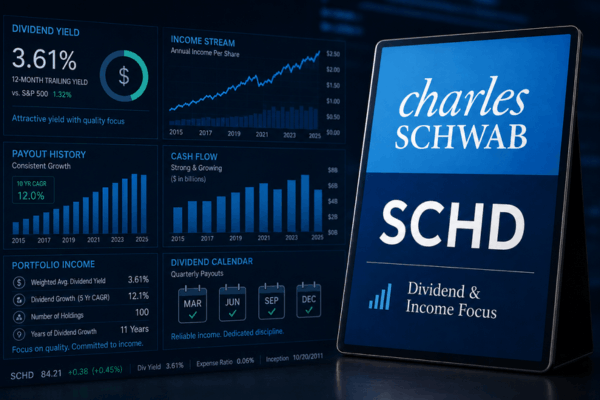
SCHD: Dividend and Income Focus
The schwab dividend etf (SCHD) tracks the Dow Jones U.S. Dividend 100 Index, focusing on high‑quality companies with strong dividend histories and financial fundamentals.
Key Features
Expense Ratio: 0.06%, remaining competitive among dividend ETFs.
Dividend Yield: Around 3.35 per cent, paid quarterly.
Holdings: Roughly 100 dividend‑paying companies selected for financial quality.
Sector Balance: Exposure across consumer staples, healthcare, energy and other sectors.
SCHD tends to hold companies with established dividend histories and resilient balance sheets, making it appealing for income‑oriented investors while still offering potential for capital growth.
Recent Context
Recent commentary highlights that SCHD has outperformed many peers in 2026, and its strong performance has been supported by sectors such as defence, energy and resilient dividend names that have attracted investor interest.
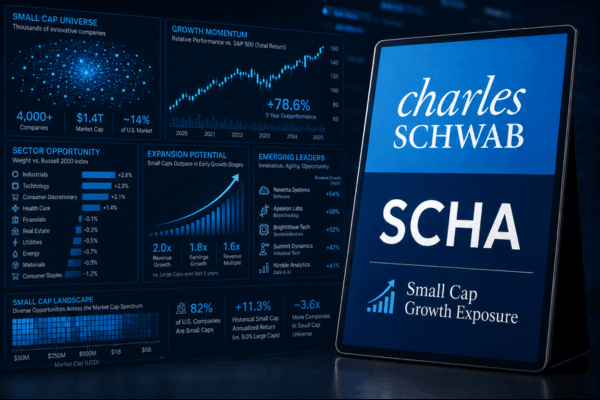
SCHA: Small Cap Growth Exposure
The small cap etf (SCHA) invests in U.S. companies with smaller market capitalisation, ideally positioned to offer growth potential over the medium to long term. It tracks the Dow Jones U.S. Small‑Cap Total Stock Market Index.
Key Features
Expense Ratio: 0.04%, which is attractive for a small‑cap strategy.
Dividend Yield: Around 1.02%, paid quarterly.
Holdings: About 1,720 small‑cap stocks.
Risk and Growth Tilt: Small‑cap stocks tend to be more volatile but offer the potential for faster growth than larger companies.
SCHA can support a portfolio by providing additional growth exposure that may outperform in certain market cycles, especially when smaller companies benefit from tight spreads and innovation‑driven expansion.
A Comparison of Key Schwab ETFs
To help visualise how these funds differ and complement each other, below is a summary comparison of SCHB, SCHD and SCHA:
ETF
Primary Focus
Expense Ratio
Dividend Yield
Ideal Use Case
SCHB
Broad U.S. market
0.03%
~1.05 %
Core diversified equity exposure
SCHD
Dividend income
0.06%
~3.35 %
Income and defensive quality
SCHA
Small‑cap growth
0.04%
~1.02 %
Growth pivot within equities
This structure shows how combining broad market exposure, income and growth strategies from the schwab etf list can help investors balance risk and reward.
Risks to Consider
Even well‑structured ETFs come with risks. It is important to understand:
Market Cycles: SCHB and SCHA track overall market performance, so downturns affect both.
Sector Concentrations: SCHD’s dividend approach can tilt exposure into particular sectors, impacting performance depending on economic conditions.
Volatility: Small‑cap stocks in SCHA can be more volatile compared with larger, established companies.
Diversification across these ETFs can help spread risk, but no investment is immune to market fluctuations.
Conclusion
A well‑constructed schwab etf list shows that SCHB, SCHD and SCHA each serve different but complementary roles in a portfolio. SCHB provides broad market coverage at low cost, SCHD offers attractive dividend income, and SCHA adds a growth tilt through small‑cap exposure.
Used together, these ETFs can form a foundation for long‑term investing that balances diversification, income and potential growth.
If you are asking “is SCHB a good investment?” in the context of building a balanced portfolio, the evidence suggests it can be a strong core holding, particularly when paired with dividend and small‑cap strategies.
FAQs
What is included in the Schwab ETF list?
It includes several ETFs across broad market, dividend, small‑cap and other equity strategies, such as SCHB, SCHD and SCHA.
Is SCHB a good investment?
For long‑term investors seeking diversified U.S. equity exposure with low fees, SCHB is widely regarded as a solid choice.
What is SCHD and who is it for?
SCHD is a dividend‑focused ETF with quality companies that pay steady income, suitable for investors prioritising yield and stability.
Share Now
Disclaimer:This content is provided for informational purposes only and does not constitute, and should not be construed as, financial, investment, or other professional advice. No statement or opinion contained herein should be considered a recommendation by Ultima Markets or the author regarding any specific investment product, strategy, or transaction. Readers are advised not to rely solely on this material when making investment decisions and should seek independent advice where appropriate.
Thank you for visiting the Ultima Markets website. Please note that this website is intended for individuals residing in jurisdictions where access is permitted by law. Ultima and its affiliated entities do not operate in your home jurisdiction.
By clicking ‘Acknowledge’, you confirm that you are entering this website solely on your own initiative and not as a result of any specific marketing outreach. You wish to obtain information from this website based on reverse solicitation principles, in accordance with the applicable laws of your home jurisdiction.