This website is managed by Ultima Markets’ international entities, and it’s important to emphasise that they are not subject to regulation by the FCA in the UK. Therefore, you must understand that you will not have the FCA’s protection when investing through this website – for example:
You will not be guaranteed Negative Balance Protection
You will not be protected by FCA’s leverage restrictions
You will not have the right to settle disputes via the Financial Ombudsman Service (FOS)
You will not be protected by Financial Services Compensation Scheme (FSCS)
Any monies deposited will not be afforded the protection required under the FCA Client Assets Sourcebook. The level of protection for your funds will be determined by the regulations of the relevant local regulator.
Note: UK clients are kindly invited to visit https://www.ultima-markets.co.uk/. Ultima Markets UK expects to begin onboarding UK clients in accordance with FCA regulatory requirements in 2026.
If you would like to proceed and visit this website, you acknowledge and confirm the following:
1.The website is owned by Ultima Markets’ international entities and not by Ultima Markets UK Ltd, which is regulated by the FCA.
2.Ultima Markets Limited, or any of the Ultima Markets international entities, are neither based in the UK nor licensed by the FCA.
3.You are accessing the website at your own initiative and have not been solicited by Ultima Markets Limited in any way.
4.Investing through this website does not grant you the protections provided by the FCA.
5.Should you choose to invest through this website or with any of the international Ultima Markets entities, you will be subject to the rules and regulations of the relevant international regulatory authorities, not the FCA.
Ultima Markets wants to make it clear that we are duly licensed and authorised to offer the services and financial derivative products listed on our website. Individuals accessing this website and registering a trading account do so entirely of their own volition and without prior solicitation.
By confirming your decision to proceed with entering the website, you hereby affirm that this decision was solely initiated by you, and no solicitation has been made by any Ultima Markets entity.
With Year-End Approaching, Has Gold Reached Its Limit?
With Year-End Approaching, Has Gold Reached Its Limit?
Gold is having a moment—and then some. As of November 2025, the precious metal is trading at approximately $4,000 per troy ounce, marking a staggering 46% gain year-to-date and cementing its status as one of the year’s most remarkable investment stories. This surge follows an extraordinary rally that saw gold shatter records throughout 2025, briefly touching heights above $4,300 per ounce in October as investors grappled with a complex web of macroeconomic pressures and geopolitical uncertainty.
For those keeping score, gold’s recent performance isn’t just impressive—it’s exceptional even by historical standards. Over the past quarter-century, the yellow metal has delivered average annual returns of approximately 10.9%, a track record that has long justified its reputation as a reliable hedge against inflation and market turbulence. But 2025’s gains have eclipsed even these lofty expectations, raising critical questions about what’s driving this unprecedented demand and whether gold’s safe-haven appeal has entered a new era.
As traditional markets navigate an increasingly uncertain landscape, gold’s resurgence serves as both a barometer of investor anxiety and a reminder of why this ancient store of value continues to command attention in modern portfolios. Understanding what’s behind this rally—and what it signals about the broader economic environment—has never been more crucial for investors seeking to navigate today’s volatile markets.
Key Factors Influencing Gold Prices in the Next 3 Months
Gold’s performance in the coming quarter (November 2025 to February 2026) will likely be shaped by several interconnected drivers:
Central Bank Demand:
Central banks around the globe continue to demonstrate robust appetite for gold, establishing what many analysts view as a fundamental price support mechanism. Industry projections suggest central bank net purchases will reach approximately 900 tonnes in 2025, fueled by an accelerating shift toward diversification away from U.S. dollar-denominated reserves. The structural buying pattern is anticipated to extend well into 2026, providing critical price underpinning during periods of economic volatility.
The strength of institutional demand became particularly evident in September, when central banks recorded 39 tonnes of net gold purchases according to IMF and other official data sources—a striking 79% month-over-month increase and the highest single month of reported net buying activity in 2025. Through the first nine months of the year, central banks have accumulated 200 tonnes of net gold reserves, underscoring the sustained nature of institutional appetite.
Central bank gold statistics, September 2025,World Gold Council
Geopolitical and Economic Risks: Persistent tensions, including U.S.-China trade negotiations and global policy uncertainties, enhance gold’s appeal as a safe-haven asset. Factors like stagflation risks, potential recessions, and U.S. policy shifts (e.g., tariffs) are seen as bullish catalysts. Additionally, inflation dynamics and a weaker U.S. dollar could further bolster demand.
Monetary Policy: Anticipated Federal Reserve rate cuts (potentially one more in 2025) are expected to weaken interest rates, making non-yielding assets like gold more attractive. However, if optimism around U.S.-China trade deals strengthens, it could temporarily reduce safe-haven buying.
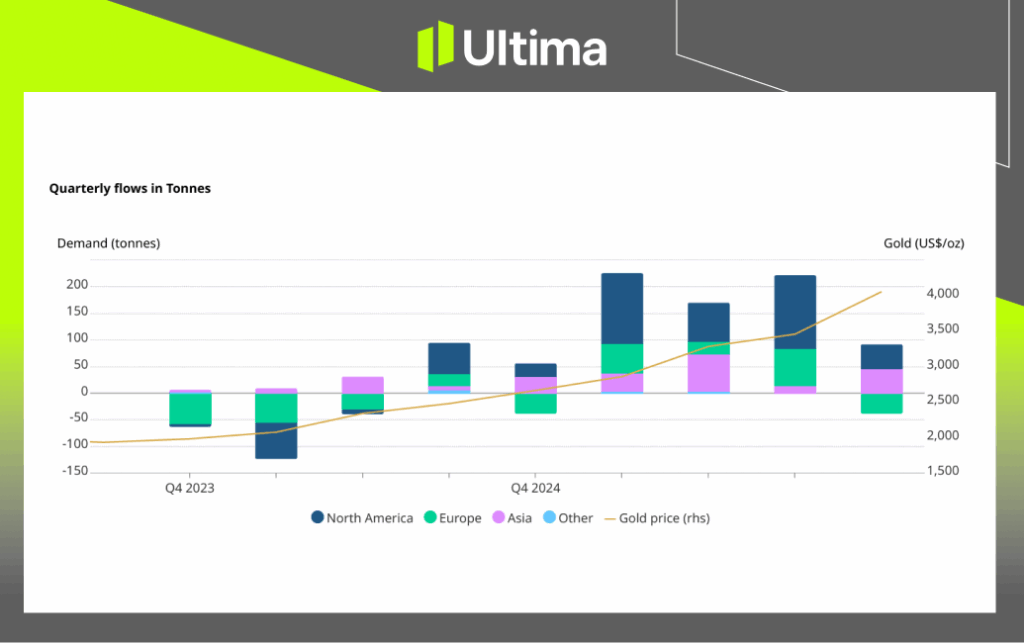
Investor and ETF Flows: For the fifth consecutive month, global physically backed gold ETFs experienced positive inflows, attracting US$8.2 billion in October. Though this represented a deceleration from September’s pace, the monthly figure still exceeded the year-to-date average of US$7.1 billion. With just two months remaining in the year, global ETFs appear poised to achieve record-breaking annual performance.
Regionally, North America and Asia drove the month’s global inflows, while Europe stood alone in registering outflows. By October’s end, total assets under management for global gold ETFs had climbed 6% month-over-month to reach US$503 billion, with holdings expanding 1% month-over-month to 3,893 tonnes.
Gold ETF flows by region,World Gold Council
Supply Constraints: Limited new mining projects and steady recycling (around 344 tonnes in Q3 2025) are tightening supply, potentially pushing prices higher amid growing demand.
Investment Potential Conclusion
The asset’s role as a hedge against inflation, debasement, and uncertainty underpins a bullish outlook, especially for diversified portfolios. However, near-term corrections are possible due to technical over-extension, suggesting opportunities for buying dips around $3,500–$3,800. Overall, the balance tilts positive, with structural demand outweighing short-term risks—position for gains while using stops to manage volatility. For safety, investors should prefer GLD or physical gold as their investment vehicles. It’s advisable to keep position sizes moderate rather than over-concentrated. To manage downside risk, consider setting a stop-loss order near the 50-day moving average, which for GLD is approximately $354 to $355 USD.
Comments, news, research, analysis, price, and all information contained in the article only serve as general information for readers and do not suggest any advice. Ultima Markets has taken reasonable measures to provide up-to-date information, but cannot guarantee accuracy, and may modify without notice. Ultima Markets will not be responsible for any loss incurred due to the application of the information provided.
Thank you for visiting the Ultima Markets website. Please note that this website is intended for individuals residing in jurisdictions where access is permitted by law. Ultima and its affiliated entities do not operate in your home jurisdiction.
By clicking ‘Acknowledge’, you confirm that you are entering this website solely on your own initiative and not as a result of any specific marketing outreach. You wish to obtain information from this website based on reverse solicitation principles, in accordance with the applicable laws of your home jurisdiction.