This website is managed by Ultima Markets’ international entities, and it’s important to emphasise that they are not subject to regulation by the FCA in the UK. Therefore, you must understand that you will not have the FCA’s protection when investing through this website – for example:
You will not be guaranteed Negative Balance Protection
You will not be protected by FCA’s leverage restrictions
You will not have the right to settle disputes via the Financial Ombudsman Service (FOS)
You will not be protected by Financial Services Compensation Scheme (FSCS)
Any monies deposited will not be afforded the protection required under the FCA Client Assets Sourcebook. The level of protection for your funds will be determined by the regulations of the relevant local regulator.
Note: UK clients are kindly invited to visit https://www.ultima-markets.co.uk/. Ultima Markets UK expects to begin onboarding UK clients in accordance with FCA regulatory requirements in 2026.
If you would like to proceed and visit this website, you acknowledge and confirm the following:
1.The website is owned by Ultima Markets’ international entities and not by Ultima Markets UK Ltd, which is regulated by the FCA.
2.Ultima Markets Limited, or any of the Ultima Markets international entities, are neither based in the UK nor licensed by the FCA.
3.You are accessing the website at your own initiative and have not been solicited by Ultima Markets Limited in any way.
4.Investing through this website does not grant you the protections provided by the FCA.
5.Should you choose to invest through this website or with any of the international Ultima Markets entities, you will be subject to the rules and regulations of the relevant international regulatory authorities, not the FCA.
Ultima Markets wants to make it clear that we are duly licensed and authorised to offer the services and financial derivative products listed on our website. Individuals accessing this website and registering a trading account do so entirely of their own volition and without prior solicitation.
By confirming your decision to proceed with entering the website, you hereby affirm that this decision was solely initiated by you, and no solicitation has been made by any Ultima Markets entity.
SpaceX has continued declining after its IPO rally. Find out why the SpaceX crash happened and see the key upcoming events investors should watch next.
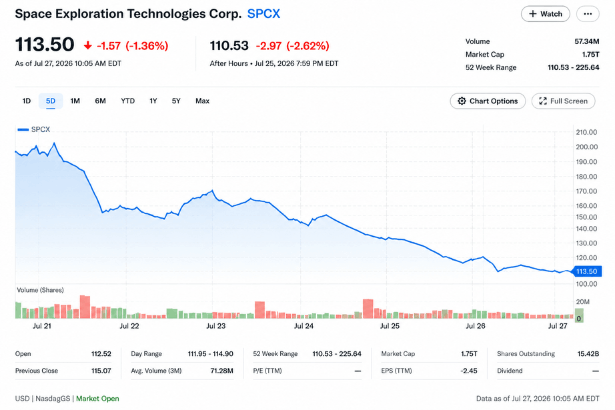
The SpaceX crash has become one of the biggest stories in the technology and space sectors after shares fell sharply from their post-IPO peak and reached a new low. After generating huge investor excitement during its market debut, SpaceX shares faced growing pressure as investors reassessed the company’s valuation, profitability outlook and future growth expectations.
The decline was not caused by one single event. While Starship launch challenges contributed to investor concerns, the bigger issue was a shift from IPO optimism to a more critical evaluation of SpaceX’s financial performance, capital requirements and long-term ability to justify its valuation.
SpaceX Stock Crash Timeline
SpaceX experienced one of the most dramatic post-IPO moves in recent market history. The company initially benefited from strong demand, limited share availability and investor enthusiasm around commercial space, Starlink and artificial intelligence.
From IPO Surge to New Low
Date
Event
12 June 2026
SpaceX completed its IPO at $135 per share
Mid-June 2026
Shares surged to an all-time high of $225.64
22 June 2026
Shares dropped sharply as investors began taking profits
7 July 2026
Shares closed at $149.47, reaching a new post-IPO low
15 July 2026
Shares briefly fell below the $135 IPO price
From its peak of around $225.64, SpaceX shares experienced a significant correction as the market began questioning whether the company’s valuation had moved too far ahead of its current financial results.
The decline highlights a common pattern among high-growth companies: strong future expectations can drive valuations higher, but investors eventually demand evidence that those expectations can translate into sustainable earnings.
Why Did SpaceX Shares Drop?
IPO Excitement Faded as Investors Reassessed Valuation
The initial SpaceX IPO attracted significant attention because it offered investors exposure to some of the biggest growth themes in the market, including commercial space, satellite internet and AI infrastructure.
Strong demand pushed shares significantly higher shortly after listing, with investors pricing in expectations for future growth from businesses such as Starlink and next-generation space technology.
However, after the initial excitement faded, investors began asking whether SpaceX’s valuation had moved too far ahead of its current financial performance.
At its peak, SpaceX reached a valuation above $2.6 trillion, placing it among the world’s most valuable companies. The challenge for investors was determining whether future growth opportunities were already fully reflected in the share price.
The decline therefore represents more of a valuation reset rather than a rejection of SpaceX’s long-term business potential.
Limited Public Shares Amplified Price Movements
One of the key factors behind SpaceX’s sharp price swings was its limited public float.
At the time of its IPO, only around 4% of SpaceX shares were available for public trading. This created a supply shortage, allowing strong investor demand to push prices higher quickly.
However, the same structure also increased downside volatility.
When sentiment turned more cautious, the limited number of publicly traded shares made the stock more sensitive to changes in buying and selling activity.
In simple terms, the limited float helped fuel the early rally, but it also amplified the decline when investors started reducing exposure.
Upcoming Share Unlocks Could Increase Selling Pressure
Another major concern behind the SpaceX crash is the potential increase in available shares after the IPO lock-up period expires.
During the early stages of trading, limited share availability supported SpaceX’s valuation by creating scarcity. However, as insider shares become eligible for sale, investors are watching whether additional supply could place pressure on the stock.
According to reported lock-up arrangements, several major unlocking events are expected:
Timeline
Potential Impact
6 August 2026 (two days after Q2 earnings report)
Internal shareholders may become eligible to sell around 20% of unlockable shares
End of August 2026
Tradable shares could increase significantly
End of October 2026
Unlocking could reach around one-third of total shares
June 2027
Elon Musk’s remaining shares may become eligible after the 366-day lock-up period
The key concern is not that all unlocked shares will immediately enter the market. Instead, investors are considering whether a larger supply of shares could remove the scarcity premium that supported SpaceX’s early valuation.
For early investors and employees holding shares purchased at lower valuations, lock-up expiry could create an opportunity to take profits, adding another layer of uncertainty for public investors.
Profitability Concerns Put Pressure on SpaceX Valuation
While SpaceX remains one of the most influential companies in the space industry, investors have become increasingly focused on whether its current financial performance supports its valuation.
Reported figures show that the company continues to invest heavily into future growth areas.
Period
Financial Performance
2025
Revenue of around $18.67 billion and reported net loss of approximately $4.9 billion
Q1 2026
Revenue of around $4.69 billion and reported net loss of approximately $4.28 billion
Starlink has become one of SpaceX’s strongest commercial businesses, providing recurring revenue through satellite internet services.
However, other areas such as advanced spacecraft development, AI infrastructure and future space technologies require significant capital investment.
This has created a key debate among investors:
Can SpaceX turn its ambitious projects into sustainable profits quickly enough to justify its valuation?
The market is increasingly looking beyond revenue growth and focusing on margins, cash flow and the company’s ability to generate long-term earnings.
AI Growth Expectations Became a Market Concern
SpaceX’s investment story has expanded beyond rockets and satellites. The company has increasingly been associated with the broader AI infrastructure trend, with investors watching potential opportunities in areas such as satellite connectivity, computing infrastructure and future space-based technology.
However, the wider AI market has become more selective as investors question whether large capital investments can generate sufficient returns.
For SpaceX, the challenge is balancing ambitious expansion plans with financial discipline.
The company’s future valuation depends not only on technological breakthroughs but also on whether these investments can become profitable businesses.
SpaceX Stock Outlook: Can Shares Recover?
The future direction of SpaceX shares will likely depend on several key factors.
Bull Case
Bear Case
Strong Starlink subscriber growth
High valuation compared with current earnings
Successful Starship commercial deployment
Development delays and high costs
AI infrastructure becomes profitable
Uncertainty around AI returns
Expansion of the global space economy
Increased share supply after unlock periods
Bullish investors believe SpaceX’s technology advantage, Starlink expansion and long-term AI opportunities could create significant future growth.
More cautious investors argue that the company must prove it can turn ambitious projects into consistent profitability.
Is SpaceX Still a Strong Company?
The SpaceX crash does not necessarily mean the company’s business model has failed.
SpaceX remains a leader in commercial space, with major advantages in reusable rockets, satellite internet and launch infrastructure.
However, public markets often separate company quality from stock valuation. A great company can still experience a sharp share price decline if investor expectations become too optimistic.
The current debate around SpaceX is therefore not about whether the company has impressive technology. It is about whether its future growth can justify the extremely high expectations built into its valuation.
What Does the SpaceX Crash Mean for Investors?
The SpaceX crash reflects a broader market shift from excitement to evaluation. After its record-breaking IPO and rapid rise, investors began looking more closely at valuation, profitability, share supply and execution risks.
Rocket launch challenges added pressure, but the main drivers were concerns over whether SpaceX’s ambitious plans could generate returns fast enough to support its valuation.
As SpaceX enters its next stage as a public company, investors will be watching Starlink growth, Starship progress, AI investments and upcoming share unlock events closely.
The future of SpaceX may still be ambitious, but the market is now demanding one thing: proof that innovation can translate into sustainable financial growth.
FAQs
Why did SpaceX shares crash?
SpaceX shares declined due to valuation concerns, limited profitability visibility, upcoming share unlock risks and changing investor sentiment toward high-growth technology companies.
Did Starship failures cause the SpaceX crash?
Starship development challenges contributed to uncertainty, but the larger factors were valuation concerns and questions about future profitability.
Is SpaceX still worth investing in?
SpaceX remains a leading space company, but investors must consider both its long-term growth potential and the risks associated with high valuation and large capital requirements.
Share Now
Disclaimer:This content is provided for informational purposes only and does not constitute, and should not be construed as, financial, investment, or other professional advice. No statement or opinion contained herein should be considered a recommendation by Ultima Markets or the author regarding any specific investment product, strategy, or transaction. Readers are advised not to rely solely on this material when making investment decisions and should seek independent advice where appropriate.
Thank you for visiting the Ultima Markets website. Please note that this website is intended for individuals residing in jurisdictions where access is permitted by law. Ultima and its affiliated entities do not operate in your home jurisdiction.
By clicking ‘Acknowledge’, you confirm that you are entering this website solely on your own initiative and not as a result of any specific marketing outreach. You wish to obtain information from this website based on reverse solicitation principles, in accordance with the applicable laws of your home jurisdiction.