This website is managed by Ultima Markets’ international entities, and it’s important to emphasise that they are not subject to regulation by the FCA in the UK. Therefore, you must understand that you will not have the FCA’s protection when investing through this website – for example:
You will not be guaranteed Negative Balance Protection
You will not be protected by FCA’s leverage restrictions
You will not have the right to settle disputes via the Financial Ombudsman Service (FOS)
You will not be protected by Financial Services Compensation Scheme (FSCS)
Any monies deposited will not be afforded the protection required under the FCA Client Assets Sourcebook. The level of protection for your funds will be determined by the regulations of the relevant local regulator.
Note: UK clients are kindly invited to visit https://www.ultima-markets.co.uk/. Ultima Markets UK expects to begin onboarding UK clients in accordance with FCA regulatory requirements in 2026.
If you would like to proceed and visit this website, you acknowledge and confirm the following:
1.The website is owned by Ultima Markets’ international entities and not by Ultima Markets UK Ltd, which is regulated by the FCA.
2.Ultima Markets Limited, or any of the Ultima Markets international entities, are neither based in the UK nor licensed by the FCA.
3.You are accessing the website at your own initiative and have not been solicited by Ultima Markets Limited in any way.
4.Investing through this website does not grant you the protections provided by the FCA.
5.Should you choose to invest through this website or with any of the international Ultima Markets entities, you will be subject to the rules and regulations of the relevant international regulatory authorities, not the FCA.
Ultima Markets wants to make it clear that we are duly licensed and authorised to offer the services and financial derivative products listed on our website. Individuals accessing this website and registering a trading account do so entirely of their own volition and without prior solicitation.
By confirming your decision to proceed with entering the website, you hereby affirm that this decision was solely initiated by you, and no solicitation has been made by any Ultima Markets entity.
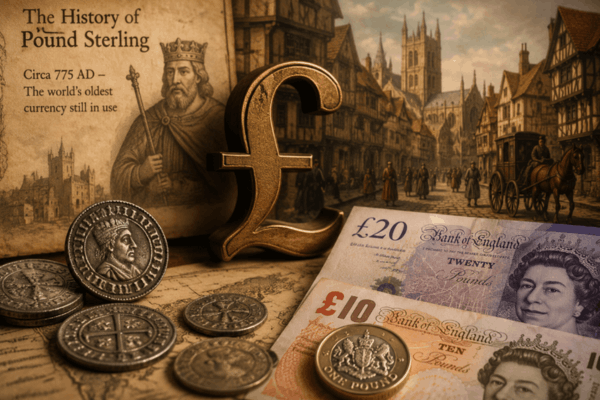
Discover the oldest currency still in use now. It is the British pound sterling. Learn about its history, evolution, and its role in global finance today.
Money has existed for thousands of years, evolving from ancient coins and precious metals into modern banknotes and digital payments. While many currencies have disappeared due to wars, economic crises, or political changes, a small number have managed to survive for centuries.
The oldest currency still in use is widely considered to be the British pound sterling (GBP), with origins dating back more than 1,200 years. However, defining the oldest currency depends on how it is measured. Some currencies have ancient historical roots, but the pound sterling is recognised for its continuous use and evolution as a national currency.
The survival of the British pound reflects more than just its age. Its ability to adapt through major economic changes, monetary reforms, and technological developments has helped it remain one of the world’s most recognised currencies.
What Is the Oldest Currency Still in Use?
The oldest currency still in use today is generally considered to be the British pound sterling, also known as GBP or the pound (£).
The origins of the pound can be traced back to around 775 AD during the Anglo-Saxon period in England, when silver pennies were introduced. These coins formed the foundation of the early monetary system, with the value of currency linked closely to the weight and quality of silver.
Over centuries, the pound evolved from a silver-based coin system into a modern fiat currency supported by the economic institutions of the United Kingdom. Although its design, structure, and payment methods have changed, the pound has maintained a continuous connection with its historical origins.
This long history makes GBP one of the oldest surviving currencies in the world.
The History and Evolution of the British Pound
The journey of the British pound reflects the changing economic landscape of Britain.
Anglo-Saxon Origins
The earliest form of sterling appeared through silver pennies used in Anglo-Saxon England. At the time, coins were valued based on their precious metal content rather than a fixed government-issued value.
The term “pound sterling” originally referred to a pound weight of sterling silver. This helped establish confidence in the currency because traders could rely on the quality of the metal behind each coin.
The Creation of Modern Banking
A major turning point came in 1694 with the establishment of the Bank of England. The institution played an important role in developing Britain’s financial system and later became responsible for issuing banknotes.
The introduction of paper money allowed the economy to expand beyond physical coins and supported the growth of domestic and international trade.
Decimalisation in 1971
For centuries, the British currency system used pounds, shillings, and pence. Before decimalisation:
1 pound equalled 20 shillings
1 shilling equalled 12 pence
In 1971, the United Kingdom switched to a decimal currency system, where one pound equals 100 pence. This reform modernised the currency and made transactions simpler.
Despite this major change, the pound sterling continued its long history as the official currency of the United Kingdom.
Timeline of the British Pound’s History
Period
Key Development
Around 775 AD
Silver pennies begin circulating in Anglo-Saxon England
1694
The Bank of England is established
18th to 19th century
Banknotes become increasingly common
1971
Britain adopts decimal currency
Today
GBP remains one of the world’s major traded currencies
The ability to adapt through these changes is one of the main reasons the pound has survived while many older monetary systems disappeared.
Other Historic Currencies Still Used Today
Although the British pound is often recognised as the oldest currency still in use, several other major currencies also have long histories.
United States Dollar (USD)
The United States dollar was introduced in 1792 following the creation of the United States Mint.
While much younger than GBP, the US dollar has become the world’s leading reserve currency due to the size of the US economy and its importance in global trade.
Swiss Franc (CHF)
The Swiss franc was introduced in 1850 after Switzerland created a unified national monetary system.
Today, the Swiss franc is widely viewed as a safe-haven currency because of Switzerland’s economic stability and strong financial sector.
Japanese Yen (JPY)
The Japanese yen was introduced in 1871 during Japan’s economic modernisation.
The yen helped replace a complex collection of regional currencies and created a unified monetary system that supported Japan’s industrial development.
Why Do Some Currencies Survive for Centuries?
Having a long history does not automatically guarantee a currency’s survival. Many currencies that once existed disappeared due to economic instability, political changes, or monetary reforms.
The oldest currencies still in use have generally survived because of three important factors.
Strong Economic Foundations
A stable economy creates confidence in a currency. Countries with strong financial systems, productive industries, and effective monetary policies are more likely to maintain a trusted currency.
Institutional Support
Central banks play an important role in protecting the value and credibility of currencies. Managing inflation, setting interest rates, and maintaining financial stability help preserve public confidence.
Ability to Adapt
Successful currencies change with the times. The British pound has moved from silver coins to banknotes and digital payments, allowing it to remain relevant in a changing financial environment.
Why Does Currency History Matter for Traders?
The history of a currency can provide useful background, but age alone does not determine its value in financial markets.
The British pound remains one of the most actively traded currencies globally. Traders often monitor GBP because of the United Kingdom’s role in global finance and the importance of London as a major financial centre.
Factors that can influence the pound include:
Bank of England interest rate decisions
UK inflation data
Economic growth figures
Employment reports
Political developments
Understanding the background of major currencies can help traders better interpret market movements and economic events.
The Future of the World’s Oldest Currency
Even the oldest currency still in use must continue adapting to changes in the financial system.
As digital payments become more common, central banks around the world are exploring new forms of digital money. The Bank of England has also researched the possibility of a digital pound, showing how traditional currencies are evolving alongside new technology.
While the way people use money may change, currencies with strong institutions and public trust are likely to remain important parts of the global financial system.
Conclusion
The oldest currency still in use, the British pound sterling, represents more than 1,200 years of monetary history. From silver pennies in Anglo-Saxon England to modern digital payments, GBP has continuously evolved to meet the needs of a changing economy.
However, longevity alone does not determine a currency’s strength. Economic stability, effective monetary policy, and market confidence remain the key factors that influence a currency’s importance in today’s global financial system.
FAQs
What is the oldest currency still in use?
The British pound sterling is generally considered the oldest currency still in continuous use, with origins dating back to around 775 AD.
Is the British pound older than the US dollar?
Yes. The pound sterling has existed for more than 1,200 years, while the US dollar was introduced in 1792.
Does the oldest currency have the highest value?
No. A currency’s value depends on factors such as economic strength, inflation, interest rates, and market demand, not its age.
Share Now
Disclaimer:This content is provided for informational purposes only and does not constitute, and should not be construed as, financial, investment, or other professional advice. No statement or opinion contained herein should be considered a recommendation by Ultima Markets or the author regarding any specific investment product, strategy, or transaction. Readers are advised not to rely solely on this material when making investment decisions and should seek independent advice where appropriate.
Thank you for visiting the Ultima Markets website. Please note that this website is intended for individuals residing in jurisdictions where access is permitted by law. Ultima and its affiliated entities do not operate in your home jurisdiction.
By clicking ‘Acknowledge’, you confirm that you are entering this website solely on your own initiative and not as a result of any specific marketing outreach. You wish to obtain information from this website based on reverse solicitation principles, in accordance with the applicable laws of your home jurisdiction.