This website is managed by Ultima Markets’ international entities, and it’s important to emphasise that they are not subject to regulation by the FCA in the UK. Therefore, you must understand that you will not have the FCA’s protection when investing through this website – for example:
You will not be guaranteed Negative Balance Protection
You will not be protected by FCA’s leverage restrictions
You will not have the right to settle disputes via the Financial Ombudsman Service (FOS)
You will not be protected by Financial Services Compensation Scheme (FSCS)
Any monies deposited will not be afforded the protection required under the FCA Client Assets Sourcebook. The level of protection for your funds will be determined by the regulations of the relevant local regulator.
Note: UK clients are kindly invited to visit https://www.ultima-markets.co.uk/. Ultima Markets UK expects to begin onboarding UK clients in accordance with FCA regulatory requirements in 2026.
If you would like to proceed and visit this website, you acknowledge and confirm the following:
1.The website is owned by Ultima Markets’ international entities and not by Ultima Markets UK Ltd, which is regulated by the FCA.
2.Ultima Markets Limited, or any of the Ultima Markets international entities, are neither based in the UK nor licensed by the FCA.
3.You are accessing the website at your own initiative and have not been solicited by Ultima Markets Limited in any way.
4.Investing through this website does not grant you the protections provided by the FCA.
5.Should you choose to invest through this website or with any of the international Ultima Markets entities, you will be subject to the rules and regulations of the relevant international regulatory authorities, not the FCA.
Ultima Markets wants to make it clear that we are duly licensed and authorised to offer the services and financial derivative products listed on our website. Individuals accessing this website and registering a trading account do so entirely of their own volition and without prior solicitation.
By confirming your decision to proceed with entering the website, you hereby affirm that this decision was solely initiated by you, and no solicitation has been made by any Ultima Markets entity.
Discover what the currency of Guatemala is, explore the GTQ’s exchange rate, forex market relevance, trading pairs, and factors behind its stability.
What Is the Currency of Guatemala?
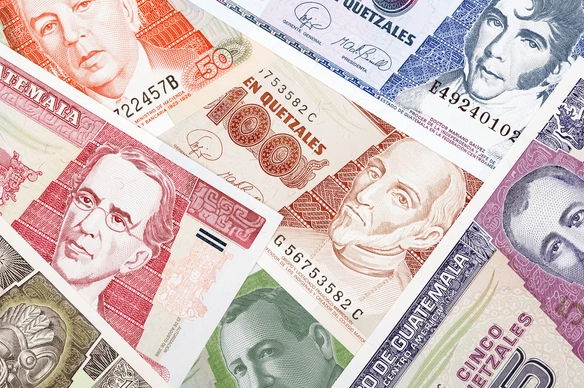
The official currency of Guatemala is the Guatemalan Quetzal (GTQ). Introduced in 1925, the GTQ has remained the national legal tender for nearly a century. If you’re wondering what currency does Guatemala use, the answer is straightforward: Guatemala uses the Quetzal (GTQ).
Understanding the USD to GTQ exchange rate and the broader forex landscape is vital, especially for traders or investors considering exposure to emerging market currencies.
Historical Overview of the Guatemalan Quetzal (GTQ)
The Guatemalan Quetzal was introduced in 1925 to replace the peso, originally pegged to the U.S. dollar at par. The peg was abandoned in the 1980s, and the country adopted a managed float exchange rate system, still in place today.
Despite periods of economic uncertainty, especially during the Guatemalan Civil War (1960–1996), the GTQ has remained relatively stable, supported by remittance inflows and conservative monetary policy.
USD to GTQ Exchange Rate 2025
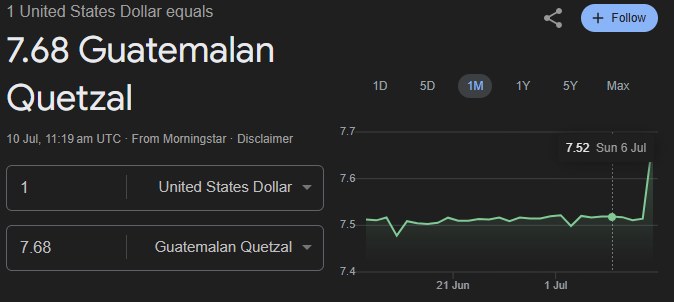
As of July 2025, the real-time exchange rate is 1 USD = 7.68 GTQ, based on real-time spot rates. The recent spike to 7.68 reflects typical market fluctuations. The GTQ has remained relatively stable throughout the year, indicating low volatility compared to other emerging market currencies.
Reasons for Guatemala Quetzal (GTQ) Stability in 2025
The Guatemalan Quetzal has maintained its value well in 2025, thanks to:
Strict monetary policy by Banco de Guatemala
Robust remittance flows (over 19% of GDP)
Stable GDP growth, forecast at 3.5%
Controlled inflation, around 4.1%
Favorable trade balance, particularly with the U.S.
Together, these factors limit large exchange rate swings and help preserve purchasing power for both local citizens and foreign investors.
Popular Currency Pairs with Guatemala Quetzal (GTQ)
Although the Guatemalan Quetzal (GTQ) is not a major global trading currency, it is involved in several common currency pairs, particularly for regional trade and remittance purposes.
Currency Pair
Liquidity Level
Key Use Cases
USD/GTQ
High
Remittances, trade, central bank reserves
EUR/GTQ
Moderate
Trade with EU, currency conversion
GBP/GTQ
Low
Tourism, expat transfers
JPY/GTQ, INR/GTQ, AUD/GTQ, ZAR/GTQ, RUB/GTQ
Low
Rare, available via fintech or P2P services
GTQ/MXN
Moderate
Regional trade between Guatemala and Mexico
Factors That Affect GTQ in the Forex Market
The Guatemalan Quetzal (GTQ), though not widely traded on major forex platforms, is influenced by several domestic and international forces. Understanding these factors is crucial for traders, investors, and anyone analyzing emerging market currencies.
U.S. Monetary Policy (Especially Federal Reserve Decisions)
When the U.S. Federal Reserve raises interest rates, the USD becomes more attractive, leading to capital outflows from emerging markets like Guatemala. This puts downward pressure on the GTQ, as demand for dollars increases.
Conversely, if the Fed signals a dovish stance (e.g., rate cuts), capital may flow into riskier assets, supporting emerging market currencies like GTQ.
Example: In 2023–2024, the Fed’s aggressive rate hikes caused regional currencies to weaken slightly, but the GTQ remained relatively resilient due to strong fundamentals.
Inflation and Interest Rates in Guatemala
Higher domestic inflation erodes the real value of the Quetzal and may trigger depreciation.
If Banco de Guatemala raises interest rates to combat inflation, it can attract foreign capital, supporting GTQ demand.
Remittance Inflows
Remittances from Guatemalans working abroad, primarily in the U.S., inject steady demand for GTQ as USD is converted into local currency. This provides a stable source of foreign currency reserves and supports the GTQ exchange rate.
Inflows exceed 19% of Guatemala’s GDP, acting as a cushion against external shocks.
Trade Balance and Export Performance
A favorable trade balance (more exports than imports) increases foreign demand for GTQ, as trading partners need the local currency to pay for Guatemalan goods like coffee, sugar, and textiles.
Guatemala’s strong export relationship with the U.S. supports consistent currency demand.
Global Commodity Prices
Since Guatemala is a commodity exporter (e.g., coffee, bananas, sugar), rising global prices increase export revenues, strengthening GTQ.
Conversely, if commodity prices fall, export earnings drop, weakening the Quetzal and increasing dependency on imports.
Political and Fiscal Stability
Stable governance and credible fiscal management reduce country risk, boosting investor confidence and demand for GTQ assets.
Political unrest or fiscal deficits often lead to capital flight and GTQ depreciation
Stable budgets and anti-corruption reforms can support currency appreciation
Guatemala has shown relatively low political volatility post-2020s, contributing to GTQ’s steady profile.
Emerging Market Risk Sentiment
GTQ, like other EM currencies, is influenced by global appetite for risk. During risk-on sentiment, investors seek higher-yielding EM assets, supporting GTQ. In risk-off periods (e.g., geopolitical tensions, recession fears), safe-haven currencies like USD are favored, leading to GTQ selling pressure.
Traders often watch the U.S. Dollar Index (DXY), VIX, and EM currency indexes to gauge this.
Is Guatemala Quetzal Good for Investment or Saving?
The Guatemalan Quetzal (GTQ) maintains stability through controlled inflation, consistent remittance inflows, and monetary policy by Banco de Guatemala. It is not widely available on global forex platforms and has limited international liquidity. GTQ-denominated assets are primarily accessed through local financial institutions.
Advantages
Disadvantages
Stability and predictability
Not easily accessible to international traders
Moderate interest rates (currently around 4.25%)
Lower liquidity and FX hedging options
Inflation-managed environment
Currency risk during external shocks
Conclusion
While not a high-volume forex pair, the Guatemalan Quetzal offers insights into Central American economic health and provides value to macro-level traders or those hedging regional investments.
At Ultima Markets, we help traders stay informed with accurate data and in-depth market analysis—even for under-the-radar currencies like the GTQ.
Share Now
Disclaimer:This content is provided for informational purposes only and does not constitute, and should not be construed as, financial, investment, or other professional advice. No statement or opinion contained herein should be considered a recommendation by Ultima Markets or the author regarding any specific investment product, strategy, or transaction. Readers are advised not to rely solely on this material when making investment decisions and should seek independent advice where appropriate.
Thank you for visiting the Ultima Markets website. Please note that this website is intended for individuals residing in jurisdictions where access is permitted by law. Ultima and its affiliated entities do not operate in your home jurisdiction.
By clicking ‘Acknowledge’, you confirm that you are entering this website solely on your own initiative and not as a result of any specific marketing outreach. You wish to obtain information from this website based on reverse solicitation principles, in accordance with the applicable laws of your home jurisdiction.