This website is managed by Ultima Markets’ international entities, and it’s important to emphasise that they are not subject to regulation by the FCA in the UK. Therefore, you must understand that you will not have the FCA’s protection when investing through this website – for example:
You will not be guaranteed Negative Balance Protection
You will not be protected by FCA’s leverage restrictions
You will not have the right to settle disputes via the Financial Ombudsman Service (FOS)
You will not be protected by Financial Services Compensation Scheme (FSCS)
Any monies deposited will not be afforded the protection required under the FCA Client Assets Sourcebook. The level of protection for your funds will be determined by the regulations of the relevant local regulator.
Note: UK clients are kindly invited to visit https://www.ultima-markets.co.uk/. Ultima Markets UK expects to begin onboarding UK clients in accordance with FCA regulatory requirements in 2026.
If you would like to proceed and visit this website, you acknowledge and confirm the following:
1.The website is owned by Ultima Markets’ international entities and not by Ultima Markets UK Ltd, which is regulated by the FCA.
2.Ultima Markets Limited, or any of the Ultima Markets international entities, are neither based in the UK nor licensed by the FCA.
3.You are accessing the website at your own initiative and have not been solicited by Ultima Markets Limited in any way.
4.Investing through this website does not grant you the protections provided by the FCA.
5.Should you choose to invest through this website or with any of the international Ultima Markets entities, you will be subject to the rules and regulations of the relevant international regulatory authorities, not the FCA.
Ultima Markets wants to make it clear that we are duly licensed and authorised to offer the services and financial derivative products listed on our website. Individuals accessing this website and registering a trading account do so entirely of their own volition and without prior solicitation.
By confirming your decision to proceed with entering the website, you hereby affirm that this decision was solely initiated by you, and no solicitation has been made by any Ultima Markets entity.
Ultima Markets does not have an establishment in Singapore and does not operate from Singapore.
Ultima Markets does not provide products or services to citizens or residents of Singapore, and account applications from Singapore citizens or residents will not be accepted.
If you are a citizen or resident of Singapore, please do not open an account or use Ultima Markets’ products or services.
By selecting “Acknowledge and Continue Browsing”, you confirm that you are accessing this website on your own initiative and that your access is not the result of any direct marketing, targeted advertising, solicitation, or promotional activity by Ultima Markets.
Nothing on this website constitutes an offer, solicitation, or promotion of products or services in any jurisdiction where such activity is prohibited. You are responsible for ensuring that your access to and use of this website complies with applicable local laws and regulations.
Discover top Microsoft competitors in various industries. From cloud and AI to enterprise software and gaming. Who is rising and who may lead the market?
Microsoft competitors span several major technology sectors. From cloud computing to artificial intelligence (AI), productivity software to enterprise systems, the competitive landscape around Microsoft in 2026 is both diverse and dynamic.
As businesses modernise and investors evaluate growth potential, understanding these competitors is essential for decision‑making.
This article lists the top Microsoft competitors, explains their strengths, includes recent financial analyst perspectives and highlights competitive trends shaping the technology market today.
What Qualifies As “Microsoft Competitors”?
Microsoft is one of the world’s largest technology companies, known for Windows, Office 365, Azure, Dynamics 365, and Xbox. However, each of these products and services has strong rivals.
When people search for Microsoft competitors, they are usually referring to companies that challenge Microsoft’s leadership in cloud services, AI, software applications, enterprise solutions and consumer technology.
Several trends influence this competition:
Rapid growth in cloud computing
Acceleration of AI adoption across industries
Demand for collaborative and cloud‑native productivity tools
Changing enterprise software requirements
Regulatory scrutiny of market dominance
Financial analysts increasingly focus not just on revenue growth but also on capital efficiency, AI capabilities, and long‑term profitability. These are areas where competition with Microsoft is especially intense.
Major Microsoft Competitors by Segment
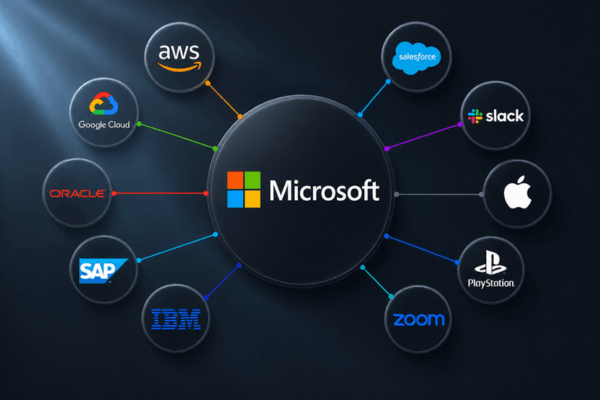
Below is a breakdown of the top Microsoft competitors in key technology areas, with insights into why each competitor matters.
1. Cloud Computing: AWS, Google Cloud, Oracle and IBM
Microsoft Azure is one of the top cloud platforms globally, but it competes closely with other major providers.
Key Competitors:
Amazon Web Services (AWS): AWS remains the largest cloud provider in the world, offering the broadest range of services and the deepest enterprise adoption. Financial analysts often praise AWS for its mature infrastructure and ability to innovate at scale.
Google Cloud Platform (GCP): Google Cloud is growing rapidly, especially in AI‑centric services, data analytics and machine learning tools. Recent reports indicate that Google Cloud’s revenue growth sometimes outpaces its larger rivals, making it one of Microsoft’s most important up‑and‑coming competitors.
Oracle Cloud: Oracle’s cloud services are strong in database management and enterprise workloads. Analysts note that Oracle’s aggressive investment in AI and cloud infrastructure has had mixed market reactions, with some investors concerned about capital intensity.
IBM Cloud: IBM competes in hybrid cloud solutions, appealing to enterprises with complex legacy systems.
Why It Matters: Cloud infrastructure has become a utility‑like market where scale, performance and specialised services determine long‑term tenancy. Microsoft Azure, AWS and Google Cloud together control much of the global cloud market share, and competition among them drives innovation, pricing changes and new services for enterprises.
2. Productivity Suites and Collaboration Tools
Microsoft Office 365 continues to dominate productivity software, but there are effective alternatives that have gained traction.
Key Competitors:
Google Workspace: Google’s cloud‑native productivity tools are popular in education, startups and remote work environments. Real‑time collaboration and seamless integration with Google services are among its strengths.
Zoho Office Suite: A cost‑effective alternative that bundles productivity applications with CRM and other business tools.
Slack and Zoom: While not full duplicates of Office 365, these tools compete in the collaboration and communication space, especially among teams prioritising messaging and video conferencing.
Why It Matters: As hybrid work persists, the ability to collaborate across devices and locations is a major competitive battleground. Microsoft’s integration of AI into its Office suite is a direct response to rival platforms that offer cloud‑first workflows and intuitive user experiences.
3. Artificial Intelligence Platforms
Artificial intelligence has shifted from a niche technology to a central competitive axis.
Key Competitors:
OpenAI: Although closely associated with Microsoft through partnership and investment, OpenAI drives independent AI innovation that influences enterprise adoption and new product development.
Google AI: Google’s research‑based AI models power many of its consumer and enterprise services. Analysts highlight Google’s strength in large language models and AI infrastructure.
Salesforce AI (Einstein & Agentforce): Salesforce is integrating AI deeply into CRM and business process automation, appealing to organisations that value AI‑driven insights and automated workflows.
Why It Matters: AI is reshaping how software is built, how decisions are made and how data is analysed. Competitors that lead in AI tooling and integration challenge Microsoft’s AI strategy across cloud services, productivity software and enterprise platforms.
4. Enterprise Software: CRM and ERP
Microsoft Dynamics 365 competes with several established enterprise software vendors.
Key Competitors:
Salesforce: A market leader in customer relationship management (CRM). Salesforce’s focus on AI and automation has renewed investor interest and market momentum.
SAP: Strong in enterprise resource planning (ERP) and industry‑specific business systems.
Oracle: Competes broadly in database systems and enterprise applications.
Why It Matters: Enterprise software decisions involve long‑term contracts, integrations with existing systems and strategic alignment with business goals. With AI now embedded in many enterprise applications, competition in this space is more intense and strategic than ever before.
5. Consumer Technology and Gaming
Microsoft’s consumer technology efforts include Windows and Xbox, and both face robust competition.
Key Competitors:
Sony PlayStation: A longstanding rival in gaming, with a loyal user base and strong exclusive content.
Nintendo: Offers unique gaming experiences and continues to perform well in global console sales.
Apple: Competes indirectly with Microsoft in personal computing, mobile ecosystems and creative software tools.
Why It Matters: Consumer preferences around gaming ecosystems and devices influence broader technology adoption trends. Subscription services, exclusive games and hardware innovation are all competitive factors in this space.
Microsoft Top Competitors Listed
Segment
Microsoft Offering
Main Competitors
Competitive Focus
Cloud Computing
Azure
AWS, Google Cloud, Oracle, IBM
AI, infrastructure, global reach
Productivity Tools
Office 365
Google Workspace, Zoho, Slack, Zoom
Collaboration, cloud‑native workflows
AI Platforms
Copilot / Azure AI
OpenAI, Google AI, Salesforce AI
Language models, automation, developer tools
Enterprise Software
Dynamics 365
Salesforce, SAP, Oracle
CRM, ERP, integration
Gaming & Consumer
Xbox, Windows
Sony PlayStation, Nintendo, Apple
Hardware, content, ecosystems
Search & Ads
Bing
Google Search, DuckDuckGo, Yahoo
Search quality, ad revenue, privacy
Why These Competitors Matter in 2026
Financial analysts emphasise that growth alone is no longer the only metric. Investor focus now includes:
Capital efficiency and return on investment: High cloud and AI infrastructure spending must deliver strong revenue growth and profitability.
AI leadership: Firms that integrate AI into scalable, enterprise‑ready systems are gaining strategic advantage.
Ecosystem strength: Platforms that lock in users and developers (such as AWS, Google Cloud or Salesforce) exert competitive pressure on Microsoft’s offerings.
Regulatory dynamics: Governments around the world, including the UK Competition and Markets Authority, are studying market structures in software and cloud ecosystems. This regulatory attention can influence how Microsoft and its rivals compete on pricing, interoperability and bundling.
Who Is on the Rise?
Several Microsoft competitors stand out for their recent performance and strategic momentum:
Google Cloud: Rapidly growing market share in cloud and AI services.
Salesforce: Expanding AI‑driven enterprise solutions with strong revenue momentum.
OpenAI and Anthropic: Independent AI labs shaping the future of generative AI adoption.
These companies are attracting investor attention for their innovation and growth potential.
Top Contender Among Microsoft Competitors Today
While several competitors are strong in their niches, Amazon Web Services (AWS) remains the number one contender to Microsoft in the global cloud computing market. AWS’s scale, breadth of infrastructure services and extensive enterprise adoption continue to make it the most formidable rival to Azure.
Although Google Cloud is quickly rising and AI integration is shifting market dynamics, AWS’s market leadership and strategic positioning sustain its competitive edge.
FAQs
Who are the top competitors to Microsoft’s cloud business?
Amazon Web Services (AWS) and Google Cloud are the primary competitors to Microsoft Azure.
Does Google Workspace compete with Microsoft Office?
Yes, Google Workspace is a major cloud‑native alternative to Microsoft Office 365.
Who is the top contender against Microsoft overall?
Amazon Web Services (AWS) remains the strongest overall competitor, especially in cloud infrastructure.
Share Now
Disclaimer:This content is provided for informational purposes only and does not constitute, and should not be construed as, financial, investment, or other professional advice. No statement or opinion contained herein should be considered a recommendation by Ultima Markets or the author regarding any specific investment product, strategy, or transaction. Readers are advised not to rely solely on this material when making investment decisions and should seek independent advice where appropriate.
Thank you for visiting the Ultima Markets website. Please note that this website is intended for individuals residing in jurisdictions where access is permitted by law. Ultima and its affiliated entities do not operate in your home jurisdiction.
By clicking ‘Acknowledge’, you confirm that you are entering this website solely on your own initiative and not as a result of any specific marketing outreach. You wish to obtain information from this website based on reverse solicitation principles, in accordance with the applicable laws of your home jurisdiction.