This website is managed by Ultima Markets’ international entities, and it’s important to emphasise that they are not subject to regulation by the FCA in the UK. Therefore, you must understand that you will not have the FCA’s protection when investing through this website – for example:
You will not be guaranteed Negative Balance Protection
You will not be protected by FCA’s leverage restrictions
You will not have the right to settle disputes via the Financial Ombudsman Service (FOS)
You will not be protected by Financial Services Compensation Scheme (FSCS)
Any monies deposited will not be afforded the protection required under the FCA Client Assets Sourcebook. The level of protection for your funds will be determined by the regulations of the relevant local regulator.
Note: UK clients are kindly invited to visit https://www.ultima-markets.co.uk/. Ultima Markets UK expects to begin onboarding UK clients in accordance with FCA regulatory requirements in 2026.
If you would like to proceed and visit this website, you acknowledge and confirm the following:
1.The website is owned by Ultima Markets’ international entities and not by Ultima Markets UK Ltd, which is regulated by the FCA.
2.Ultima Markets Limited, or any of the Ultima Markets international entities, are neither based in the UK nor licensed by the FCA.
3.You are accessing the website at your own initiative and have not been solicited by Ultima Markets Limited in any way.
4.Investing through this website does not grant you the protections provided by the FCA.
5.Should you choose to invest through this website or with any of the international Ultima Markets entities, you will be subject to the rules and regulations of the relevant international regulatory authorities, not the FCA.
Ultima Markets wants to make it clear that we are duly licensed and authorised to offer the services and financial derivative products listed on our website. Individuals accessing this website and registering a trading account do so entirely of their own volition and without prior solicitation.
By confirming your decision to proceed with entering the website, you hereby affirm that this decision was solely initiated by you, and no solicitation has been made by any Ultima Markets entity.
Ultima Markets does not have an establishment in Singapore and does not operate from Singapore.
Ultima Markets does not provide products or services to citizens or residents of Singapore, and account applications from Singapore citizens or residents will not be accepted.
If you are a citizen or resident of Singapore, please do not open an account or use Ultima Markets’ products or services.
By selecting “Acknowledge and Continue Browsing”, you confirm that you are accessing this website on your own initiative and that your access is not the result of any direct marketing, targeted advertising, solicitation, or promotional activity by Ultima Markets.
Nothing on this website constitutes an offer, solicitation, or promotion of products or services in any jurisdiction where such activity is prohibited. You are responsible for ensuring that your access to and use of this website complies with applicable local laws and regulations.
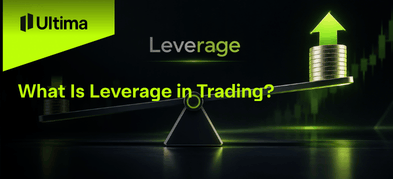
Learn what is leverage in trading, how margin works, how it affects profits and losses, and the key risks every beginner should understand before trading
If you are asking what is leverage in trading, think of it as a way to control a larger market position using a smaller amount of your own capital. Instead of paying the full value of a position upfront, you provide a portion of it as margin.
For example, with 1:100 leverage, $100 of required margin could provide exposure to a $10,000 position. This can make your capital more efficient, but there is an important trade-off: your profit or loss is still calculated from the full $10,000 position.
That is why leverage is useful to understand before trading forex, commodities, indices or other leveraged products. A relatively small market movement can have a much larger impact on your account when your position is large compared with the capital available.
What Is Leverage and How Does It Work?
Leverage is normally expressed as a ratio, such as 1:10, 1:50 or 1:100.
The ratio shows how much market exposure can be controlled relative to the margin required.
Leverage
Margin Required for a $10,000 Position
1:10
$1,000
1:20
$500
1:50
$200
1:100
$100
1:500
$20
With 1:100 leverage, for example, the margin required to control a $10,000 position would be $100.
This does not mean the broker simply deposits another $9,900 into your account. Instead, leverage determines the margin needed to maintain the position.
The basic formula is:
Leverage = Position Value ÷ Margin Required
If a $20,000 position requires $200 in margin:
$20,000 ÷ $200 = 100
The leverage ratio is therefore 1:100.
You can reverse the formula to calculate margin:
Margin Required = Position Value ÷ Leverage
What Is the Difference Between Leverage and Margin?
Leverage and margin describe two sides of the same concept.
Leverage tells you how much market exposure you can control relative to the capital required.
Margin is the amount of money that needs to be allocated to open and maintain the leveraged position.
For example, 1:20 leverage corresponds to an initial margin requirement of 5%, while 1:100 corresponds to 1%.
This inverse relationship is also used by major trading providers when explaining leverage and margin to beginners.
Margin requirements are not necessarily fixed forever. They can vary according to the instrument, position size, account type and market conditions.
Maximum Leverage vs Effective Leverage
A common mistake is assuming that an account offering high leverage means every trade automatically uses that level of leverage.
It does not.
Imagine your trading account has equity of $10,000 and allows leverage of up to 1:500.
If you open a position worth only $20,000, your effective leverage is:
$20,000 ÷ $10,000 = 2
Your effective leverage is therefore approximately 2:1, even though the account allows significantly higher maximum leverage.
This distinction is important because your actual risk is influenced heavily by how large your position is relative to your account, not simply the maximum leverage displayed by the broker.
Higher available leverage gives you greater capacity to open a position. It does not mean you need to use all of it.
How Does Leverage Affect Profit and Loss?
To understand what is leverage more clearly, it helps to compare two positions with the same market exposure.
Suppose two traders both gain exposure to a position worth $10,000.
No Leverage
1:10 Leverage
Position value
$10,000
$10,000
Capital required
$10,000
$1,000 margin
Market rises 2%
+$200
+$200
Return relative to capital required
+2%
+20%
Market falls 2%
-$200
-$200
Loss relative to capital required
-2%
-20%
The asset moved by the same 2% in both examples, and the profit or loss on the position was still $200.
What changed was the amount of capital required to obtain that exposure.
This is why people often say leverage magnifies profits and losses. More precisely, leverage allows traders to take larger exposure relative to the capital committed, which can make changes in account equity much larger in percentage terms.
Does Trading With Leverage Cost Money?
Leverage itself should not be confused with a standalone trading fee, but leveraged trades can involve several costs.
Depending on the market and account, these may include:
spreads
commissions
overnight financing
other transaction charges
Overnight financing is particularly important for traders who hold leveraged positions for several days.
For some CFD products, financing costs can be calculated using the total value of the underlying position rather than only the margin deposited. Singapore’s MoneySense specifically highlights this when explaining CFD trading costs.
This means a position requiring relatively little margin could still generate financing costs based on a much larger market exposure.
Traders should therefore consider both potential price movements and trading costs when deciding how much leverage to use.
Why Can Leverage Change?
Another detail beginners sometimes overlook is that available leverage can vary.
Different markets have different levels of volatility and risk, so a broker may not offer the same leverage for EUR/USD, gold, shares and cryptocurrencies.
Leverage may also depend on:
account type
instrument
position size
regulatory jurisdiction
periods of increased volatility
Some providers also use tiered leverage, where larger positions receive lower leverage.
For example, Ultima Markets’ XAUUSD247 specifications currently use a tiered structure, with leverage temporarily adjusted during certain major USD news releases and specified market opening or closing periods.
For this reason, traders should always check the latest instrument specifications rather than assuming one leverage ratio applies to every trade.
What Happens When Your Margin Gets Too Low?
When a leveraged trade moves against you, losses reduce your account equity.
If your available equity falls too far relative to the margin required for your open trades, your margin level may fall below the broker’s required threshold.
This can lead to a margin call or positions being automatically closed.
The exact rules depend on the provider and jurisdiction.
For example, UK FCA rules for retail CFDs require firms to close positions when funds fall to 50% of the margin needed to maintain open CFD positions. UK retail CFD leverage is also restricted to between 30:1 and 2:1 depending on the underlying asset.
This also shows why leverage can vary substantially between countries.
Is High Leverage Risky?
The main risk of leverage is taking a position that is too large for your account.
A small price movement can then cause a significant change in account equity.
Recent regulatory data illustrates this risk. On 12 October 2026, Australia’s ASIC reported that 68% of retail clients who traded CFDs during the 2023–24 financial year made a net loss. Aggregate net retail losses exceeded A$458 million, including A$73 million in fees.
This does not mean leverage itself guarantees a loss. It does show why regulators view leveraged products as high risk and why position sizing, margin management and risk controls matter.
How Much Leverage Should a Beginner Use?
There is no single leverage ratio that is right for every trader.
Instead of asking for the highest possible leverage, beginners may find it more useful to consider:
account size
position size
market volatility
stop-loss distance
maximum acceptable loss per trade
available free margin
A trader with access to 1:500 leverage can still choose a much smaller position and therefore use considerably lower effective leverage.
Starting with smaller positions can also make it easier to understand how market movements affect account equity before increasing exposure.
Conclusion
So, what is leverage in practical terms?
It is a tool that allows you to control greater market exposure while committing only part of the position’s total value as margin.
The important point is that leverage should be considered together with position size. Having access to higher leverage does not require you to use the maximum available amount.
Before opening a leveraged trade, understand the position’s full value, margin requirement, potential loss and trading costs. Used carefully, leverage can improve capital efficiency. Used excessively, it can cause losses to accumulate much faster.
FAQ
What does 1:100 leverage mean?
It means $1 of required margin can provide exposure to up to $100 in market value. A $10,000 position would require $100 at 1:100 leverage.
Is higher leverage better?
Not necessarily. Higher leverage reduces the margin required for the same position but can make it easier to take excessive exposure.
What is leverage in forex?
Forex leverage allows traders to control a currency position larger than the margin required to open it.
What is the difference between margin and leverage?
Leverage describes the relationship between market exposure and required capital. Margin is the amount of capital allocated to maintain the position.
Share Now
Disclaimer:This content is provided for informational purposes only and does not constitute, and should not be construed as, financial, investment, or other professional advice. No statement or opinion contained herein should be considered a recommendation by Ultima Markets or the author regarding any specific investment product, strategy, or transaction. Readers are advised not to rely solely on this material when making investment decisions and should seek independent advice where appropriate.
Thank you for visiting the Ultima Markets website. Please note that this website is intended for individuals residing in jurisdictions where access is permitted by law. Ultima and its affiliated entities do not operate in your home jurisdiction.
By clicking ‘Acknowledge’, you confirm that you are entering this website solely on your own initiative and not as a result of any specific marketing outreach. You wish to obtain information from this website based on reverse solicitation principles, in accordance with the applicable laws of your home jurisdiction.