This website is managed by Ultima Markets’ international entities, and it’s important to emphasise that they are not subject to regulation by the FCA in the UK. Therefore, you must understand that you will not have the FCA’s protection when investing through this website – for example:
You will not be guaranteed Negative Balance Protection
You will not be protected by FCA’s leverage restrictions
You will not have the right to settle disputes via the Financial Ombudsman Service (FOS)
You will not be protected by Financial Services Compensation Scheme (FSCS)
Any monies deposited will not be afforded the protection required under the FCA Client Assets Sourcebook. The level of protection for your funds will be determined by the regulations of the relevant local regulator.
Note: UK clients are kindly invited to visit https://www.ultima-markets.co.uk/. Ultima Markets UK expects to begin onboarding UK clients in accordance with FCA regulatory requirements in 2026.
If you would like to proceed and visit this website, you acknowledge and confirm the following:
1.The website is owned by Ultima Markets’ international entities and not by Ultima Markets UK Ltd, which is regulated by the FCA.
2.Ultima Markets Limited, or any of the Ultima Markets international entities, are neither based in the UK nor licensed by the FCA.
3.You are accessing the website at your own initiative and have not been solicited by Ultima Markets Limited in any way.
4.Investing through this website does not grant you the protections provided by the FCA.
5.Should you choose to invest through this website or with any of the international Ultima Markets entities, you will be subject to the rules and regulations of the relevant international regulatory authorities, not the FCA.
Ultima Markets wants to make it clear that we are duly licensed and authorised to offer the services and financial derivative products listed on our website. Individuals accessing this website and registering a trading account do so entirely of their own volition and without prior solicitation.
By confirming your decision to proceed with entering the website, you hereby affirm that this decision was solely initiated by you, and no solicitation has been made by any Ultima Markets entity.
Ultima Markets does not have an establishment in Singapore and does not operate from Singapore.
Ultima Markets does not provide products or services to citizens or residents of Singapore, and account applications from Singapore citizens or residents will not be accepted.
If you are a citizen or resident of Singapore, please do not open an account or use Ultima Markets’ products or services.
By selecting “Acknowledge and Continue Browsing”, you confirm that you are accessing this website on your own initiative and that your access is not the result of any direct marketing, targeted advertising, solicitation, or promotional activity by Ultima Markets.
Nothing on this website constitutes an offer, solicitation, or promotion of products or services in any jurisdiction where such activity is prohibited. You are responsible for ensuring that your access to and use of this website complies with applicable local laws and regulations.
What is a spread in trading? It can make a big difference in your trading costs. Read on how it affects your profits and learn how to navigate your trades.
If you have ever opened a trading platform, you have probably noticed two different prices for the same asset, one for buying and another for selling. The difference between these prices is known as the spread. But what is a spread in trading, and why does it matter?
For beginners, this raises a common question: What does spread mean in trading? Simply put, it represents the gap between the buying and selling prices of an asset, making it an important part of trading costs.
Although spreads may seem small, they can influence your entry price, profitability and trading strategy. This guide explains how spreads work, why they exist, what affects them and how you can manage their costs.
What Does Spread Mean in Trading?
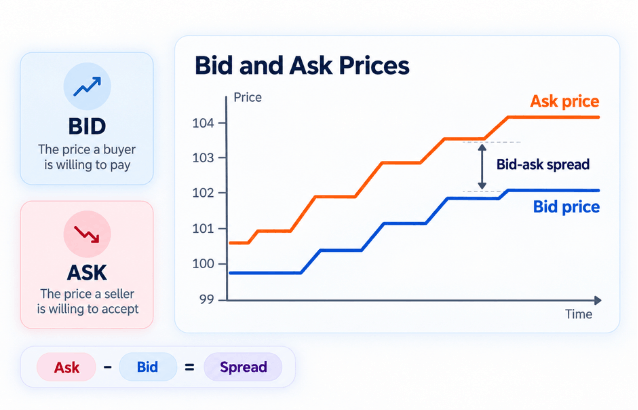
A spread is the difference between two related prices, rates or yields. In most everyday trading, however, the term refers to the bid-ask spread.
Bid price: The price at which you can sell an asset.
Ask price: The price at which you can buy an asset.
The difference between these two prices is the spread. In simple terms, a spread in trading means the price difference you encounter when buying or selling a financial instrument.
Example:
Suppose EUR/USD is quoted at:
Price
EUR/USD
Bid (Sell)
1.1000
Ask (Buy)
1.1002
Spread
0.0002 (2 pips)
If you buy EUR/USD at 1.1002 and immediately sell it at 1.1000, you would incur a loss equivalent to the spread, assuming market prices remain unchanged.
This explains why a newly opened trade typically shows a small unrealised loss. The market must move sufficiently in your favour to cover the spread before the position becomes profitable, excluding other fees.
Why Do Spreads Exist?
Spreads are a natural part of financial markets, reflecting differences between buying and selling prices.
Broker Compensation
Some brokers incorporate their fees into the spread instead of charging a separate commission. Others provide tighter spreads alongside commission-based pricing.
Market-Making Costs
Market makers and liquidity providers quote buying and selling prices to facilitate trading. Spreads help compensate them for supplying liquidity and managing price fluctuations.
Immediate Execution
Spreads also reflect the cost of executing trades at available market prices rather than waiting for another participant to accept your preferred price.
Think of exchanging currency at an airport. The exchange counter offers one rate when buying your currency and another when selling it. The difference between those rates works much like a trading spread.
How Is a Spread Measured?
In forex, spreads are commonly measured in pips, a standard unit used to measure currency price movements.
For most currency pairs, 1 pip equals 0.0001. For Japanese yen pairs, 1 pip typically equals 0.01.
For example, EUR/USD quoted at 1.1051 / 1.1053 has a spread of 2 pips, while USD/JPY quoted at 150.00 / 150.04 has a spread of 4 pips.
Other instruments, including shares, indices and commodities, may express spreads in price points, ticks or currency values.
Types of Spreads in Trading
When comparing trading conditions, you will generally encounter two main spread structures: fixed and variable.
Fixed Spread
Fixed spreads are designed to remain constant under specified trading conditions, regardless of minor market fluctuations.
Their main advantage is predictability, allowing traders to estimate transaction costs more easily. However, fixed spreads may be wider than variable spreads during periods of high liquidity.
Some brokers may also apply exceptions or execution restrictions during extreme market volatility.
Variable (Floating) Spread
Variable spreads change according to market conditions, particularly liquidity and volatility.
During active trading sessions, variable spreads can become very narrow as buying and selling activity increases.
However, they may widen significantly during major economic announcements or periods of low liquidity, making trading expenses less predictable.
Neither spread structure is necessarily better for every trader. The choice depends on trading frequency, preferred instruments and individual strategies.
What Affects the Size of a Spread?
Understanding what a spread in trading is also involves knowing why its size changes.
Several factors can influence whether a spread becomes narrower or wider.
Factor
Impact on Spreads
Liquidity
Highly liquid markets generally have tighter spreads because more buyers and sellers are active.
Volatility
Sharp price movements and uncertainty can cause spreads to widen.
Asset Type
Major forex pairs often have narrower spreads than less frequently traded currency pairs.
Trading Hours
Spreads are often tighter during active trading sessions, particularly when major markets overlap.
Economic News
Important announcements can temporarily widen spreads as market participants adjust their prices.
For example, EUR/USD often benefits from strong liquidity during the London and New York session overlap. However, spreads can widen around major announcements, such as US employment data or Federal Reserve interest rate decisions.
Therefore, traders should consider not only the minimum advertised spread but also how pricing behaves under different market conditions.
How to Calculate the Cost of a Spread
Now that you understand what a spread in trading is, the next step is calculating how much it costs when placing a trade.
For forex pairs with a known pip value, the calculation is straightforward:
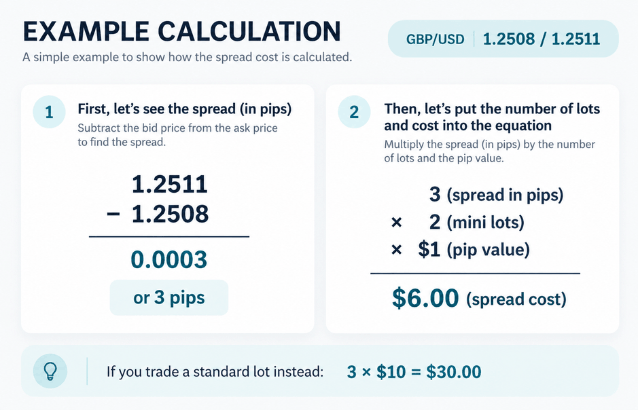
Spread Cost = Spread (in pips) × Pip Value × Number of Lots
For currency pairs such as EUR/USD, where USD is the quote currency, typical pip values are:
Pip values can differ depending on the currency pair and account currency.
Example: Calculating Spread Costs
Suppose GBP/USD is quoted at 1.2508 / 1.2511.
The spread is:
1.2511 − 1.2508 = 0.0003, or 3 pips.
If you trade 2 mini lots, with each mini lot worth USD 1 per pip:
Spread Cost = 3 × USD 1 × 2 = USD 6
For comparison, trading 1 standard lot with the same spread would cost:
Spread Cost = 3 × USD 10 = USD 30
This illustrates why position size matters. Even when the spread remains unchanged, larger positions result in higher spread costs.
For frequent traders, these expenses can accumulate across multiple transactions. The calculations above exclude commissions, slippage and other potential trading fees.
How to Reduce Spread Costs
Although spreads cannot always be avoided, understanding how they work can help traders manage expenses more effectively.
1. Trade During High-Liquidity Sessions
Major forex pairs often experience narrower spreads when trading activity is high, particularly during the London and New York session overlap.
2. Be Cautious Around Economic Announcements
Events such as inflation reports, employment data and central bank decisions can trigger volatility and temporarily widen spreads.
3. Compare Broker Trading Conditions
Look beyond advertised minimum spreads. Consider average spreads, commissions, execution quality and additional trading fees.
For example, Ultima Markets offers minimum spreads starting from 0.0 pips on selected ECN accounts, with separate commissions. Actual spreads vary depending on the instrument and market conditions.
4. Understand Different Order Types
Limit orders allow traders to specify acceptable execution prices, potentially helping control entry costs. However, they do not eliminate spreads or guarantee order execution.
5. Consider Your Trading Frequency
Spread costs are particularly important for scalping and short-term strategies involving frequent trades. For longer-term positions, overnight financing charges and other expenses may also influence total costs.
Conclusion
Understanding what a spread in trading is helps you recognise an important cost involved in buying and selling financial instruments. A narrower spread generally means lower transaction costs, while a wider spread requires a greater favourable price movement before a trade becomes profitable.
Whether you trade forex, commodities or indices, spreads can vary depending on liquidity, volatility and trading hours.
By comparing spreads alongside commissions and execution conditions, you can make more informed trading decisions and manage your overall trading expenses.
FAQ
What is a good spread in trading?
A good spread is generally one that is low relative to the instrument being traded. For major forex pairs such as EUR/USD, a spread below 1 pip can be considered competitive during liquid market conditions, although commissions and other costs also matter.
What is a spread trading example?
If EUR/USD has a bid price of 1.1000 and an ask price of 1.1002, the bid-ask spread is 2 pips. Separately, spread trading can also refer to buying one financial instrument while selling a related instrument to trade their price difference.
What does spread mean in trading?
The spread in trading is the difference between an asset’s bid (selling) price and ask (buying) price. It represents part of the transaction cost and can fluctuate with market conditions.
What is 0.6 spread in forex?
A 0.6 spread typically means a difference of 0.6 pips between the bid and ask prices. For a standard lot of EUR/USD, this represents approximately USD 6 in spread costs, excluding commissions and other fees.
Which spread is best for trading?
The best spread depends on your trading strategy. Tight variable spreads may suit active traders, while fixed spreads provide more predictable costs. Comparing total trading expenses is more important than focusing solely on the spread.
Is a higher or lower spread better?
A lower spread is generally better because it reduces transaction costs. However, traders should also consider commissions, slippage and execution quality when comparing trading conditions.
Share Now
Disclaimer:This content is provided for informational purposes only and does not constitute, and should not be construed as, financial, investment, or other professional advice. No statement or opinion contained herein should be considered a recommendation by Ultima Markets or the author regarding any specific investment product, strategy, or transaction. Readers are advised not to rely solely on this material when making investment decisions and should seek independent advice where appropriate.
Thank you for visiting the Ultima Markets website. Please note that this website is intended for individuals residing in jurisdictions where access is permitted by law. Ultima and its affiliated entities do not operate in your home jurisdiction.
By clicking ‘Acknowledge’, you confirm that you are entering this website solely on your own initiative and not as a result of any specific marketing outreach. You wish to obtain information from this website based on reverse solicitation principles, in accordance with the applicable laws of your home jurisdiction.