This website is managed by Ultima Markets’ international entities, and it’s important to emphasise that they are not subject to regulation by the FCA in the UK. Therefore, you must understand that you will not have the FCA’s protection when investing through this website – for example:
You will not be guaranteed Negative Balance Protection
You will not be protected by FCA’s leverage restrictions
You will not have the right to settle disputes via the Financial Ombudsman Service (FOS)
You will not be protected by Financial Services Compensation Scheme (FSCS)
Any monies deposited will not be afforded the protection required under the FCA Client Assets Sourcebook. The level of protection for your funds will be determined by the regulations of the relevant local regulator.
Note: UK clients are kindly invited to visit https://www.ultima-markets.co.uk/. Ultima Markets UK expects to begin onboarding UK clients in accordance with FCA regulatory requirements in 2026.
If you would like to proceed and visit this website, you acknowledge and confirm the following:
1.The website is owned by Ultima Markets’ international entities and not by Ultima Markets UK Ltd, which is regulated by the FCA.
2.Ultima Markets Limited, or any of the Ultima Markets international entities, are neither based in the UK nor licensed by the FCA.
3.You are accessing the website at your own initiative and have not been solicited by Ultima Markets Limited in any way.
4.Investing through this website does not grant you the protections provided by the FCA.
5.Should you choose to invest through this website or with any of the international Ultima Markets entities, you will be subject to the rules and regulations of the relevant international regulatory authorities, not the FCA.
Ultima Markets wants to make it clear that we are duly licensed and authorised to offer the services and financial derivative products listed on our website. Individuals accessing this website and registering a trading account do so entirely of their own volition and without prior solicitation.
By confirming your decision to proceed with entering the website, you hereby affirm that this decision was solely initiated by you, and no solicitation has been made by any Ultima Markets entity.
What is a gamma squeeze? Explore how options mechanics trigger explosive price moves, the role of market makers, and what every trader should understand.
What Is a Gamma Squeeze? How to Use It?
If you have been following financial markets over the past few years, you have likely come across the term during periods of sharp, unexpected volatility. But what is a gamma squeeze, exactly, and why does it matter to traders?
Simply put, a gamma squeeze is a rapid, self-reinforcing spike in a stock’s price driven by options market mechanics, specifically the hedging behaviour of market makers.
Understanding how this works can help traders better read unusual price action, manage risk more effectively, and identify potential opportunities before a move exhausts itself.
Understanding the Options Concepts Behind It
To make sense of a gamma squeeze, two key options terms need to be understood first.
Delta
Delta measures how much an option’s price moves for every $1 change in the underlying stock. An option with a delta of 0.50, for example, moves $0.50 for every $1 the stock moves.
Gamma
Gamma measures how quickly delta changes as the stock price moves. High gamma means delta is highly sensitive to price shifts, and that sensitivity is precisely what fuels a squeeze. Importantly, gamma is at its highest for at-the-money options, particularly as they approach expiration. This is what makes hedging activity far more aggressive in the final days before a contract expires.
How Hedging Creates the Feedback Loop
When traders buy call options in large volumes, market makers who sell those contracts must hedge their exposure by purchasing shares of the underlying stock.
As the stock price rises, delta increases, which means market makers must buy even more shares to stay hedged.
That additional buying pushes the price higher, which raises delta further, triggering yet more buying. This feedback loop is the core engine behind a gamma squeeze.
The Core Mechanics of a Gamma Squeeze
In practical terms, a gamma squeeze occurs when a surge in call option buying forces market makers into an accelerating cycle of stock purchases to maintain delta-neutral positions. The conditions that make a squeeze most powerful are:
A large volume of short-dated, out-of-the-money call options being purchased rapidly
Open interest concentrating around specific strike prices
A stock with relatively low float or thin liquidity
Market makers holding significant short gamma exposure
The closer expiry gets, the more volatile gamma becomes near the strike price. This is why gamma squeezes tend to be most explosive in the final days before options expiration, particularly on weekly contracts.
GameStop and the Real-World Impact
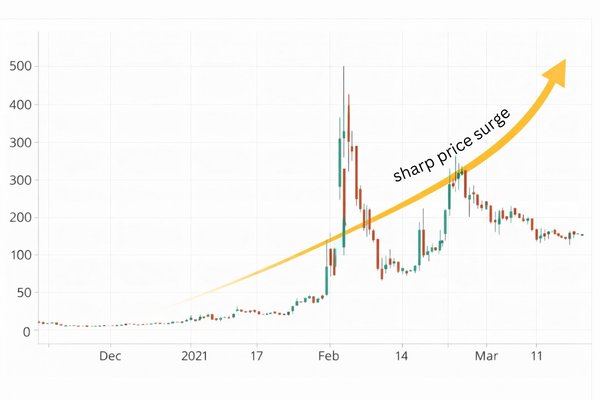
No conversation about what is a gamma squeeze is complete without GameStop (GME). In January 2021, retail traders coordinating on Reddit’s WallStreetBets forum mass-purchased out-of-the-money call options on GME. As prices started rising, market makers scrambled to delta-hedge by buying shares, igniting the feedback loop described above.
The Numbers Behind the Move
The data reflects just how extreme the event was:
Metric
Data Point
Options volume surge
Over 10x normal daily average
Short interest at peak
Over 140% of available float
Price gain in three weeks
Over 2,400%
Intraday peak price
$483, up from roughly $20
The episode triggered trading halts across multiple platforms and drew formal scrutiny from the SEC. While GME was amplified by a simultaneous short squeeze, it remains the clearest modern example of how options mechanics can produce extraordinary, fundamentals-defying price moves.
AMC Entertainment followed a similar pattern shortly after, with coordinated options and share buying triggering significant hedging flows from market makers.
Gamma Squeeze vs Short Squeeze: Key Differences
These two terms are frequently used interchangeably, but they have distinct drivers and it is worth separating them clearly.
Factor
Gamma Squeeze
Short Squeeze
Primary Driver
Market maker delta hedging
Short sellers forced to cover
Fuel
Call option buying volume
High short interest
Speed
Hours to days
Days to weeks
Key Metric
Options open interest and GEX
Short interest as % of float
Resolution
Options expire or IV collapses
Short positions fully covered
The two forces can and do occur at the same time, as seen with GME, AMC, and Bed Bath and Beyond in 2022. When both align simultaneously, the resulting price action becomes significantly more extreme and difficult to predict.
How Traders Identify and Navigate a Gamma Squeeze
Signals to Watch For
Traders who want to anticipate or respond to a gamma squeeze tend to monitor a specific set of signals:
Unusual call buying activity: A sudden spike in call options, particularly short-dated and out-of-the-money, is often the earliest warning sign that a squeeze could be building.
Gamma exposure (GEX) data: Some market data providers publish aggregate gamma exposure by strike. When a stock shows large negative GEX, market makers are short gamma and must buy more aggressively as prices rise.
Low float and high short interest: Fewer available shares mean each incremental hedging purchase has a greater impact on price.
Rising implied volatility (IV): As a squeeze develops, IV tends to spike sharply, making options more expensive and sometimes accelerating buying from traders trying to enter before the move peaks.
Options-to-volume ratio: When options volume significantly outpaces regular stock volume, derivatives activity may start influencing the underlying price more than usual.
Understanding the Risks
Gamma squeezes carry significant risk for every party involved.
For buyers, timing is critical. Entering a squeeze late means paying heavily inflated premiums for options that can lose most of their value within hours once the move unwinds. When a squeeze peaks, implied volatility collapses sharply in a process known as a volatility crush, and out-of-the-money options can fall close to zero even if the stock does not decline dramatically.
For short sellers and market makers, being short gamma during a squeeze results in forced buying at progressively worse prices. During GME’s peak, certain hedge funds reported losses exceeding $1 billion within a single trading week.
For retail traders on any side of the trade, leverage amplifies both the gains and the losses, making position sizing and a clearly defined exit plan essential before entering any position in a high-gamma environment.
Where the Market Stands in 2026
The dynamics behind gamma squeezes have not faded since 2021. In 2024, stocks including Super Micro Computer (SMCI) and several AI-adjacent names showed clear signs of gamma-driven price acceleration, with options volumes spiking sharply ahead of major single-day moves.
Conclusion
Knowing what is a gamma squeeze gives traders a meaningful edge when interpreting unusual market behaviour. When large volumes of call options force market makers into an escalating hedging cycle, prices can move far beyond what fundamentals justify, and they can reverse just as quickly.
Whether you are an active trader looking to ride momentum or a risk-conscious investor wanting to avoid being caught on the wrong side, understanding gamma mechanics is an essential part of navigating modern markets.
As options participation continues to grow, gamma squeezes will remain a recurring feature of the trading landscape.
FAQs
What is a gamma squeeze in simple terms?
It is when heavy call option buying forces market makers to purchase large amounts of stock to hedge, pushing the price higher and triggering a self-reinforcing buying cycle.
How long does a gamma squeeze typically last?
Most peak within one to five trading days and resolve quickly once options expire or buying momentum dries up.
Can a gamma squeeze happen on any stock?
It can, but it is most common in stocks with low float, high short interest, and concentrated options activity around specific strike prices.
Share Now
Disclaimer:This content is provided for informational purposes only and does not constitute, and should not be construed as, financial, investment, or other professional advice. No statement or opinion contained herein should be considered a recommendation by Ultima Markets or the author regarding any specific investment product, strategy, or transaction. Readers are advised not to rely solely on this material when making investment decisions and should seek independent advice where appropriate.
Thank you for visiting the Ultima Markets website. Please note that this website is intended for individuals residing in jurisdictions where access is permitted by law. Ultima and its affiliated entities do not operate in your home jurisdiction.
By clicking ‘Acknowledge’, you confirm that you are entering this website solely on your own initiative and not as a result of any specific marketing outreach. You wish to obtain information from this website based on reverse solicitation principles, in accordance with the applicable laws of your home jurisdiction.