This website is managed by Ultima Markets’ international entities, and it’s important to emphasise that they are not subject to regulation by the FCA in the UK. Therefore, you must understand that you will not have the FCA’s protection when investing through this website – for example:
You will not be guaranteed Negative Balance Protection
You will not be protected by FCA’s leverage restrictions
You will not have the right to settle disputes via the Financial Ombudsman Service (FOS)
You will not be protected by Financial Services Compensation Scheme (FSCS)
Any monies deposited will not be afforded the protection required under the FCA Client Assets Sourcebook. The level of protection for your funds will be determined by the regulations of the relevant local regulator.
Note: UK clients are kindly invited to visit https://www.ultima-markets.co.uk/. Ultima Markets UK expects to begin onboarding UK clients in accordance with FCA regulatory requirements in 2026.
If you would like to proceed and visit this website, you acknowledge and confirm the following:
1.The website is owned by Ultima Markets’ international entities and not by Ultima Markets UK Ltd, which is regulated by the FCA.
2.Ultima Markets Limited, or any of the Ultima Markets international entities, are neither based in the UK nor licensed by the FCA.
3.You are accessing the website at your own initiative and have not been solicited by Ultima Markets Limited in any way.
4.Investing through this website does not grant you the protections provided by the FCA.
5.Should you choose to invest through this website or with any of the international Ultima Markets entities, you will be subject to the rules and regulations of the relevant international regulatory authorities, not the FCA.
Ultima Markets wants to make it clear that we are duly licensed and authorised to offer the services and financial derivative products listed on our website. Individuals accessing this website and registering a trading account do so entirely of their own volition and without prior solicitation.
By confirming your decision to proceed with entering the website, you hereby affirm that this decision was solely initiated by you, and no solicitation has been made by any Ultima Markets entity.
Discover what is the best day of the week to buy stocks. Learn about market trends and how Mondays, Tuesdays, and other days impact stock price movements.
The Best Day of the Week to Buy Stocks
When it comes to stock trading, timing is often considered one of the most critical factors influencing success. Traders and investors alike frequently seek out the “best” day of the week to buy stocks, with the goal of maximising returns and minimising risks. But can the day of the week really make a significant difference in your investment strategy?
In this article, we’ll explore patterns in stock price movements throughout the week, backed by data and historical trends, to help you understand if there’s a specific day when buying stocks might be more advantageous.
Understanding Stock Market Trends Throughout the Week
Stock prices are influenced by a variety of factors, including corporate earnings reports, geopolitical events, economic data releases, and overall market sentiment. While these factors can impact stock prices at any time, certain days of the week tend to show recurring patterns that traders can take advantage of. By examining these patterns, we can get a sense of which days might offer better opportunities for buying stocks.
Days of the Week and Their Impact on Stock Prices
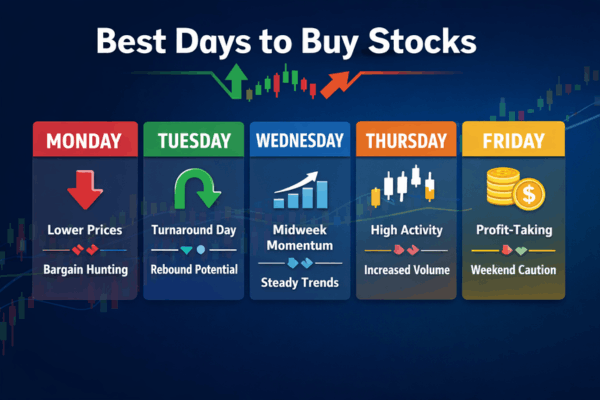
Monday: The Slow Start
Mondays are often characterised by a phenomenon known as the weekend effect, where stock prices tend to be lower due to uncertainty and market sentiment adjustments from over the weekend. Traders return from the weekend to absorb new news and market developments, leading to potentially slower or lower trading activity.
Several studies have pointed to Mondays showing lower average returns compared to other days of the week, with a tendency for stocks to dip as investors react to any weekend news. This makes Monday an interesting day for bargain hunters, as the potential to buy at a lower price may be present. However, it’s crucial to consider overall market sentiment before making a decision.
Tuesday: The Turnaround Day
By Tuesday, markets have usually absorbed the initial news from the previous weekend and Monday, which allows traders to make more informed decisions. As a result, the market tends to show more stability, and trends begin to take shape.
Many traders consider Tuesday a turnaround day, as it often represents a time when prices begin to stabilise after any Monday dips. Historical data has suggested that Tuesday tends to see better returns compared to Monday, making it an ideal time for traders who may have missed the opportunity to buy on Monday. However, this trend isn’t universal, and other factors like market news can still play a role in Tuesday’s performance.
Wednesday: Midweek Momentum
Wednesday marks the midpoint of the trading week, and by this time, the market has typically established its overall direction. Traders are more comfortable with the available data, and stocks tend to follow a clearer pattern.
Midweek returns are generally stronger, as investors gain a clearer picture of market trends and adjust their strategies accordingly. For long-term investors, Wednesday can offer an opportunity to assess stock prices with a clearer understanding of the market’s trajectory.
Midweek is often seen as an ideal time to evaluate stocks with upward momentum, as trends tend to firm up by this day.
Thursday: Peak of Trading Activity
Thursday is frequently regarded as one of the most active days for stock trading. By this time, much of the week’s news has been digested, and investors are preparing for any key announcements that may come later in the week, such as Friday’s economic data releases.
Thursdays are typically marked by higher trading volumes and greater liquidity, as both institutional and retail traders execute their trades. This makes it an appealing day for those who want to take advantage of clearer price movements.
However, while Thursday offers significant activity, it also comes with the risk of higher volatility, which may require careful consideration when making trading decisions.
Friday: The Weekend Effect Returns
Fridays can be unpredictable. As the week comes to a close, many investors and traders look to close their positions ahead of the weekend, which often leads to lower trading volumes and more market uncertainty. Some traders may take profits from the week, creating downward pressure on stock prices.
For short-term traders, Friday presents a potential buying opportunity if prices dip due to profit-taking or low market activity. On the other hand, for long-term investors, the risk of volatility on Fridays might lead them to hold off on making decisions until next week. It’s also worth noting that friday’s market activity can vary based on the broader sentiment at the time.
Is There a Best Day to Buy Stocks?
After considering each day’s characteristics, it’s evident that there is no single “best” day to buy stocks that applies universally. The best day depends on various factors, including your trading strategy, risk tolerance, and market conditions.
For short-term traders, Tuesday and Thursday may offer the best opportunities, as these days tend to see greater stability and price action. Midweek can also provide solid opportunities for momentum trades, as trends often become clearer by Wednesday.
For long-term investors, the best day to buy stocks may not be as important as focusing on the fundamentals of the stocks you are considering. Midweek, particularly Wednesday, could be a favorable time to buy, as the market will have had time to digest early-week news and trends.
Additionally, bargain hunters might find Monday and Friday to be more favorable days to pick up stocks that have dipped in price, especially if the market shows signs of price correction.
Conclusion
While the day of the week does show some historical tendencies in stock price movements, it’s important to note that market timing is not the only factor that should guide your trading decisions. The best day to buy stocks depends on your trading style, goals, and risk tolerance.
For most long-term investors, trying to time the market based on the day of the week may not yield substantial benefits over a well-thought-out investment strategy that focuses on company fundamentals.
Before making any investment decisions, it’s essential to conduct thorough research, stay informed about market conditions, and have a clear strategy in place. Market trends and the broader economic environment will always play a more significant role in determining the success of your investments than any individual day of the week.
FAQs
Does the best day to buy stocks vary by sector?
Yes, different sectors may show unique patterns depending on earnings reports, industry news, and other sector-specific events. It’s important to consider these factors when making trading decisions.
Should I always buy stocks on the same day each week?
Not necessarily. While certain days may offer advantages, it’s more important to evaluate market conditions and specific opportunities for each stock.
Can I rely solely on the day of the week to time my stock purchases?
No, relying solely on timing based on the day of the week may not be effective. A solid investment strategy that incorporates technical and fundamental analysis is always crucial for long-term success.
Share Now
Disclaimer:This content is provided for informational purposes only and does not constitute, and should not be construed as, financial, investment, or other professional advice. No statement or opinion contained herein should be considered a recommendation by Ultima Markets or the author regarding any specific investment product, strategy, or transaction. Readers are advised not to rely solely on this material when making investment decisions and should seek independent advice where appropriate.
Thank you for visiting the Ultima Markets website. Please note that this website is intended for individuals residing in jurisdictions where access is permitted by law. Ultima and its affiliated entities do not operate in your home jurisdiction.
By clicking ‘Acknowledge’, you confirm that you are entering this website solely on your own initiative and not as a result of any specific marketing outreach. You wish to obtain information from this website based on reverse solicitation principles, in accordance with the applicable laws of your home jurisdiction.