This website is managed by Ultima Markets’ international entities, and it’s important to emphasise that they are not subject to regulation by the FCA in the UK. Therefore, you must understand that you will not have the FCA’s protection when investing through this website – for example:
You will not be guaranteed Negative Balance Protection
You will not be protected by FCA’s leverage restrictions
You will not have the right to settle disputes via the Financial Ombudsman Service (FOS)
You will not be protected by Financial Services Compensation Scheme (FSCS)
Any monies deposited will not be afforded the protection required under the FCA Client Assets Sourcebook. The level of protection for your funds will be determined by the regulations of the relevant local regulator.
Note: UK clients are kindly invited to visit https://www.ultima-markets.co.uk/. Ultima Markets UK expects to begin onboarding UK clients in accordance with FCA regulatory requirements in 2026.
If you would like to proceed and visit this website, you acknowledge and confirm the following:
1.The website is owned by Ultima Markets’ international entities and not by Ultima Markets UK Ltd, which is regulated by the FCA.
2.Ultima Markets Limited, or any of the Ultima Markets international entities, are neither based in the UK nor licensed by the FCA.
3.You are accessing the website at your own initiative and have not been solicited by Ultima Markets Limited in any way.
4.Investing through this website does not grant you the protections provided by the FCA.
5.Should you choose to invest through this website or with any of the international Ultima Markets entities, you will be subject to the rules and regulations of the relevant international regulatory authorities, not the FCA.
Ultima Markets wants to make it clear that we are duly licensed and authorised to offer the services and financial derivative products listed on our website. Individuals accessing this website and registering a trading account do so entirely of their own volition and without prior solicitation.
By confirming your decision to proceed with entering the website, you hereby affirm that this decision was solely initiated by you, and no solicitation has been made by any Ultima Markets entity.
Ultima Markets does not have an establishment in Singapore and does not operate from Singapore.
Ultima Markets does not provide products or services to citizens or residents of Singapore, and account applications from Singapore citizens or residents will not be accepted.
If you are a citizen or resident of Singapore, please do not open an account or use Ultima Markets’ products or services.
By selecting “Acknowledge and Continue Browsing”, you confirm that you are accessing this website on your own initiative and that your access is not the result of any direct marketing, targeted advertising, solicitation, or promotional activity by Ultima Markets.
Nothing on this website constitutes an offer, solicitation, or promotion of products or services in any jurisdiction where such activity is prohibited. You are responsible for ensuring that your access to and use of this website complies with applicable local laws and regulations.
Learn what is short selling and what it means to short a stock. See how shorting works, and the risks traders should know before taking short positions.
When investors believe a stock price may decline, they can use a strategy known as short selling to potentially profit from falling markets. Unlike traditional investing, where traders buy shares and hope prices rise, short sellers take a position based on the expectation that an asset’s value will decrease.
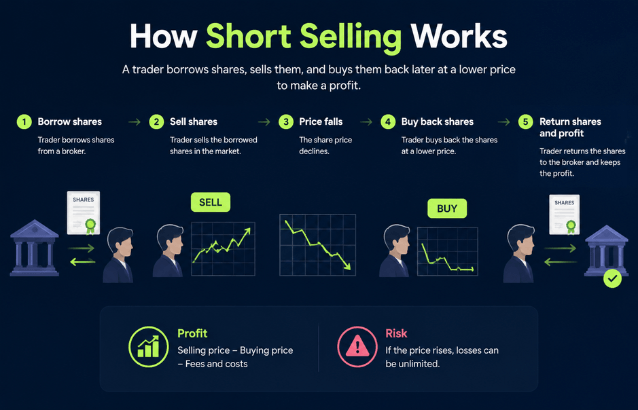
So, what is short selling? Short selling is a trading strategy where an investor borrows shares, sells them at the current market price, and attempts to buy them back later at a lower price. The difference between the selling price and the repurchase price represents the potential profit, after accounting for fees and borrowing costs.
For beginners, what does it mean to short a stock can seem confusing because traders sell shares they do not initially own. However, short selling is widely used by professional investors, hedge funds, and traders to speculate on falling prices, manage portfolio risks, and improve market efficiency.
In this guide, we will explain how short selling works, why traders short stocks, the risks involved, and what investors should know before opening a short position.
How Does Short Selling Work?
To understand what is short selling, it is important to understand the process behind it.
A typical short selling transaction involves four steps:
Borrow shares from a broker A trader borrows shares of a company through their broker.
Sell the borrowed shares The trader sells these shares in the market at the current price.
Wait for the price movement If the stock price falls as expected, the trader can buy the shares back at a lower price.
Return the shares The borrowed shares are returned to the broker, and the trader keeps the difference as potential profit.
For example, suppose a trader believes Company A is overvalued and its stock is trading at $100.
The trader shorts 10 shares:
Shares sold: 10 × $100 = $1,000
Stock price falls to $70
Shares bought back: 10 × $70 = $700
Potential profit: $300 before costs
However, if the stock price rises instead, the trader faces losses because they must buy back the shares at a higher price.
What Does It Mean to Short a Stock?
Many beginners search for what does it mean to short a stock because the concept is different from normal stock investing.
To short a stock means taking a bearish position by selling borrowed shares with the expectation that the share price will decline.
When investors buy a stock, they usually take a long position. They make money if the stock price rises. Short sellers do the opposite by attempting to benefit from a price decline.
For example:
A long investor buys a stock at $50 and hopes it rises to $70.
A short seller sells the stock at $50 and hopes to buy it back at $30.
The key difference is that traditional investors buy first and sell later, while short sellers sell first and buy later.
What Is Shorting a Stock and Why Do Traders Do It?
Another common question is what is shorting a stock? Shorting a stock is the process of using a short selling strategy on a specific company.
Traders may short stocks for several reasons:
Profit From Falling Prices
The main purpose of short selling is to potentially profit when a stock price declines.
Traders may decide to short a stock when they believe:
The company is overvalued
Earnings expectations are too optimistic
Business conditions are weakening
Market sentiment has become overly positive
Hedge Existing Investments
Short selling can also be used to manage portfolio risk.
For example, an investor holding many technology stocks may use short positions to reduce the impact of a potential market decline.
Express a Market View
Some traders short stocks because their research suggests that a company’s current valuation does not reflect its actual business performance.
How to Short a Stock
The process of shorting a stock usually requires access to a brokerage account that supports short positions.
The basic steps include:
1. Research the Market
Traders analyse company fundamentals, technical indicators, and broader market conditions before opening a short position.
2. Find Shares Available to Borrow
The broker must have shares available for borrowing before a short trade can be opened.
3. Open a Short Position
The trader sells the borrowed shares and monitors the position.
4. Close the Trade
If the stock price falls, the trader buys back the shares at a lower price. If the price rises, the trader may close the position at a loss.
Risks of Short Selling
Although short selling can provide opportunities in falling markets, it also carries significant risks.
Unlimited Loss Potential
One of the biggest risks of short selling is that losses can theoretically be unlimited.
When buying a stock, the maximum loss is usually limited to the amount invested because a share price cannot fall below zero. However, a stock price can continue rising, creating larger losses for short sellers.
Borrowing Costs
Short sellers may need to pay borrowing fees to maintain their positions. These costs can increase if many traders are shorting the same stock.
Short Squeeze Risk
A short squeeze happens when a heavily shorted stock rises sharply, forcing short sellers to buy shares back to close their positions.
This additional buying pressure can push prices even higher and increase losses for short sellers.
Traders often monitor short interest, which shows how many shares have been sold short but not yet covered, because high short interest can increase the possibility of a short squeeze.
One well-known example was GameStop in 2021, when heavy short interest contributed to extreme price movements and significant volatility.
Short Selling vs Buying Stocks
Buying Stocks
Short Selling
Market expectation
Price rises
Price falls
Position
Long
Short
Starting action
Buy shares
Sell borrowed shares
Profit comes from
Price increase
Price decrease
Main risk
Stock losing value
Stock price rising significantly
Can You Short a Stock Through CFDs?
Traditional short selling involves borrowing shares through a broker. However, some traders use derivative products such as Contracts for Difference (CFDs) to gain exposure to falling prices without owning the underlying asset.
With CFDs, traders can open a short position when they believe a market may decline. However, leverage can increase both potential gains and losses, so proper risk management is important.
Conclusion
Understanding what is short selling, what does it mean to short a stock, and what is shorting a stock helps traders understand how markets work during both rising and falling conditions.
Short selling gives traders another way to approach financial markets, but it requires careful research, disciplined risk management, and an understanding of market volatility. Whether used for speculation or hedging, short selling remains an important strategy in modern trading.
FAQs
What does it mean to short a stock?
To short a stock means selling borrowed shares because you expect the stock price to fall. The aim is to buy them back later at a lower price.
What is shorting a stock?
Shorting a stock is another term for short selling. It involves borrowing shares, selling them, and attempting to profit if the price decreases.
How does short selling work?
Short selling works by borrowing shares, selling them, and buying them back later. Traders profit when the repurchase price is lower than the original selling price.
Is short selling risky?
Yes. Short selling can involve significant risks because losses may increase if the stock price rises.
Why do investors short stocks?
Investors short stocks to potentially profit from falling prices, hedge investments, or identify companies they believe are overvalued.
What happens if a shorted stock goes up?
If a shorted stock rises, the trader loses money because they must buy back shares at a higher price.
Share Now
Disclaimer:This content is provided for informational purposes only and does not constitute, and should not be construed as, financial, investment, or other professional advice. No statement or opinion contained herein should be considered a recommendation by Ultima Markets or the author regarding any specific investment product, strategy, or transaction. Readers are advised not to rely solely on this material when making investment decisions and should seek independent advice where appropriate.
Thank you for visiting the Ultima Markets website. Please note that this website is intended for individuals residing in jurisdictions where access is permitted by law. Ultima and its affiliated entities do not operate in your home jurisdiction.
By clicking ‘Acknowledge’, you confirm that you are entering this website solely on your own initiative and not as a result of any specific marketing outreach. You wish to obtain information from this website based on reverse solicitation principles, in accordance with the applicable laws of your home jurisdiction.