This website is managed by Ultima Markets’ international entities, and it’s important to emphasise that they are not subject to regulation by the FCA in the UK. Therefore, you must understand that you will not have the FCA’s protection when investing through this website – for example:
You will not be guaranteed Negative Balance Protection
You will not be protected by FCA’s leverage restrictions
You will not have the right to settle disputes via the Financial Ombudsman Service (FOS)
You will not be protected by Financial Services Compensation Scheme (FSCS)
Any monies deposited will not be afforded the protection required under the FCA Client Assets Sourcebook. The level of protection for your funds will be determined by the regulations of the relevant local regulator.
Note: UK clients are kindly invited to visit https://www.ultima-markets.co.uk/. Ultima Markets UK expects to begin onboarding UK clients in accordance with FCA regulatory requirements in 2026.
If you would like to proceed and visit this website, you acknowledge and confirm the following:
1.The website is owned by Ultima Markets’ international entities and not by Ultima Markets UK Ltd, which is regulated by the FCA.
2.Ultima Markets Limited, or any of the Ultima Markets international entities, are neither based in the UK nor licensed by the FCA.
3.You are accessing the website at your own initiative and have not been solicited by Ultima Markets Limited in any way.
4.Investing through this website does not grant you the protections provided by the FCA.
5.Should you choose to invest through this website or with any of the international Ultima Markets entities, you will be subject to the rules and regulations of the relevant international regulatory authorities, not the FCA.
Ultima Markets wants to make it clear that we are duly licensed and authorised to offer the services and financial derivative products listed on our website. Individuals accessing this website and registering a trading account do so entirely of their own volition and without prior solicitation.
By confirming your decision to proceed with entering the website, you hereby affirm that this decision was solely initiated by you, and no solicitation has been made by any Ultima Markets entity.
Discover the megaphone pattern in trading. Learn how to identify it, read its signals and see breakout strategies. See why volatility matters in markets.
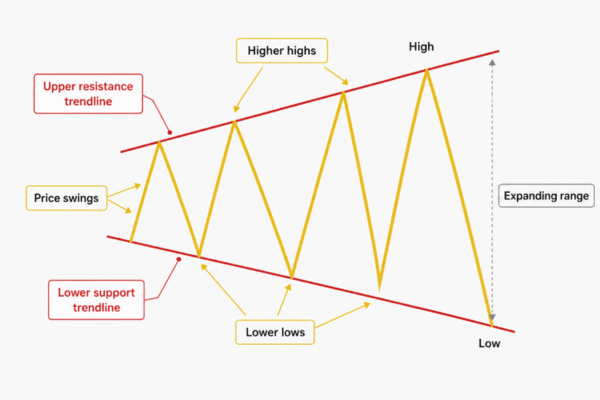
The megaphone pattern is a technical analysis chart pattern that appears when price swings become wider over time. Instead of moving in a clean trend or a narrowing range, the market starts making higher highs and lower lows. When these swing points are connected with two diverging trendlines, the structure looks like a megaphone.
Also known as a broadening formation, the megaphone pattern often reflects rising volatility and uncertainty. It shows that buyers and sellers are becoming more aggressive, but neither side has full control yet.
For traders, the pattern can be useful because it highlights a market that is becoming less stable. However, it should not be treated as a simple buy or sell signal. The megaphone pattern is best understood as a volatility warning first, while direction becomes clearer only after a confirmed breakout.
What Is a Megaphone Pattern?
A megaphone pattern forms when price action expands in both directions. The upper trendline slopes upward because each new swing high is higher than the previous one. The lower trendline slopes downward because each new swing low is lower than the last.
This creates a widening chart structure. It is the opposite of a triangle pattern, where price becomes compressed before a breakout. In a megaphone structure, volatility increases as the pattern develops.
Key Features of the Pattern
A typical megaphone pattern includes:
Feature
What It Means
Higher highs
Buyers are still pushing price upward
Lower lows
Sellers are becoming more aggressive
Diverging trendlines
The price range is expanding
Wider swings
Market volatility is increasing
Unclear direction
Neither buyers nor sellers have full control
Some traders look for at least five meaningful swing points before treating the formation as valid. This usually means several touches across both the upper and lower trendlines.
Why Does the Megaphone Pattern Form?
The megaphone pattern usually appears when the market strongly disagrees about an asset’s value. Buyers push prices to new highs, but sellers quickly respond and drive prices to new lows. Each move becomes larger than the previous one, creating a wider trading range.
Common Market Conditions
This pattern may form during periods of:
Earnings announcements
Economic data releases
Interest rate uncertainty
Political or geopolitical risk
Sudden changes in market sentiment
Low liquidity or emotional trading
In simple terms, the market is moving, but it is not moving with clean conviction. The widening structure shows instability, which is why traders often view the pattern as a warning sign.
How to Identify a Megaphone Pattern
To identify a megaphone pattern, look for price action that expands over time. The highs should rise, while the lows should fall. Then, draw one trendline across the swing highs and another across the swing lows.
If the two lines move away from each other, the chart may be forming a broadening structure.
Identification Checklist
A stronger setup usually has:
At least two higher highs
At least two lower lows
Two trendlines moving away from each other
Price moving between both sides of the pattern
Expanding volatility as the structure develops
A breakout or breakdown before directional bias is confirmed
Volume can also help. If volume rises as the swings become wider, it may support the idea that the pattern reflects stronger market participation. If volume is weak, traders may be more cautious about trusting the breakout.
Is the Megaphone Pattern Bullish or Bearish?
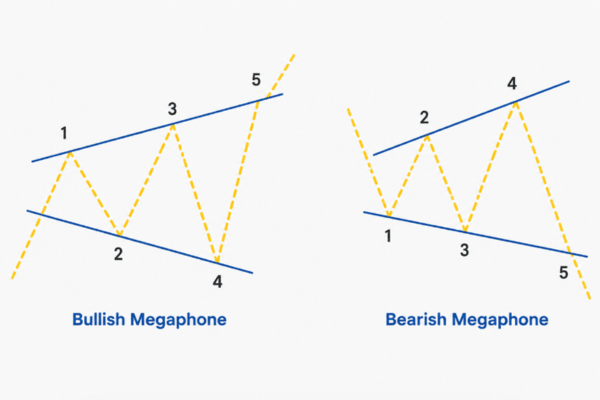
The megaphone pattern can be bullish or bearish, depending on where it appears and how price eventually breaks out.
A bullish signal may appear when price breaks above the upper trendline and holds above it. This suggests buyers may be gaining control after a period of uncertainty.
A bearish signal may appear when price breaks below the lower trendline and continues lower. This suggests sellers may be taking control and volatility is resolving to the downside.
Why Confirmation Matters
The pattern itself is not automatically bullish or bearish. This is one of the most important points for traders to understand.
A megaphone structure mainly tells traders that volatility is expanding. Direction only becomes clearer when price confirms a breakout. Traders may look for confirmation through:
A candle close outside the pattern
Higher volume during the breakout
A retest of the broken trendline
Support from other indicators
Alignment with the broader market trend
Without confirmation, the pattern can produce false signals.
How Traders Use the Megaphone Pattern
There are two common ways traders use the megaphone pattern: breakout trading and swing trading inside the pattern.
Breakout Approach
With the breakout approach, traders wait for price to move above the upper trendline or below the lower trendline. They may then look for a confirmed candle close before considering a trade.
An upside breakout may suggest bullish momentum, while a downside breakout may suggest bearish pressure. However, because this pattern is volatile, many traders wait for a retest before acting.
Swing Trading Approach
Some short-term traders use the pattern to trade between the boundaries. They may look for buying opportunities near the lower trendline and selling opportunities near the upper trendline.
This approach can be risky because each price swing may become larger than expected. Stop-loss placement is also more difficult because the range keeps expanding.
Target Calculation
A common way to estimate a target is to measure the widest part of the pattern, from the highest high to the lowest low. For an upside breakout, traders may add that distance to the breakout level. For a downside breakout, they may subtract it from the breakdown level.
However, full targets are not always reached. Many traders use partial targets, nearby support and resistance levels, or tighter position sizing to manage risk.
Reliability, Risks and Common Mistakes
The megaphone pattern can be useful, but it is not one of the easiest chart patterns to trade. Its main value is that it warns traders about expanding volatility and possible instability.
Historical chart-pattern research suggests that broadening formations often experience pullbacks, throwbacks, and failed breakouts. This means the first move outside the pattern may not always continue smoothly.
Common Mistakes to Avoid
Traders often make mistakes such as:
Entering before the breakout is confirmed
Assuming the pattern is always bearish
Ignoring the wider market trend
Using stops that are too tight
Overlooking volume
Taking positions that are too large for the volatility
A failed breakout happens when price moves outside the pattern but quickly returns inside the range. This is common because the market is already unstable while the pattern is forming.
Megaphone Pattern vs Triangle Pattern
Pattern
Structure
Market Message
Megaphone pattern
Expanding highs and lows
Volatility is increasing
Triangle pattern
Narrowing highs and lows
Volatility is compressing
This difference matters. A triangle often shows consolidation before a breakout, while a megaphone pattern shows growing disagreement and wider price movement.
Conclusion
The megaphone pattern is a chart formation that shows expanding volatility, higher highs, and lower lows. It reflects disagreement between buyers and sellers and often appears during uncertain market conditions.
While the pattern can lead to bullish or bearish breakouts, it should not be used as a standalone signal. Traders should wait for confirmation, check volume, analyse the wider trend, and manage risk carefully.
In simple terms, the megaphone pattern tells you that the market is becoming less stable. The opportunity may come later, but the first message is caution.
FAQs
What does the megaphone pattern mean?
It means price volatility is expanding. The market is making higher highs and lower lows, which shows uncertainty.
Is the megaphone pattern bullish?
It can be bullish if price breaks above the upper trendline and confirms the move.
Is the megaphone pattern bearish?
It can be bearish if price breaks below the lower trendline and continues lower.
Share Now
Disclaimer:This content is provided for informational purposes only and does not constitute, and should not be construed as, financial, investment, or other professional advice. No statement or opinion contained herein should be considered a recommendation by Ultima Markets or the author regarding any specific investment product, strategy, or transaction. Readers are advised not to rely solely on this material when making investment decisions and should seek independent advice where appropriate.
Thank you for visiting the Ultima Markets website. Please note that this website is intended for individuals residing in jurisdictions where access is permitted by law. Ultima and its affiliated entities do not operate in your home jurisdiction.
By clicking ‘Acknowledge’, you confirm that you are entering this website solely on your own initiative and not as a result of any specific marketing outreach. You wish to obtain information from this website based on reverse solicitation principles, in accordance with the applicable laws of your home jurisdiction.