This website is managed by Ultima Markets’ international entities, and it’s important to emphasise that they are not subject to regulation by the FCA in the UK. Therefore, you must understand that you will not have the FCA’s protection when investing through this website – for example:
You will not be guaranteed Negative Balance Protection
You will not be protected by FCA’s leverage restrictions
You will not have the right to settle disputes via the Financial Ombudsman Service (FOS)
You will not be protected by Financial Services Compensation Scheme (FSCS)
Any monies deposited will not be afforded the protection required under the FCA Client Assets Sourcebook. The level of protection for your funds will be determined by the regulations of the relevant local regulator.
Note: UK clients are kindly invited to visit https://www.ultima-markets.co.uk/. Ultima Markets UK expects to begin onboarding UK clients in accordance with FCA regulatory requirements in 2026.
If you would like to proceed and visit this website, you acknowledge and confirm the following:
1.The website is owned by Ultima Markets’ international entities and not by Ultima Markets UK Ltd, which is regulated by the FCA.
2.Ultima Markets Limited, or any of the Ultima Markets international entities, are neither based in the UK nor licensed by the FCA.
3.You are accessing the website at your own initiative and have not been solicited by Ultima Markets Limited in any way.
4.Investing through this website does not grant you the protections provided by the FCA.
5.Should you choose to invest through this website or with any of the international Ultima Markets entities, you will be subject to the rules and regulations of the relevant international regulatory authorities, not the FCA.
Ultima Markets wants to make it clear that we are duly licensed and authorised to offer the services and financial derivative products listed on our website. Individuals accessing this website and registering a trading account do so entirely of their own volition and without prior solicitation.
By confirming your decision to proceed with entering the website, you hereby affirm that this decision was solely initiated by you, and no solicitation has been made by any Ultima Markets entity.
Robotaxi stock is becoming a major autonomous vehicle theme. See how Tesla, Waymo and Zoox compare, the analyst sentiment and the stock price outlook.
Robotaxis have quickly moved from a futuristic concept into one of the most talked-about themes in the autonomous vehicle market. As more companies test and launch self-driving ride-hailing services, investors are paying closer attention to the stocks connected to this fast-changing industry.
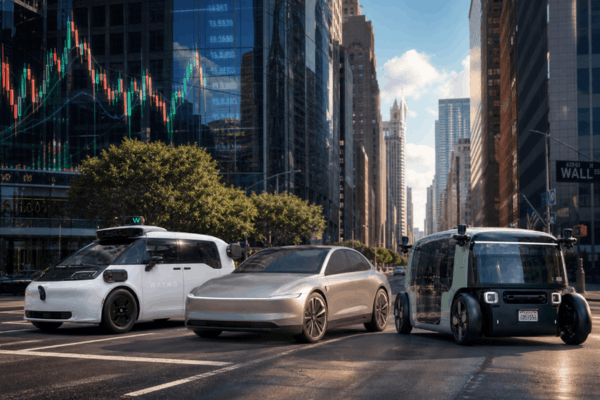
For those searching for robotaxi stock, the opportunity is not limited to one company. Tesla, Alphabet’s Waymo and Amazon’s Zoox are among the most closely watched leaders, while names such as Uber and Nvidia are also gaining attention through ride-hailing partnerships and autonomous driving technology.
The key question for investors is not only which company can build the best self-driving vehicle. It is also which business can scale safely, meet regulatory requirements, control costs and turn robotaxi services into a profitable model.
What Is A Robotaxi?
A robotaxi is a self-driving taxi or autonomous vehicle that can transport passengers without a human driver behind the wheel. These vehicles use a mix of cameras, sensors, artificial intelligence, mapping systems and real-time data to navigate roads and complete journeys.
In simple terms, robotaxis are designed to work like ride-hailing services, but without a human driver. A passenger books a ride through an app, enters the vehicle and travels to the destination while the autonomous system controls the driving.
This is why robotaxis are often discussed alongside autonomous vehicle technology. They are not only a new form of transport, but also a potential business model for companies that can operate large self-driving fleets safely and efficiently.
Why Robotaxi Stocks Are Getting More Attention
The interest in robotaxi stock is growing because the potential market is large. Goldman Sachs Research projects the global robotaxi market could reach about $415 billion by 2035, with the US market estimated at $48 billion.
That is why investors are watching this space closely. Robotaxis could reshape ride-hailing, taxi services, fleet operations and even parts of private car ownership. However, the market is still early. Commercial rollouts remain limited, regulation varies by city and profitability is not yet proven at scale.
Tesla Robotaxi Stock
Tesla is the name most investors associate with robotaxi stock. The company is led by Elon Musk, who has served as Tesla’s chief executive officer since October 2008.
Tesla’s robotaxi story is built around Full Self-Driving, its large installed vehicle base and the future Cybercab. In its Q1 2026 update, Tesla said paid robotaxi miles nearly doubled sequentially, Austin’s unsupervised operating area expanded, and unsupervised rides launched in Dallas and Houston. The company also said Cybercab is expected to replace the current Model Y-based fleet over time.
That gives Tesla the most direct robotaxi upside. If the company proves that it can safely scale driverless rides across major cities, the stock could receive a larger autonomy premium. The challenge is that this premium is already a major part of the TSLA debate.
Analyst sentiment reflects that tension. MarketBeat shows Tesla with a Hold consensus rating from 41 analysts, with an average 12-month price target of about $398.42. Reuters has also reported that several Wall Street analysts viewed Tesla’s robotaxi rollout as slower than expected, with Musk taking a more cautious tone around safety and technical hurdles.
For Tesla stock moving forward, the key issue is execution. Faster robotaxi expansion could support the share price, while delays, investigations or weak utilisation could reduce confidence in the autonomy story.
Waymo Stock Exposure Through Alphabet
Waymo may be the strongest robotaxi business today, even though there is no separate Waymo stock. Waymo began as Google’s self-driving car project and was later established under Alphabet as a self-driving technology company.
The operating data is what makes Waymo stand out. Alphabet said Waymo has surpassed 500,000 fully autonomous rides per week, doubled ride volume in less than a year and now operates in 11 major US cities. Waymo’s own safety data also says it had driven 170.7 million rider-only miles through December 2025, with materially fewer serious injury, airbag deployment and injury-causing crashes than human-driving benchmarks.
For investors, the downside is that Alphabet is not a pure robotaxi stock. Search, YouTube, Google Cloud, AI spending and advertising still drive most of Alphabet’s valuation. Waymo may become a major value driver, but it remains only one part of a much larger company.
Analyst sentiment on Alphabet is more constructive than Tesla. MarketBeat shows GOOGL with a Moderate Buy consensus rating and an average 12-month price target of $397.48.
The stock price outlook for Alphabet is therefore more balanced. Waymo gives GOOGL long-term robotaxi upside, but Alphabet shares will still move mainly on Google’s core earnings unless Waymo becomes large enough to materially change group profits.
Zoox Stock Exposure Through Amazon
Zoox is the third major leader in the robotaxi race. Amazon acquired Zoox in 2020 to support its vision of autonomous ride-hailing, with Zoox CEO Aicha Evans and co-founder Jesse Levinson continuing to lead the business.
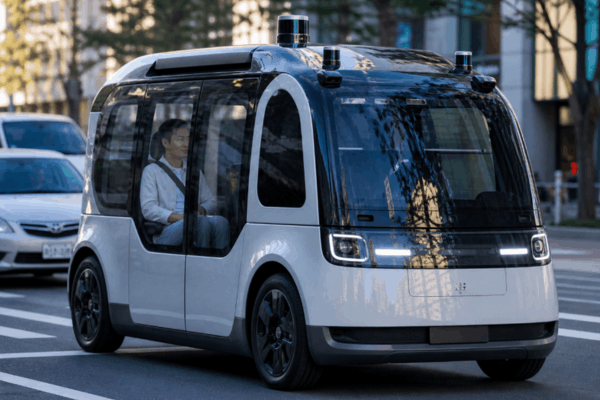
Zoox is different from Tesla and Waymo because it is building a purpose-built robotaxi, not adapting a traditional passenger car. Its vehicle has no steering wheel or pedals, which makes the design exciting but also increases the importance of regulatory approval.
Reuters reported that Zoox is expanding in San Francisco and Las Vegas, while testing in Austin and Miami. The company has logged nearly 2 million autonomous miles and served more than 350,000 riders. Regulators are also reviewing Zoox’s petition to deploy up to 2,500 robotaxis without traditional human controls.
For Amazon investors, Zoox is a long-term option rather than a near-term stock driver. AMZN still depends much more on AWS, advertising, retail margins and AI infrastructure. MarketBeat shows Amazon with a Moderate Buy consensus rating and an average target price of $310.25.
Beyond Tesla, Waymo and Zoox
The robotaxi stock theme is broader than the big three. Uber is building an aggregator model, partnering with autonomous vehicle developers rather than relying on one in-house system. Reuters reported that Uber plans to facilitate robotaxi trips in up to 15 cities globally by the end of 2026.
Nvidia is another important name because it supplies autonomous driving technology rather than operating robotaxis directly. Its Alpamayo platform includes AI models, simulation tools and datasets designed for autonomous vehicle development.
Investors who prefer a basket approach can also look at thematic funds. Roundhill’s CABZ Robotaxi, Autonomous Vehicles & Technology ETF began trading in January 2026 and has a gross expense ratio of 0.59%.
Robotaxi Stock Price Outlook
Robotaxi stock prices will likely move in three stages.
In the bull case, robotaxi networks scale quickly, safety data remains strong, regulators approve more cities and cost per mile falls. Tesla would probably benefit most because its valuation is closely tied to autonomy. Alphabet could gain a larger Waymo premium, while Amazon may receive more recognition for Zoox.
In the base case, progress continues city by city. Waymo expands steadily, Tesla ramps cautiously and Zoox works through regulatory approvals. In this scenario, robotaxi news supports the stocks but does not dominate every earnings cycle.
In the bear case, safety incidents, slow adoption, high capex or regulatory restrictions damage confidence. Tesla would be the most exposed because it is the most direct robotaxi stock. Alphabet and Amazon would be more insulated because their core businesses are larger and more diversified.
Conclusion
The best robotaxi stock depends on investor risk appetite. Tesla offers the most direct upside, but also the most volatility. Alphabet owns Waymo, the current commercial leader, but Waymo is only one part of the wider Google business. Amazon owns Zoox, a bold purpose-built robotaxi platform, but Zoox is still a long-term option inside AMZN.
For investors, the smarter question is not simply “which robotaxi stock will win?” It is: which company has the best mix of technology, safety, scale, regulation and valuation support?
FAQs
What is the best robotaxi stock?
Tesla is the most direct robotaxi stock, while Alphabet offers exposure to Waymo, the current operating leader.
Are robotaxi stocks risky?
Yes. Key risks include safety, regulation, slow rollout, high spending and uncertain profitability.
Share Now
Disclaimer:This content is provided for informational purposes only and does not constitute, and should not be construed as, financial, investment, or other professional advice. No statement or opinion contained herein should be considered a recommendation by Ultima Markets or the author regarding any specific investment product, strategy, or transaction. Readers are advised not to rely solely on this material when making investment decisions and should seek independent advice where appropriate.
Thank you for visiting the Ultima Markets website. Please note that this website is intended for individuals residing in jurisdictions where access is permitted by law. Ultima and its affiliated entities do not operate in your home jurisdiction.
By clicking ‘Acknowledge’, you confirm that you are entering this website solely on your own initiative and not as a result of any specific marketing outreach. You wish to obtain information from this website based on reverse solicitation principles, in accordance with the applicable laws of your home jurisdiction.