This website is managed by Ultima Markets’ international entities, and it’s important to emphasise that they are not subject to regulation by the FCA in the UK. Therefore, you must understand that you will not have the FCA’s protection when investing through this website – for example:
You will not be guaranteed Negative Balance Protection
You will not be protected by FCA’s leverage restrictions
You will not have the right to settle disputes via the Financial Ombudsman Service (FOS)
You will not be protected by Financial Services Compensation Scheme (FSCS)
Any monies deposited will not be afforded the protection required under the FCA Client Assets Sourcebook. The level of protection for your funds will be determined by the regulations of the relevant local regulator.
Note: UK clients are kindly invited to visit https://www.ultima-markets.co.uk/. Ultima Markets UK expects to begin onboarding UK clients in accordance with FCA regulatory requirements in 2026.
If you would like to proceed and visit this website, you acknowledge and confirm the following:
1.The website is owned by Ultima Markets’ international entities and not by Ultima Markets UK Ltd, which is regulated by the FCA.
2.Ultima Markets Limited, or any of the Ultima Markets international entities, are neither based in the UK nor licensed by the FCA.
3.You are accessing the website at your own initiative and have not been solicited by Ultima Markets Limited in any way.
4.Investing through this website does not grant you the protections provided by the FCA.
5.Should you choose to invest through this website or with any of the international Ultima Markets entities, you will be subject to the rules and regulations of the relevant international regulatory authorities, not the FCA.
Ultima Markets wants to make it clear that we are duly licensed and authorised to offer the services and financial derivative products listed on our website. Individuals accessing this website and registering a trading account do so entirely of their own volition and without prior solicitation.
By confirming your decision to proceed with entering the website, you hereby affirm that this decision was solely initiated by you, and no solicitation has been made by any Ultima Markets entity.
Ultima Markets does not have an establishment in Singapore and does not operate from Singapore.
Ultima Markets does not provide products or services to citizens or residents of Singapore, and account applications from Singapore citizens or residents will not be accepted.
If you are a citizen or resident of Singapore, please do not open an account or use Ultima Markets’ products or services.
By selecting “Acknowledge and Continue Browsing”, you confirm that you are accessing this website on your own initiative and that your access is not the result of any direct marketing, targeted advertising, solicitation, or promotional activity by Ultima Markets.
Nothing on this website constitutes an offer, solicitation, or promotion of products or services in any jurisdiction where such activity is prohibited. You are responsible for ensuring that your access to and use of this website complies with applicable local laws and regulations.
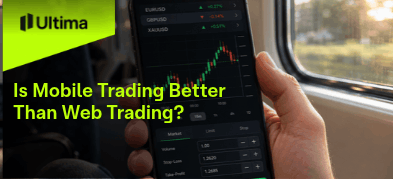
Learn about mobile trading, its popularity, benefits and risks, and how it compares with desktop platforms to find a setup that suits your trading style.
Mobile trading has made financial markets easier to access. A smartphone can put charts, account balances and order controls within reach, allowing traders to manage positions without sitting at a computer.
But does greater convenience lead to better trading? The answer depends on your strategy, the platform’s capabilities and how you respond to constant market access.
This guide examines how popular mobile trading has become, where it outperforms other methods and when a desktop setup makes more sense.
What Is Mobile Trading?
Mobile trading means buying, selling and managing financial instruments through a smartphone or tablet, usually using a broker’s app or a platform such as MetaTrader.
Depending on the provider, an app may offer shares, exchange-traded funds, forex or derivatives such as contracts for difference (CFDs). Check the product carefully: buying a share and trading a share CFD involve different ownership rights, costs and risks.
The phone is the interface used to send instructions. It does not change the underlying instrument or remove its risks. Access also remains subject to trading hours and the broker’s available markets.
Is Mobile Trading Popular?
Yes, although adoption differs across markets and age groups.
The FINRA Foundation’s December 2025 investor report, using 2024 US survey data, found that 46% of investors used mobile apps to execute trades, compared with 30% in 2018. Websites remained more widely used at 62%.
Mobile usage reached 80% among investors under 35, compared with 19% among those aged 55 and older. Respondents could use several methods, so these figures represent overlapping users, rather than shares of trading volume.
Hong Kong offers another example. The Investor and Financial Education Council’s Retail Investor Study 2025, published in February 2026, found that 65% of surveyed stock investors used securities brokerage apps most often, up from 28% in 2023. This measure excludes bank apps.
These studies establish that mobile access is mainstream in the markets surveyed. They do not establish a single global adoption rate, and their different questions mean the percentages should not be compared directly.
Why Do Traders Choose Mobile Apps?
Access Away From the Desk
A phone allows traders to check exposure or manage an existing position while away from their workstation. For someone balancing trading with a full-time job, that flexibility can be valuable.
Consider a swing trader holding a position for several days. Research might happen on a laptop, while a mobile app provides account access between scheduled reviews. There is no need to recreate the entire research process every time the account is checked.
Alerts and Convenient Controls
Price alerts can direct attention to a level identified in advance. Used selectively, they can reduce the temptation to watch every market movement.
Mobile apps can also be technically sophisticated. Interactive Brokers, for example, documents advanced order types and options tools on its mobile platform. The relevant comparison is the functionality of each platform version, rather than an assumption that every phone app offers only basic trading.
Mobile Trading vs Desktop and Web Trading
Mobile and desktop describe devices, while web trading describes browser access. A web platform can run on a computer or phone, so these categories overlap.
The following comparison is a practical guide. Individual platforms may differ substantially.
Trading task
Mobile app
Installed desktop platform
Browser platform on a computer
Checking positions away from home
Convenient
Requires a portable computer or remote access
Requires computer access
Comparing several charts
Limited by screen space
More room for charts and windows
Useful if layouts support it
Reviewing orders
Touch controls require careful checking
Larger order tickets and keyboard access
Depends on the interface
Custom tools and automation
Check app-specific support
Check strategy and software support
Check browser-specific support
Getting started
Requires app installation
Requires installation and a compatible system
Usually accessed through a supported browser
For detailed analysis, a larger screen can make it easier to compare timeframes, read news and review exposure together. Mobile access is particularly useful for monitoring and carrying out a plan already prepared.
Neither device guarantees better execution. Connection quality, broker infrastructure, liquidity and market conditions also matter. A fast phone cannot ensure an order fills at the price displayed.
Does Mobile Trading Improve Returns?
Popularity and convenience do not establish a performance advantage. Behavioural research gives reasons to treat constant access carefully.
In the December 2024 version of Smart(Phone) Investing?, researchers examining transaction data from two German banks found that smartphone use increased purchases of riskier, lottery-like and less diversified assets.
Smartphone purchases also delivered lower returns and reduced portfolio Sharpe ratios, a measure of returns relative to risk. These findings concern the investors and period studied; they do not mean every mobile trader will underperform.
App design can also influence behaviour. In a 2024 experiment involving more than 9,000 consumers, the UK Financial Conduct Authority found that digital engagement features, including push notifications and points with prize draws, could increase trading frequency and risk-taking.
The practical distinction is between an alert supporting your plan and a prompt encouraging another trade. A notification that a researched price level has been reached serves a different purpose from a message promoting a trending asset.
Before acting, ask whether the trade would still make sense without the notification.
Which Trading Method Suits Your Strategy?
Occasional investors and swing traders: Mobile access may be sufficient for straightforward transactions and position checks, provided research and order review remain thorough.
Active day traders: A desktop setup can be more practical when the strategy requires several charts, rapid order changes and sustained concentration. A phone may serve as an additional access route.
Traders using automation: Verify where the strategy actually runs. A mobile dashboard that displays automated positions does not necessarily execute the trading software itself.
Beginners: Choose the environment in which you can understand the product, calculate exposure and review an order without rushing. An intuitive interface does not make a complex instrument easier to value.
For traders who need detailed analysis and access while travelling, using both devices is a reasonable workflow. This is a practical recommendation, rather than evidence that combining devices increases returns.
How to Use Mobile Trading More Effectively
Start by testing the complete process on a demo account: finding an instrument, choosing an order type, setting the position size and reviewing or closing the trade. Practise correcting an entry before submitting it.
Before choosing an app, check:
Provider and product: Verify the legal entity, relevant regulatory status and instruments offered.
Costs: Compare spreads, commissions, financing charges and currency conversion where applicable.
Controls: Confirm the order types and risk tools available on mobile.
Security: Use an official download source, a unique password and multifactor authentication where available.
Backup access: Know how to reach the account if the phone is unavailable.
Prepare entries, exits and position sizes before opening the order ticket. Turn off promotional notifications that distract from the plan, and record the reason for each trade in a trading journal.
Also check what happens when the app disconnects. MetaTrader 5 documentation states that stop-loss and take-profit instructions are stored and executed on the broker’s server, while its trailing stop runs in the trading platform. Do not assume every automated feature continues operating when a device is off.
Conclusion
Mobile trading offers a clear advantage in portability. Desktop trading offers more working space for detailed analysis and strategies requiring several tools at once.
The better choice is the setup that lets you follow your strategy consistently. Use mobile access where it improves control, and assess its value by the quality of your decisions, rather than how often it allows you to trade.
FAQ
Is Mobile Trading Good for Beginners?
It can be accessible, but beginners still need to understand order types, costs and risk. Practise on a demo account before committing money.
Can You Day Trade on a Phone?
Yes, if the platform supports it. Strategies requiring several charts and frequent order changes may be more practical on a computer.
Is Mobile Trading Cheaper Than Desktop Trading?
Not automatically. Compare the provider’s account terms and charges for each channel rather than assuming the device determines the cost.
Share Now
Disclaimer:This content is provided for informational purposes only and does not constitute, and should not be construed as, financial, investment, or other professional advice. No statement or opinion contained herein should be considered a recommendation by Ultima Markets or the author regarding any specific investment product, strategy, or transaction. Readers are advised not to rely solely on this material when making investment decisions and should seek independent advice where appropriate.
Thank you for visiting the Ultima Markets website. Please note that this website is intended for individuals residing in jurisdictions where access is permitted by law. Ultima and its affiliated entities do not operate in your home jurisdiction.
By clicking ‘Acknowledge’, you confirm that you are entering this website solely on your own initiative and not as a result of any specific marketing outreach. You wish to obtain information from this website based on reverse solicitation principles, in accordance with the applicable laws of your home jurisdiction.