This website is managed by Ultima Markets’ international entities, and it’s important to emphasise that they are not subject to regulation by the FCA in the UK. Therefore, you must understand that you will not have the FCA’s protection when investing through this website – for example:
You will not be guaranteed Negative Balance Protection
You will not be protected by FCA’s leverage restrictions
You will not have the right to settle disputes via the Financial Ombudsman Service (FOS)
You will not be protected by Financial Services Compensation Scheme (FSCS)
Any monies deposited will not be afforded the protection required under the FCA Client Assets Sourcebook. The level of protection for your funds will be determined by the regulations of the relevant local regulator.
Note: UK clients are kindly invited to visit https://www.ultima-markets.co.uk/. Ultima Markets UK expects to begin onboarding UK clients in accordance with FCA regulatory requirements in 2026.
If you would like to proceed and visit this website, you acknowledge and confirm the following:
1.The website is owned by Ultima Markets’ international entities and not by Ultima Markets UK Ltd, which is regulated by the FCA.
2.Ultima Markets Limited, or any of the Ultima Markets international entities, are neither based in the UK nor licensed by the FCA.
3.You are accessing the website at your own initiative and have not been solicited by Ultima Markets Limited in any way.
4.Investing through this website does not grant you the protections provided by the FCA.
5.Should you choose to invest through this website or with any of the international Ultima Markets entities, you will be subject to the rules and regulations of the relevant international regulatory authorities, not the FCA.
Ultima Markets wants to make it clear that we are duly licensed and authorised to offer the services and financial derivative products listed on our website. Individuals accessing this website and registering a trading account do so entirely of their own volition and without prior solicitation.
By confirming your decision to proceed with entering the website, you hereby affirm that this decision was solely initiated by you, and no solicitation has been made by any Ultima Markets entity.
Ultima Markets does not have an establishment in Singapore and does not operate from Singapore.
Ultima Markets does not provide products or services to citizens or residents of Singapore, and account applications from Singapore citizens or residents will not be accepted.
If you are a citizen or resident of Singapore, please do not open an account or use Ultima Markets’ products or services.
By selecting “Acknowledge and Continue Browsing”, you confirm that you are accessing this website on your own initiative and that your access is not the result of any direct marketing, targeted advertising, solicitation, or promotional activity by Ultima Markets.
Nothing on this website constitutes an offer, solicitation, or promotion of products or services in any jurisdiction where such activity is prohibited. You are responsible for ensuring that your access to and use of this website complies with applicable local laws and regulations.
Explore the Iraqi Dinar to USD forecast 2025-2027, including key trading insights, exchange rate stability and forex trading strategies.
Iraqi Dinar to USD Forecast
The Iraqi Dinar (IQD) is expected to remain relatively stable against the US Dollar (USD) through 2025. The exchange rate is likely to stay within the range of IQD 1,307 to 1,318 per USD, based on Iraq’s oil revenues, the Central Bank of Iraq’s managed exchange rate policy, and geopolitical factors.
Why this matters
The IQD is pegged to the USD via a managed exchange rate system, with limited fluctuations in the short term. Despite the managed peg, various economic, geopolitical, and monetary factors can still affect the exchange rate. By forecasting the performance of the Iraqi Dinar, we help traders understand potential risks and opportunities in the market.
How will the Iraqi Dinar perform in 2026 and 2027
In 2026, the exchange rate for IQD/USD could slightly appreciate or depreciate, with projections ranging between IQD 1,300 and 1,330 per USD. By 2027, a more significant change could occur, with rates potentially fluctuating between IQD 1,280 and 1,350 per USD, depending on Iraq’s oil sector performance and political reforms.
Current Rate & Recent Performance
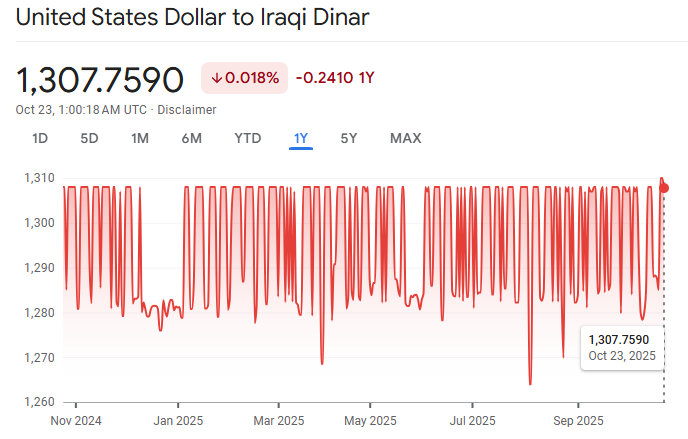
USD to IQD exchange rate as of October 23, 2025, at 1,307.7590. The data indicates a slight decline of 0.018% over the past year, with minor fluctuations in the exchange rate, as seen in the chart’s volatility.
Exchange Rate Stability: The IQD appears to be maintaining a stable range, staying between 1,270–1,310 IQD per USD over the past year, with periodic spikes and dips.
Low Volatility: The fluctuations are relatively minor, which indicates that the rate is likely influenced by managed policies from the Central Bank of Iraq, rather than dramatic market forces.
Current Rate: As of the latest data point, 1,307.7590 IQD per USD is the prevailing exchange rate, highlighting the continued stability of the IQD.
What Drives the IQD/USD Exchange Rate?
Understanding the forecast means understanding the levers behind IQD value.
Oil Revenues and Government Budget
Iraq’s economy remains heavily oil-dependent: crude oil exports account for over 90% of export revenues. Higher oil production, higher global oil prices and effective revenue management strengthen foreign reserve levels and may support a stronger IQD (or a stable peg). Conversely, a drop in oil prices or production disruptions weaken the fiscal position, reducing FX reserves and putting pressure on the IQD.
Central Bank Policy & Exchange Rate Regime
The Central Bank of Iraq maintains a managed exchange rate rather than allowing full floating. That reduces volatility but also caps large revaluation. Monetary policy, foreign reserve levels, and the CBI’s ability to defend the IQD are therefore key.
Political Stability, Reforms and External Pressures
Political instability, corruption and security issues remain major risks in Iraq. These affect investor confidence and currency stability. External factors like sanctions, banking restrictions, dollar‐liquidity issues. For instance, in February 2025, five Iraqi banks were banned from USD transactions to curb money-laundering. Economic diversification and institutional reforms (e.g., digital payments, improved banking oversight) can gradually improve the outlook.
Liquidity & Market Accessibility
The IQD is thinly traded in global forex markets. Liquidity is limited, which raises risk for speculative flows. Many “dinar revaluation” narratives come from speculative forums rather than credible economic backing. The understanding of this risk is critical.
Investment & Trading Implications
When considering the Iraqi Dinar (IQD) to USD exchange rate, several key factors come into play that affect both short-term trading and long-term investment. Given the managed nature of the IQD exchange rate by the Central Bank of Iraq (CBI), there are unique opportunities and risks for traders and investors.
Low Volatility & Stable Range: The IQD is not a highly volatile currency. As shown in the recent chart, the exchange rate remains fairly stable, fluctuating between 1,270 and 1,310 IQD per USD over the past year. Forex traders who prefer trading in stable, low-volatility markets may find the IQD appealing for range-bound trading strategies.
Managed Exchange Rate: The CBI’s policy of maintaining a fixed exchange rate, rather than allowing the IQD to float freely, provides a stable trading environment. However, this also means that large price swings or sudden shifts in the exchange rate are unlikely without significant external shocks (e.g., drastic oil price changes or political instability).
Risk of Speculation: Traders looking for quick gains based on major currency swings should exercise caution. The IQD is not typically subject to significant speculative-driven movements like more liquid currencies. Therefore, attempting to capitalize on minor fluctuations could involve unnecessary risk due to lower market liquidity.
Liquidity Considerations: The IQD is less liquid than major currencies, which could result in wider spreads for forex traders. This means the cost of executing trades could be higher, especially for larger positions, making it a less efficient currency for high-frequency or large-scale trades.
Key Risks for Both Traders and Investors
Oil Price Fluctuations: As Iraq’s economy is heavily reliant on oil exports, any global changes in oil prices can have an immediate effect on the IQD’s strength. A fall in oil prices could place significant downward pressure on the Dinar, while higher oil prices can provide support for the currency.
Political and Security Risks: Iraq continues to face challenges from political instability, regional conflicts, and issues of governance. Any escalation in conflicts or internal strife could undermine investor confidence, resulting in a sell-off in the currency and a weakening of the IQD.
Central Bank Policies: The Central Bank of Iraq’s intervention plays a major role in determining the value of the IQD. While the CBI aims for stability, any sudden changes in monetary policy, such as tightening or loosening the currency peg, could impact exchange rate stability and create unexpected volatility.
Liquidity Issues: The lack of a robust foreign exchange market for the IQD means that liquidity can be limited, making it challenging for large investors or traders to enter or exit positions without facing slippage or wider spreads.
Conclusion
The Iraqi Dinar (IQD) offers a unique trading opportunity for forex traders seeking a low-volatility, stable currency with a managed exchange rate. Based on the current exchange rate and market dynamics, the USD/IQD pair is expected to remain in a stable range between 1,307 and 1,318 IQD per USD through 2025, with minimal fluctuations.
In summary, the IQD is a stable currency suitable for low-risk, range-bound trading strategies. Forex traders should focus on managing risks due to liquidity constraints and take advantage of small fluctuations in the exchange rate. As long as Iraq’s political and economic situation remains stable, there are opportunities for traders who are disciplined in their approach and able to navigate the forex market’s unique challenges with the IQD.
FAQs
What is the future prediction for Iraqi dinar?
The future of the Iraqi dinar is uncertain, with factors like political stability, oil prices, and economic reforms influencing its value. Predictions vary, but many experts expect gradual improvement if Iraq stabilizes and diversifies its economy.
Will the dinar revalue in 2026?
No credible economic sources or official institutions have confirmed a planned revaluation of the Iraqi dinar in 2026. The Central Bank of Iraq has stated it does not intend to change the exchange rate, and forecasts project only minor fluctuation around the current rate rather than a major revaluation.
What is the future of the Iraqi economy?
The future of the Iraqi economy depends on its ability to diversify away from oil dependency, improve political stability, and attract foreign investment. Economic growth is possible with successful reforms, but challenges remain.
Share Now
Disclaimer:This content is provided for informational purposes only and does not constitute, and should not be construed as, financial, investment, or other professional advice. No statement or opinion contained herein should be considered a recommendation by Ultima Markets or the author regarding any specific investment product, strategy, or transaction. Readers are advised not to rely solely on this material when making investment decisions and should seek independent advice where appropriate.
Thank you for visiting the Ultima Markets website. Please note that this website is intended for individuals residing in jurisdictions where access is permitted by law. Ultima and its affiliated entities do not operate in your home jurisdiction.
By clicking ‘Acknowledge’, you confirm that you are entering this website solely on your own initiative and not as a result of any specific marketing outreach. You wish to obtain information from this website based on reverse solicitation principles, in accordance with the applicable laws of your home jurisdiction.