This website is managed by Ultima Markets’ international entities, and it’s important to emphasise that they are not subject to regulation by the FCA in the UK. Therefore, you must understand that you will not have the FCA’s protection when investing through this website – for example:
You will not be guaranteed Negative Balance Protection
You will not be protected by FCA’s leverage restrictions
You will not have the right to settle disputes via the Financial Ombudsman Service (FOS)
You will not be protected by Financial Services Compensation Scheme (FSCS)
Any monies deposited will not be afforded the protection required under the FCA Client Assets Sourcebook. The level of protection for your funds will be determined by the regulations of the relevant local regulator.
Note: UK clients are kindly invited to visit https://www.ultima-markets.co.uk/. Ultima Markets UK expects to begin onboarding UK clients in accordance with FCA regulatory requirements in 2026.
If you would like to proceed and visit this website, you acknowledge and confirm the following:
1.The website is owned by Ultima Markets’ international entities and not by Ultima Markets UK Ltd, which is regulated by the FCA.
2.Ultima Markets Limited, or any of the Ultima Markets international entities, are neither based in the UK nor licensed by the FCA.
3.You are accessing the website at your own initiative and have not been solicited by Ultima Markets Limited in any way.
4.Investing through this website does not grant you the protections provided by the FCA.
5.Should you choose to invest through this website or with any of the international Ultima Markets entities, you will be subject to the rules and regulations of the relevant international regulatory authorities, not the FCA.
Ultima Markets wants to make it clear that we are duly licensed and authorised to offer the services and financial derivative products listed on our website. Individuals accessing this website and registering a trading account do so entirely of their own volition and without prior solicitation.
By confirming your decision to proceed with entering the website, you hereby affirm that this decision was solely initiated by you, and no solicitation has been made by any Ultima Markets entity.
What's the difference between index funds vs mutual funds? Compare fees, performance, taxes and trading style so you can choose the right fund for 2026.
Index Funds vs Mutual Funds Explained
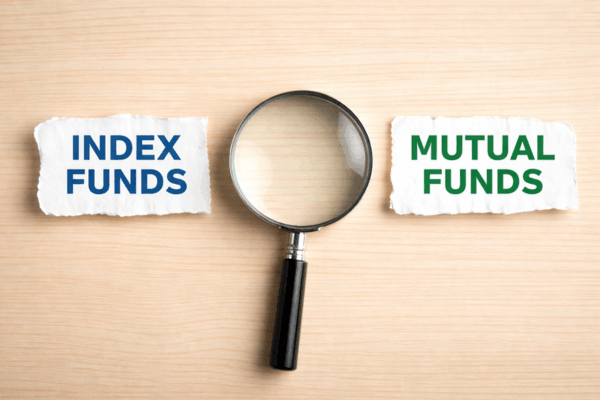
If you have been comparing index funds vs mutual funds, you may have noticed the advice online can feel inconsistent. Some sources treat them like opposites, while others say they overlap. The truth is simple once you separate two ideas that often get mixed together.
A mutual fund describes how a fund is packaged and traded. An index fund describes how a fund invests. That means an index fund can be a mutual fund, and many are. Index funds can also come as ETFs.
This guide explains the differences that actually affect outcomes, including fees, performance expectations, tax impact, and convenience. The goal is to help you choose the right option based on how you invest, not just on labels.
What Is A Mutual Fund
A mutual fund pools money from many investors and buys a portfolio of assets based on a stated goal. Most mutual funds are bought and sold at net asset value once per day, typically after the market closes.
Mutual funds can be:
Actively managed, where a manager selects securities to try to outperform
Passively managed, where the fund tracks an index
What Is An Index Fund
An index fund is designed to track a market index, such as a broad equity index or a bond index. It typically holds all or a sample of the securities in that index to mirror performance. Index funds can be structured as mutual funds or ETFs.
So when people say index funds vs mutual funds, what they often mean is one of these comparisons:
Index mutual funds vs actively managed mutual funds
Index mutual funds vs index ETFs
Index Funds Vs Mutual Funds At A Glance
Feature
Index Mutual Fund
Active Mutual Fund
Index ETF
Main goal
Track an index
Try to outperform
Track an index
How it trades
Once daily at NAV
Once daily at NAV
Trades throughout the day
Typical cost trend
Often very low
Often higher
Often low, not always lowest
Tax efficiency
Can be good
Often less efficient
Often more efficient in taxable accounts
Best fit
Automated long term investing
Specific manager approach
Flexibility and trading control
The Core Differences That Actually Matter
Costs And Fees That Can Shape Your Long Term Return
Costs are one of the few variables you can control upfront. A higher fee is not automatically wrong, but it raises the hurdle a fund must clear to deliver a better outcome.
The Investment Company Institute reports asset weighted average expense ratios, which reflect what investors actually pay across the market. In 2024, the averages were:
Actively managed equity mutual funds around 0.64%
Index equity mutual funds around 0.05%
Index equity ETFs around 0.14%
Two practical takeaways come from these figures.
First, the cost gap between active and index funds can be large. That gap compounds over time, so costs deserve attention even when the difference looks small.
Second, an index ETF is not guaranteed to be cheaper than an index mutual fund. Many investors assume ETFs always win on fees, but index mutual funds can be extremely low cost.
Performance Expectations
Index funds aim to match their benchmark, minus small frictions like fees and tracking differences. That is why they are often used as core holdings. You know what you are buying, and you reduce manager risk.
Active mutual funds try to beat a benchmark. Sometimes they succeed, especially in certain categories, but many do not after fees. Morningstar’s active passive research summary reported 38% of active strategies both survived and beat their passive counterparts in 2025.
A sensible way to interpret this is not that active is pointless, but that it is harder than many people expect. If you choose active, it should be a deliberate choice with a clear rationale, not the default.
Taxes And Distributions In Taxable Accounts
Taxes depend on your country and account type, but one concept is widely relevant: funds can distribute income and capital gains, and those distributions can create taxes even if you did not sell your fund shares.
Investor education resources often point out that ETFs may be more tax efficient than comparable mutual funds in taxable accounts because of how ETF trading and portfolio management can reduce capital gains distributions.
A concrete recent data point helps here. State Street reported that in 2025, 4% of passive ETFs distributed a capital gain, compared with 41% of passive mutual funds.
This does not mean ETFs never distribute gains, but it supports a practical takeaway: if you are investing in a taxable account and want to reduce the chance of surprise taxable distributions, an index ETF may be worth considering.
Trading And Convenience
Mutual funds trade once per day at NAV, which suits investors who want a straightforward process and prefer not to think about intraday pricing.
ETFs trade throughout the day and can be bought using tools such as limit orders. This can be useful if you care about execution price and flexibility, but it also means you should be aware of spreads and liquidity.
In practice, the best structure is the one that matches your habits. Many long term investors do not need intraday trading. Others value it. Neither is automatically better.
Extra Mutual Fund Charges To Watch
Some mutual funds include charges such as loads and distribution fees like 12b 1 fees, which are disclosed in the prospectus.
The market has moved towards cheaper share classes. ICI reports that a large share of long term mutual fund sales now go into no load funds without 12b 1 fees.
Still, it is worth checking:
Expense ratio
Any sales charges or distribution fees
Any platform transaction fees
How To Choose Between Index Funds And Mutual Funds
Use this quick guide.
Choose an index fund if you want broad diversification, predictable exposure, and usually lower ongoing fees.
Choose an index mutual fund if you invest regularly and want a simple automated approach with end of day pricing.
Choose an index ETF if you want intraday flexibility or you invest in a taxable account and want to reduce the chance of capital gains distributions.
Consider an active mutual fund only when you have a clear reason to pay for active decisions, and you can stick with the strategy through different market cycles.
Conclusion
When you compare index funds vs mutual funds, focus on two questions.
First, do you want passive market tracking or active manager decisions. Second, do you prefer mutual fund trading at end of day NAV or ETF trading throughout the day.
For many investors, a low cost index fund is a strong foundation, whether that is an index mutual fund for automation or an index ETF for flexibility and potential tax advantages. Active mutual funds can still play a role, but they tend to work best when chosen intentionally, with fees and expectations kept realistic.
FAQs
Are Index Funds Safer Than Mutual Funds
Not automatically. Safety depends on what the fund holds. A broad bond index fund may be less volatile than an equity fund, while a concentrated sector index fund could be more volatile than a diversified active fund.
Can A Mutual Fund Be Passive
Yes. Many mutual funds are index funds that track a benchmark. That is why the phrase index funds vs mutual funds can be confusing.
Why Do ETFs Often Have Fewer Capital Gains Distributions
Investor education resources explain that ETF structure can reduce capital gains distributions compared with mutual funds in taxable accounts, depending on how the ETF operates and how the market functions.
Share Now
Disclaimer:This content is provided for informational purposes only and does not constitute, and should not be construed as, financial, investment, or other professional advice. No statement or opinion contained herein should be considered a recommendation by Ultima Markets or the author regarding any specific investment product, strategy, or transaction. Readers are advised not to rely solely on this material when making investment decisions and should seek independent advice where appropriate.
Thank you for visiting the Ultima Markets website. Please note that this website is intended for individuals residing in jurisdictions where access is permitted by law. Ultima and its affiliated entities do not operate in your home jurisdiction.
By clicking ‘Acknowledge’, you confirm that you are entering this website solely on your own initiative and not as a result of any specific marketing outreach. You wish to obtain information from this website based on reverse solicitation principles, in accordance with the applicable laws of your home jurisdiction.