This website is managed by Ultima Markets’ international entities, and it’s important to emphasise that they are not subject to regulation by the FCA in the UK. Therefore, you must understand that you will not have the FCA’s protection when investing through this website – for example:
You will not be guaranteed Negative Balance Protection
You will not be protected by FCA’s leverage restrictions
You will not have the right to settle disputes via the Financial Ombudsman Service (FOS)
You will not be protected by Financial Services Compensation Scheme (FSCS)
Any monies deposited will not be afforded the protection required under the FCA Client Assets Sourcebook. The level of protection for your funds will be determined by the regulations of the relevant local regulator.
Note: UK clients are kindly invited to visit https://www.ultima-markets.co.uk/. Ultima Markets UK expects to begin onboarding UK clients in accordance with FCA regulatory requirements in 2026.
If you would like to proceed and visit this website, you acknowledge and confirm the following:
1.The website is owned by Ultima Markets’ international entities and not by Ultima Markets UK Ltd, which is regulated by the FCA.
2.Ultima Markets Limited, or any of the Ultima Markets international entities, are neither based in the UK nor licensed by the FCA.
3.You are accessing the website at your own initiative and have not been solicited by Ultima Markets Limited in any way.
4.Investing through this website does not grant you the protections provided by the FCA.
5.Should you choose to invest through this website or with any of the international Ultima Markets entities, you will be subject to the rules and regulations of the relevant international regulatory authorities, not the FCA.
Ultima Markets wants to make it clear that we are duly licensed and authorised to offer the services and financial derivative products listed on our website. Individuals accessing this website and registering a trading account do so entirely of their own volition and without prior solicitation.
By confirming your decision to proceed with entering the website, you hereby affirm that this decision was solely initiated by you, and no solicitation has been made by any Ultima Markets entity.
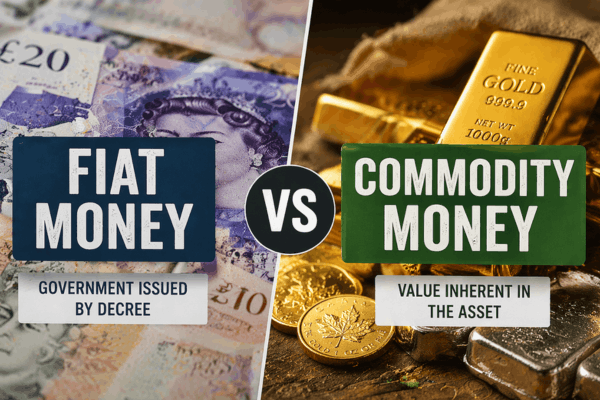
Discover the differences between commodity money vs fiat money. Explore their historical significance, advantages, and disadvantages in modern economies.
Money plays a vital role in every economy, acting as a medium of exchange, store of value, and unit of account. Over the course of history, commodity money and fiat money have served as the primary forms of money.
Although both types of money fulfil the same functions, they are fundamentally different in terms of their underlying value and the role they play in modern economies.
This article explores the differences between commodity money and fiat money, their historical significance, and their relevance in today’s financial systems.
The Difference Between Commodity Money vs Fiat Money
What is Commodity Money?
Commodity money is a form of currency that derives its value from the physical commodity it is made from. The value of commodity money is intrinsic, meaning that the commodity itself is valuable for its own use, outside of being used as money.
Historically, commodities such as gold, silver, salt, grain, and even livestock were used as money. These commodities were valued due to their scarcity, usefulness, and desirability. For example, gold has been widely accepted as money for centuries due to its durability, divisibility, and relatively high intrinsic value.
Commodity money has historical roots, with ancient civilizations such as the Greeks and Romans using metals like gold and silver as currency. The intrinsic value of these metals also made them more stable forms of money compared to other alternatives.
Key Features of Commodity Money
Intrinsic value: The commodity itself holds value.
Scarcity: Supply is limited by the availability of the commodity.
Durability: Metals like gold are resistant to wear and corrosion, making them long-lasting.
Historical use: Widely accepted across different societies for thousands of years.
What is Fiat Money?
In contrast, fiat money has no intrinsic value. The value of fiat money comes from government decree. It is valued because the government says it is valuable, and the public accepts it as a medium of exchange.
Fiat money includes paper currencies like the US dollar, Euro, Pound, and Ringgit. Unlike commodity money, fiat currencies are not backed by any physical commodity like gold or silver. The trust in the issuing government and its economy is what gives fiat money its value.
Governments, through central banks, manage the supply of fiat money and regulate its use. The flexibility to adjust the money supply through monetary policy tools, such as interest rates and quantitative easing, is a key feature of fiat currencies.
Key Features of Fiat Money
No intrinsic value: The money has value only because the government declares it as such.
Legal tender: Accepted by law for transactions.
Controlled supply: Governments or central banks control the money supply to manage economic stability.
Flexibility: Central banks can adjust the money supply to control inflation and economic growth.
Key Differences Between Commodity Money and Fiat Money
To clearly understand the distinction between these two types of money, here’s a comparison based on various criteria:
Feature
Commodity Money
Fiat Money
Value Basis
Derived from the intrinsic value of the commodity.
Value based on government decree and trust.
Supply Control
Limited by the availability of the commodity.
Central banks control the supply.
Inflation
Less prone to inflation due to limited supply.
Can be inflated if the supply is increased recklessly.
Economic Flexibility
Restricted by the finite supply of the commodity.
Highly flexible, as governments can adjust money supply.
Monetary Policy
Little to no room for monetary policy.
Central banks can implement monetary policy to control the economy.
Portability
Bulky and impractical in large quantities.
Easy to transport, especially in digital form.
The Transition from Commodity to Fiat Money
Historically, commodity money dominated global trade. Gold, silver, and other precious metals were used for thousands of years, providing a stable form of currency. The gold standard, where money could be exchanged for a fixed amount of gold, was widely used until the early 20th century.
However, during the Great Depression of the 1930s, many nations abandoned the gold standard due to its limitations. Governments needed the ability to increase the money supply to combat economic downturns and stimulate growth. This flexibility was not possible with commodity money, as its supply was constrained by the availability of physical commodities.
In 1971, the US officially left the gold standard, and the world transitioned to a fiat money system. Today, virtually all global currencies, including the US Dollar, Euro, and Pound Sterling, are fiat money.
Advantages and Disadvantages of Commodity Money
Advantages of Commodity Money:
Intrinsic value: The commodity itself has inherent worth, making it a reliable store of value.
Stability: Commodities like gold tend to hold their value over the long term.
Historical reliability: Commodity money has been trusted and used for centuries.
Disadvantages of Commodity Money:
Limited supply: The supply of commodity money is restricted by the availability of the commodity, limiting economic flexibility.
Inconvenience: Commodities like gold can be heavy and difficult to transport in large quantities.
Market fluctuations: The value of commodity money can fluctuate based on changes in the commodity market.
Advantages and Disadvantages of Fiat Money
Advantages of Fiat Money:
Flexibility: Governments can control the money supply to manage economic conditions such as inflation and deflation.
Convenience: Fiat money is easy to transport, and digital currencies offer additional convenience.
Control: Governments and central banks can implement monetary policy to adjust the money supply, stimulate growth, and manage inflation.
Disadvantages of Fiat Money:
Inflation risk: If too much fiat money is printed, it can lead to inflation, eroding the purchasing power of the currency.
Dependence on trust: The value of fiat money relies entirely on the public’s trust in the government or central authority.
Potential for devaluation: Fiat currencies are susceptible to devaluation if the government mismanages the economy or loses credibility.
Modern Implications on Commodity Money vs Fiat Money
In today’s economy, fiat money dominates, and commodity money plays a more limited role. Most modern currencies, such as the US Dollar, Euro, and Pound Sterling, are fiat currencies that are not backed by any physical commodity.
However, commodity money is still relevant in the form of gold and silver. Gold, in particular, is considered a safe haven asset, especially during times of economic uncertainty or high inflation. Many investors view gold as a store of value that can preserve wealth when fiat currencies lose value.
Additionally, in recent years, the rise of cryptocurrencies like Bitcoin has introduced a new type of digital commodity-like currency. Cryptocurrencies are not controlled by central banks and have a limited supply, which makes them somewhat similar to commodity money. However, they do not have the same inherent physical value as gold or silver.
Conclusion
Both commodity money and fiat money have played critical roles in shaping modern economies. Commodity money, with its intrinsic value, served societies well for centuries, but the flexibility and economic management offered by fiat money have made it the dominant form of currency today.
Understanding the differences between these two systems allows us to appreciate the evolution of money and its ongoing importance in global financial systems. As the world moves towards digital currencies and explores alternatives, it will be fascinating to see how these systems continue to evolve.
FAQs
What is the main difference between commodity money and fiat money?
Commodity money is backed by a physical commodity, while fiat money’s value comes from government decree and public trust.
Why did the world move from commodity money to fiat money?
The shift to fiat money allowed governments to have more flexibility in controlling the money supply and responding to economic crises.
Can fiat money lose value?
Yes, fiat money can lose value due to inflation or loss of public trust in the government or central bank backing it.
Share Now
Disclaimer:This content is provided for informational purposes only and does not constitute, and should not be construed as, financial, investment, or other professional advice. No statement or opinion contained herein should be considered a recommendation by Ultima Markets or the author regarding any specific investment product, strategy, or transaction. Readers are advised not to rely solely on this material when making investment decisions and should seek independent advice where appropriate.
Thank you for visiting the Ultima Markets website. Please note that this website is intended for individuals residing in jurisdictions where access is permitted by law. Ultima and its affiliated entities do not operate in your home jurisdiction.
By clicking ‘Acknowledge’, you confirm that you are entering this website solely on your own initiative and not as a result of any specific marketing outreach. You wish to obtain information from this website based on reverse solicitation principles, in accordance with the applicable laws of your home jurisdiction.