This website is managed by Ultima Markets’ international entities, and it’s important to emphasise that they are not subject to regulation by the FCA in the UK. Therefore, you must understand that you will not have the FCA’s protection when investing through this website – for example:
You will not be guaranteed Negative Balance Protection
You will not be protected by FCA’s leverage restrictions
You will not have the right to settle disputes via the Financial Ombudsman Service (FOS)
You will not be protected by Financial Services Compensation Scheme (FSCS)
Any monies deposited will not be afforded the protection required under the FCA Client Assets Sourcebook. The level of protection for your funds will be determined by the regulations of the relevant local regulator.
Note: UK clients are kindly invited to visit https://www.ultima-markets.co.uk/. Ultima Markets UK expects to begin onboarding UK clients in accordance with FCA regulatory requirements in 2026.
If you would like to proceed and visit this website, you acknowledge and confirm the following:
1.The website is owned by Ultima Markets’ international entities and not by Ultima Markets UK Ltd, which is regulated by the FCA.
2.Ultima Markets Limited, or any of the Ultima Markets international entities, are neither based in the UK nor licensed by the FCA.
3.You are accessing the website at your own initiative and have not been solicited by Ultima Markets Limited in any way.
4.Investing through this website does not grant you the protections provided by the FCA.
5.Should you choose to invest through this website or with any of the international Ultima Markets entities, you will be subject to the rules and regulations of the relevant international regulatory authorities, not the FCA.
Ultima Markets wants to make it clear that we are duly licensed and authorised to offer the services and financial derivative products listed on our website. Individuals accessing this website and registering a trading account do so entirely of their own volition and without prior solicitation.
By confirming your decision to proceed with entering the website, you hereby affirm that this decision was solely initiated by you, and no solicitation has been made by any Ultima Markets entity.
Learn CSX stock split history and what the 2021 3 for 1 split means for price, dividends, and options, plus share trading context and calendar.
If you are searching for csx stock split information, you are likely trying to understand why CSX shares trade at their current price level and whether another split could happen in the future.
This guide explains the CSX stock split in plain language, covers its full split history, and shows how stock splits affect investors and traders today.
CSX Share Price Overview
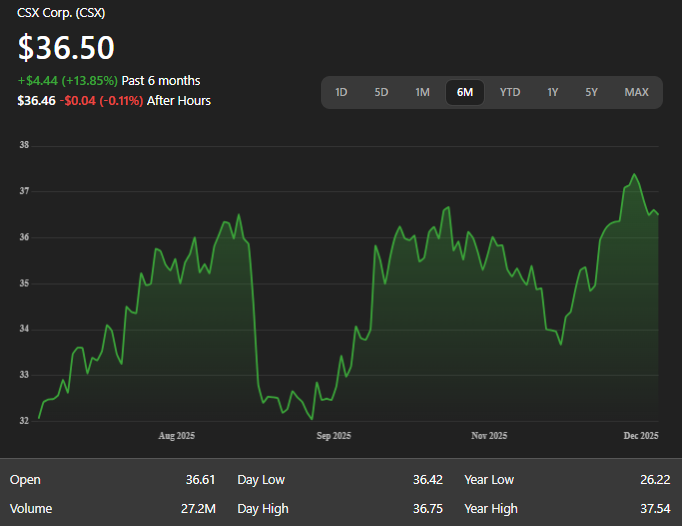
CSX trades on the Nasdaq under the ticker CSX. As of the latest market sessions, CSX shares trade in the mid-$30 range, reflecting prices that already account for the company’s most recent stock split.
When you compare CSX’s current share price with older articles or charts showing much higher prices, the difference usually comes from split-adjusted pricing, not a collapse in company value.
What Is a Stock Split?
A stock split is a corporate action that increases the number of shares outstanding while reducing the price per share by the same proportion. A stock split does not change the company’s market capitalization, does not create profits or losses by itself. They adjusts how ownership is divided across shares.
For example, in a 3-for-1 stock split:
One share becomes three shares
The share price adjusts to roughly one-third
The total value of your position remains the same at the moment of the split
Companies typically use stock splits to keep share prices within a range that feels accessible and liquid for investors.
What Was the CSX Stock Split?
The most recent csx stock split occurred in June 2021, when CSX executed a 3-for-1 stock split. CSX structured this action as a stock dividend, which is a common method companies use to distribute additional shares.
Key details of the CSX stock split
Split ratio: 3 for 1
Announcement: Early June 2021
Record date: Mid-June 2021
Distribution: Late June 2021
For every one share held on the record date, shareholders received two additional shares, bringing the total to three shares per original share.
How the CSX Stock Split Changed Share Price
After the split, CSX’s share count tripled. The share price adjusted to about one-third of its pre-split level. Shareholder value remained unchanged at the split moment.
This explains why older price references may show CSX trading above $90 or $100, while current prices appear much lower.
Most financial platforms display split-adjusted charts, meaning historical prices are recalculated as if the split had always existed.
CSX Stock Split History
Investors often search for csx stock split history to understand how frequently the company has split its stock and under what conditions. CSX has completed five stock splits since becoming publicly traded.
Year
CSX Stock Split Ratio
2021
3 for 1
2011
3 for 1
2006
2 for 1
1995
2 for 1
1983
3 for 1
CSX typically splits its stock after long periods of sustained price appreciation, not after short-term rallies. This pattern reflects board decisions focused on accessibility rather than speculation.
2011 CSX Stock Split (3-for-1)
CSX executed a 3-for-1 stock split in 2011 following several years of recovery and expansion after the global financial crisis.
Key reasons behind the 2011 split:
CSX shares had risen steadily over multiple years
Freight volumes improved as economic activity recovered
The company used the split to realign its share price with market norms
This move preserved long-term shareholder value while improving tradability.
1983 CSX Stock Split (3-for-1)
The 1983 stock split marked an important phase in CSX’s early public history.
Why CSX split its stock in 1983:
The company emerged from restructuring efforts
Improved cost discipline and operational focus supported price gains
Investor confidence began to rebuild after industry challenges
The split helped reset the share structure after sustained appreciation
This early split reflected growing stability rather than short-term optimism.
Did the CSX Stock Split Affect Dividends?
The csx stock split did not automatically increase dividend income. A stock split changes the dividend per share, but it does not directly change the total dividend paid, assuming the company keeps the same payout policy.
How dividends work after a split
Before the split: fewer shares, higher dividend per share
After the split: more shares, lower dividend per share
Total dividend received can remain similar
Dividend changes depend on board decisions and company performance, not on the stock split itself.
How the CSX Stock Split Affects Long-Term Investors
For long-term investors, a stock split mainly affects how ownership is displayed, not what it is worth.
Key points to understand:
Your percentage ownership stays the same
Long-term returns depend on earnings and cash flow
Split-adjusted charts provide accurate performance comparisons
Investors should always confirm whether historical price data is split adjusted when analyzing returns over many years.
How the CSX Stock Split Affects Traders
Traders pay attention to stock splits for different reasons than long-term investors.
Liquidity and volume
A lower share price can attract more market participants, which may increase volume and improve liquidity.
Psychological price levels
After a split, traders often anchor to new round numbers, which can influence short-term support and resistance zones.
Options trading
When a stock splits:
Option contracts adjust automatically
Strike prices and deliverables change
Economic exposure stays the same
Options traders should always review corporate action notices to understand contract adjustments.
Conclusion
Understanding the csx stock split helps investors read CSX’s share price and historical charts accurately, but stock splits alone should never drive trading decisions. Traders and investors should also follow the economic calendar to track key data releases that influence transportation and industrial stocks, then combine this insight with disciplined share trading strategies. By using reliable market tools and staying informed, platforms such as Ultima Markets support traders in analysing stocks like CSX within a broader economic and market context.
FAQs
Did CSX stock split?
No, CSX has not had a stock split in recent years.
How many stock splits has CSX had?
CSX has had four stock splits in its history, with the most recent one occurring in 1997.
Is CSX a good buy now?
Whether CSX is a good buy depends on your investment goals and market conditions. The company has a strong position in the railroad industry, but always consider factors like market trends and financial performance before making a decision. It’s advisable to consult with a financial advisor.
Share Now
Disclaimer:This content is provided for informational purposes only and does not constitute, and should not be construed as, financial, investment, or other professional advice. No statement or opinion contained herein should be considered a recommendation by Ultima Markets or the author regarding any specific investment product, strategy, or transaction. Readers are advised not to rely solely on this material when making investment decisions and should seek independent advice where appropriate.
Thank you for visiting the Ultima Markets website. Please note that this website is intended for individuals residing in jurisdictions where access is permitted by law. Ultima and its affiliated entities do not operate in your home jurisdiction.
By clicking ‘Acknowledge’, you confirm that you are entering this website solely on your own initiative and not as a result of any specific marketing outreach. You wish to obtain information from this website based on reverse solicitation principles, in accordance with the applicable laws of your home jurisdiction.