This website is managed by Ultima Markets’ international entities, and it’s important to emphasise that they are not subject to regulation by the FCA in the UK. Therefore, you must understand that you will not have the FCA’s protection when investing through this website – for example:
You will not be guaranteed Negative Balance Protection
You will not be protected by FCA’s leverage restrictions
You will not have the right to settle disputes via the Financial Ombudsman Service (FOS)
You will not be protected by Financial Services Compensation Scheme (FSCS)
Any monies deposited will not be afforded the protection required under the FCA Client Assets Sourcebook. The level of protection for your funds will be determined by the regulations of the relevant local regulator.
Note: UK clients are kindly invited to visit https://www.ultima-markets.co.uk/. Ultima Markets UK expects to begin onboarding UK clients in accordance with FCA regulatory requirements in 2026.
If you would like to proceed and visit this website, you acknowledge and confirm the following:
1.The website is owned by Ultima Markets’ international entities and not by Ultima Markets UK Ltd, which is regulated by the FCA.
2.Ultima Markets Limited, or any of the Ultima Markets international entities, are neither based in the UK nor licensed by the FCA.
3.You are accessing the website at your own initiative and have not been solicited by Ultima Markets Limited in any way.
4.Investing through this website does not grant you the protections provided by the FCA.
5.Should you choose to invest through this website or with any of the international Ultima Markets entities, you will be subject to the rules and regulations of the relevant international regulatory authorities, not the FCA.
Ultima Markets wants to make it clear that we are duly licensed and authorised to offer the services and financial derivative products listed on our website. Individuals accessing this website and registering a trading account do so entirely of their own volition and without prior solicitation.
By confirming your decision to proceed with entering the website, you hereby affirm that this decision was solely initiated by you, and no solicitation has been made by any Ultima Markets entity.
Ultima Markets does not have an establishment in Singapore and does not operate from Singapore.
Ultima Markets does not provide products or services to citizens or residents of Singapore, and account applications from Singapore citizens or residents will not be accepted.
If you are a citizen or resident of Singapore, please do not open an account or use Ultima Markets’ products or services.
By selecting “Acknowledge and Continue Browsing”, you confirm that you are accessing this website on your own initiative and that your access is not the result of any direct marketing, targeted advertising, solicitation, or promotional activity by Ultima Markets.
Nothing on this website constitutes an offer, solicitation, or promotion of products or services in any jurisdiction where such activity is prohibited. You are responsible for ensuring that your access to and use of this website complies with applicable local laws and regulations.
Heard the phrase buy the rumor, sell the news? Discover what it means, why it happens, and how recent moves in gold and Bitcoin show this classic pattern.
Buy the Rumor, Sell the News Explained
You’ve probably heard traders say buy the rumor, sell the news. It sounds like a cliché, but in practice it captures one of the most common patterns in financial markets.
This phrase describes a phenomenon where prices often rise in anticipation of an event, only to stall or reverse once the news becomes official. Even positive headlines can disappoint if they fail to exceed what the market had already priced in.
What Buy the Rumor, Sell the News Means
The phrase describes a recurring market dynamic. Traders act on speculation ahead of an announcement. Whether it is an earnings report, a central bank decision, or a major policy change.
This is because optimism and anticipation often push prices higher before the event. Once the news is released, many of those early buyers lock in profits, liquidity spikes, and the price reaction can appear counterintuitive. The news itself may be good, but because markets are forward-looking, much of the move has already happened.
Why It Happens
Markets discount the future. By the time an event arrives, expectations are often already embedded in prices. When the result simply meets consensus, the catalyst for further gains is gone. Instead, traders focus on the fine print, which are guidance, tone, and cross-asset signals such as the dollar or bond yields. Many use the announcement as an exit point.
This explains why a stock can fall on strong earnings, or why gold can slip after a central bank cut. Liquidity is highest around news, so even small shifts in sentiment or outlook can trigger sharp reversals. It is not the headline that matters most, but how it compares with what was expected.
Recent Examples
Fed rate cut and gold in September 2025
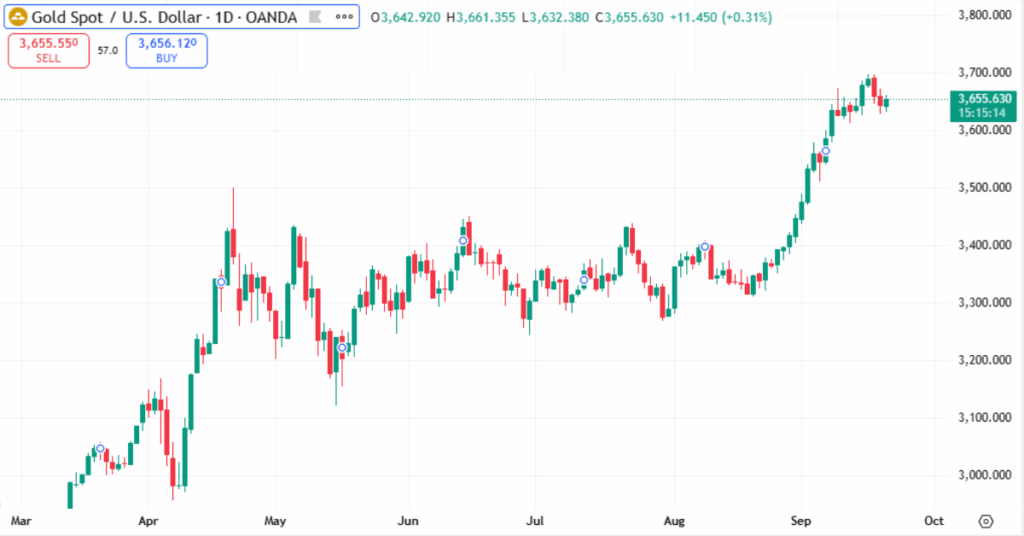
In September 2025, gold surged to an all-time high near 3,707 dollars per ounce as traders anticipated a widely expected 25 basis point Federal Reserve rate cut. When the cut was delivered, Chair Jerome Powell called it a risk-management move and stressed a meeting-by-meeting approach. That cautious tone steadied the dollar and Treasury yields, and gold slipped back into the 3,646–3,690 range. At the same time, SPDR Gold Trust holdings fell by 0.44 percent, showing investors were taking profits.
This was a textbook case of markets buying the rumor, then selling the news once expectations had been met.
Bitcoin spot ETF approvals in January 2024
Crypto markets offered a similar lesson. After months of anticipation, the SEC approved U.S. spot Bitcoin ETFs on January 10, 2024. The announcement was historic, but instead of rallying further, Bitcoin fell in the following days as traders unwound positions. Analysts widely described the move as a sell-the-news reaction, driven by profit-taking after a crowded run-up.
How Traders Use Buy the rumor, Sell the news
Recognising buy the rumor, sell the news helps traders manage expectations and risk. Before an event, it is important to assess how much is already priced in through futures, options, or flows. On the release, comparing the outcome and tone to consensus can indicate whether there is room for continuation or risk of reversal. After the event, monitoring cross-asset signals, such as the dollar for gold or ETF flows for crypto, can help confirm whether the move has staying power.
Common Pitfalls
One of the biggest mistakes is assuming positive news will automatically drive prices higher. Once expectations are fully priced in, markets often move in the opposite direction. Another pitfall is joining the trade too late, just before an announcement, when entry levels are poor and the risk of reversal is greatest.
Traders also stumble when they ignore cross-market clues. For example, buying gold on a Fed cut without considering the dollar’s reaction, or chasing crypto gains without watching ETF inflows and outflows.
Key Takeaway
The saying buy the rumor, sell the news is more than market folklore. It reflects how markets trade on expectations rather than headlines. Prices often run ahead of well-telegraphed events and then retrace when uncertainty fades and profits are taken. For traders, the lesson is simple: measure what is priced in, pay attention to tone and detail, and manage risk when liquidity is at its most volatile.
Share Now
Disclaimer:This content is provided for informational purposes only and does not constitute, and should not be construed as, financial, investment, or other professional advice. No statement or opinion contained herein should be considered a recommendation by Ultima Markets or the author regarding any specific investment product, strategy, or transaction. Readers are advised not to rely solely on this material when making investment decisions and should seek independent advice where appropriate.
Thank you for visiting the Ultima Markets website. Please note that this website is intended for individuals residing in jurisdictions where access is permitted by law. Ultima and its affiliated entities do not operate in your home jurisdiction.
By clicking ‘Acknowledge’, you confirm that you are entering this website solely on your own initiative and not as a result of any specific marketing outreach. You wish to obtain information from this website based on reverse solicitation principles, in accordance with the applicable laws of your home jurisdiction.