This website is managed by Ultima Markets’ international entities, and it’s important to emphasise that they are not subject to regulation by the FCA in the UK. Therefore, you must understand that you will not have the FCA’s protection when investing through this website – for example:
You will not be guaranteed Negative Balance Protection
You will not be protected by FCA’s leverage restrictions
You will not have the right to settle disputes via the Financial Ombudsman Service (FOS)
You will not be protected by Financial Services Compensation Scheme (FSCS)
Any monies deposited will not be afforded the protection required under the FCA Client Assets Sourcebook. The level of protection for your funds will be determined by the regulations of the relevant local regulator.
Note: UK clients are kindly invited to visit https://www.ultima-markets.co.uk/. Ultima Markets UK expects to begin onboarding UK clients in accordance with FCA regulatory requirements in 2026.
If you would like to proceed and visit this website, you acknowledge and confirm the following:
1.The website is owned by Ultima Markets’ international entities and not by Ultima Markets UK Ltd, which is regulated by the FCA.
2.Ultima Markets Limited, or any of the Ultima Markets international entities, are neither based in the UK nor licensed by the FCA.
3.You are accessing the website at your own initiative and have not been solicited by Ultima Markets Limited in any way.
4.Investing through this website does not grant you the protections provided by the FCA.
5.Should you choose to invest through this website or with any of the international Ultima Markets entities, you will be subject to the rules and regulations of the relevant international regulatory authorities, not the FCA.
Ultima Markets wants to make it clear that we are duly licensed and authorised to offer the services and financial derivative products listed on our website. Individuals accessing this website and registering a trading account do so entirely of their own volition and without prior solicitation.
By confirming your decision to proceed with entering the website, you hereby affirm that this decision was solely initiated by you, and no solicitation has been made by any Ultima Markets entity.
AI CapEx is surging. Learn how Big Tech is funding the AI infrastructure, from chips to data centres, and whether spending can deliver long-term returns.
AI capex has become one of the most important themes in financial markets in 2026. Technology companies are investing heavily in processors, servers, data centres, networking, cooling systems and power infrastructure to support artificial intelligence.
The scale is rising faster than earlier forecasts. Current-year capital expenditure estimates for Microsoft, Alphabet, Amazon, Meta and Oracle increased from about $485 billion in January to roughly $730 billion by July.
These are company-wide figures rather than pure AI budgets, but data centres and cloud infrastructure are major drivers. The debate is therefore shifting from how much Big Tech can spend to who will finance the build-out and whether it can generate durable returns.
What Is AI Capex?
The scale of artificial intelligence investment is moving beyond a traditional technology upgrade cycle. Companies are not only spending on AI models and software, but also on the physical infrastructure required to support them, including advanced chips, data centres, networking systems and power capacity.
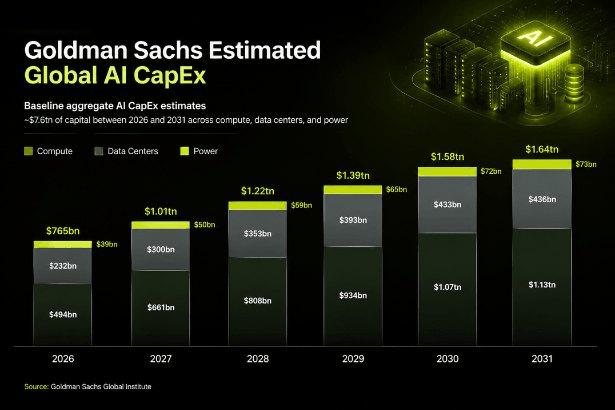
Goldman Sachs estimates that global AI infrastructure investment could reach approximately $7.6 trillion between 2026 and 2031 under its baseline scenario. This includes spending on computing power, data-centre expansion and energy infrastructure needed to support the next stage of AI adoption.
Goldman Sachs Estimated Global AI CapEx
According to Goldman Sachs, compute infrastructure represents the largest portion of future AI investment, followed by data centres and power systems. This highlights why semiconductor companies, memory producers and infrastructure suppliers have become early beneficiaries of the AI expansion.
However, these figures should be viewed as estimates rather than guaranteed spending. The actual size of the AI capex cycle will depend on several factors, including AI adoption, hardware demand, energy availability and the ability of companies to generate sufficient returns from new infrastructure.
One important factor is hardware replacement cycles. AI accelerators have shorter economic lifespans compared with traditional infrastructure assets, meaning companies may need to continue investing in newer and more efficient chips to remain competitive. This creates a challenge for technology companies: large upfront spending must eventually translate into stronger revenue growth, higher margins and sustainable cash flow.
How Will the AI Buildout Be Funded?
The size of AI infrastructure investment raises another important question: where will the capital come from?
Historically, large technology companies have funded expansion through strong operating cash flows. However, the scale of AI infrastructure spending means external financing is expected to play a larger role.
Morgan Stanley estimates that global data-centre investment between 2025 and 2028 will require approximately $2.9 trillion in capital. While hyperscalers are expected to fund a significant portion through internal cash flow, a growing share may come from debt markets, private credit and other institutional investors.
The funding structure shows that the AI buildout is becoming more connected to global capital markets. While major technology companies still have strong balance sheets, financing through private credit, infrastructure funds and debt markets will become increasingly important as investment requirements grow.
This does not necessarily mean AI investment is facing a funding crisis. Instead, it highlights a shift in how the next phase of AI expansion will be financed. Investors are likely to pay closer attention to borrowing costs, debt levels and whether new infrastructure can generate sufficient returns.
Ultimately, the biggest challenge for AI companies may not be building more computing capacity, but proving that these investments can create long-term economic value.
Who Will Fund the AI Build-Out?
The largest technology companies have largely financed infrastructure through operating cash flow. Morgan Stanley expects that model to become less sufficient as spending grows.
The bank estimates approximately $2.9 trillion of global data-centre hardware and construction spending from 2025 to 2028. Around $2.5 trillion is associated with AI workloads, while the estimate excludes power investment. Approximately $1.4 trillion could be covered by hyperscaler cash flows, leaving about $1.5 trillion to be funded by external capital.
Morgan Stanley Estimated AI Infrastructure Funding Structure
Funding Source
Estimated Amount
Share
Hyperscaler internal cash flow
$1.4 trillion
~48%
Private credit, asset-backed financing and infrastructure debt
$800 billion
~28%
Other capital sources
$350 billion
~12%
Corporate debt
$200 billion
~7%
Securitised credit
$150 billion
~5%
Source: Morgan Stanley research estimates.
The Morgan Stanley and Goldman Sachs figures are not directly comparable. Morgan Stanley covers a shorter period, focuses on data-centre hardware and construction, and excludes power. Goldman Sachs estimates wider ecosystem spending through 2031.
Morgan Stanley does not expect an immediate financing bottleneck in its base case. However, borrowing costs and risk allocation will matter more as bond investors, private credit funds, infrastructure managers and sovereign capital take a larger role.
Is AI Capex Starting to Pay Off?
There is evidence of demand. Microsoft has said its AI business exceeded a $37 billion annual revenue run rate, while Amazon reported 28% growth in AWS during its first quarter. The difficult question is whether this growth can keep pace with infrastructure spending.
Reuters estimates that Microsoft, Alphabet, Amazon, Meta and Oracle could collectively spend more on capex than they generate in free cash flow by 2027. From 2025 to 2027, their annual capex is projected to rise by about $534 billion, compared with a $340 billion increase in operating cash flow. That represents approximately $1.57 of additional investment for every $1 of additional operating cash flow.
Oracle shows how pressure can develop. Its fiscal 2026 capex reached $55.7 billion, equal to 174% of operating cash flow. Other hyperscalers have stronger cash positions, but investors increasingly want evidence that AI infrastructure can improve revenue, margins and cash flow, not simply increase computing capacity.
Which Sectors Could Benefit From AI Capex?
The earliest beneficiaries are companies receiving orders during the build-out. These include semiconductor designers, chip foundries, memory producers, networking specialists, optical-equipment suppliers, data-centre contractors and cooling providers.
Power is also part of the opportunity. AI facilities require grid connections, transformers, turbines, backup generation and power-management equipment. A data centre that cannot secure electricity may absorb capital long before it produces revenue.
As the cycle matures, attention may shift towards companies that use the infrastructure effectively. Cloud platforms, software providers and businesses applying AI to reduce costs or improve output could benefit when markets begin rewarding measurable monetisation rather than AI exposure alone. Morgan Stanley has already observed that investors are distinguishing between companies that merely discuss AI and those showing improvements in cash flow and operating performance.
What Could Slow the AI Capex Cycle?
The largest risk may be a widening delay between spending money and earning a return. Power interconnection queues, permitting, specialist labour shortages and long lead times for transformers, switchgear and cooling systems can postpone projects. Rapid changes in chip and data-centre design may also make recently built assets less competitive sooner than expected.
Financing conditions matter too. Higher yields and wider credit spreads raise the cost of infrastructure, particularly for companies unable to rely entirely on internal cash flow.
Cheaper models and custom chips could reduce the cost of each AI task. However, this would not necessarily reduce total spending. Lower-cost computing could encourage companies to use more AI, build larger models and automate a wider range of tasks. In that case, cost savings would change which suppliers earn the highest margins rather than significantly reducing the size of the overall build-out.
Conclusion
AI capex is not disappearing, but the investment story is becoming more selective. The first stage rewarded companies linked to chips, cloud computing and data-centre construction. The next stage will focus more heavily on financing discipline, capacity utilisation and cash generation.
Investors may need to look beyond headline capex forecasts and monitor AI revenue, contracted backlog, free cash flow, depreciation, borrowing costs and project delivery. These indicators can help reveal whether infrastructure is becoming productive or simply more expensive.
The next leaders may not be the companies spending the most. They are more likely to be those that convert large infrastructure commitments into lasting revenue, stronger margins and durable cash flow.
FAQs
What does AI capex mean?
It is spending on long-term AI infrastructure, including chips, servers, data centres, networking, cooling and power systems.
How much could be spent on AI infrastructure?
Goldman Sachs’ baseline scenario estimates about $7.6 trillion across compute, data centres and power from 2026 to 2031.
Why does AI capex affect technology stocks?
It can support future growth, but it also reduces near-term free cash flow and raises depreciation.
Could AI capex slow down?
Yes. Spending could weaken if demand disappoints, financing becomes more expensive, projects are delayed or returns fall short.
Share Now
Disclaimer:This content is provided for informational purposes only and does not constitute, and should not be construed as, financial, investment, or other professional advice. No statement or opinion contained herein should be considered a recommendation by Ultima Markets or the author regarding any specific investment product, strategy, or transaction. Readers are advised not to rely solely on this material when making investment decisions and should seek independent advice where appropriate.
Thank you for visiting the Ultima Markets website. Please note that this website is intended for individuals residing in jurisdictions where access is permitted by law. Ultima and its affiliated entities do not operate in your home jurisdiction.
By clicking ‘Acknowledge’, you confirm that you are entering this website solely on your own initiative and not as a result of any specific marketing outreach. You wish to obtain information from this website based on reverse solicitation principles, in accordance with the applicable laws of your home jurisdiction.