This website is managed by Ultima Markets’ international entities, and it’s important to emphasise that they are not subject to regulation by the FCA in the UK. Therefore, you must understand that you will not have the FCA’s protection when investing through this website – for example:
You will not be guaranteed Negative Balance Protection
You will not be protected by FCA’s leverage restrictions
You will not have the right to settle disputes via the Financial Ombudsman Service (FOS)
You will not be protected by Financial Services Compensation Scheme (FSCS)
Any monies deposited will not be afforded the protection required under the FCA Client Assets Sourcebook. The level of protection for your funds will be determined by the regulations of the relevant local regulator.
Note: UK clients are kindly invited to visit https://www.ultima-markets.co.uk/. Ultima Markets UK expects to begin onboarding UK clients in accordance with FCA regulatory requirements in 2026.
If you would like to proceed and visit this website, you acknowledge and confirm the following:
1.The website is owned by Ultima Markets’ international entities and not by Ultima Markets UK Ltd, which is regulated by the FCA.
2.Ultima Markets Limited, or any of the Ultima Markets international entities, are neither based in the UK nor licensed by the FCA.
3.You are accessing the website at your own initiative and have not been solicited by Ultima Markets Limited in any way.
4.Investing through this website does not grant you the protections provided by the FCA.
5.Should you choose to invest through this website or with any of the international Ultima Markets entities, you will be subject to the rules and regulations of the relevant international regulatory authorities, not the FCA.
Ultima Markets wants to make it clear that we are duly licensed and authorised to offer the services and financial derivative products listed on our website. Individuals accessing this website and registering a trading account do so entirely of their own volition and without prior solicitation.
By confirming your decision to proceed with entering the website, you hereby affirm that this decision was solely initiated by you, and no solicitation has been made by any Ultima Markets entity.
Ultima Markets does not have an establishment in Singapore and does not operate from Singapore.
Ultima Markets does not provide products or services to citizens or residents of Singapore, and account applications from Singapore citizens or residents will not be accepted.
If you are a citizen or resident of Singapore, please do not open an account or use Ultima Markets’ products or services.
By selecting “Acknowledge and Continue Browsing”, you confirm that you are accessing this website on your own initiative and that your access is not the result of any direct marketing, targeted advertising, solicitation, or promotional activity by Ultima Markets.
Nothing on this website constitutes an offer, solicitation, or promotion of products or services in any jurisdiction where such activity is prohibited. You are responsible for ensuring that your access to and use of this website complies with applicable local laws and regulations.
Resurging Oil Prices, Middle East Tensions, and the Revised Fed Outlook
Resurging Oil Prices, Middle East Tensions, and the Revised Fed Outlook
The delicate balance of the global economy has been disrupted once again. Just as financial markets were beginning to celebrate a cooling in United States inflation, renewed geopolitical conflict in the Middle East brought sudden volatility back to energy markets.
With crude oil prices spiking rapidly, the main narrative surrounding the Federal Reserve’s interest rate path is swiftly pivoting from inflation relief back toward hawkish caution.
For the coming weeks and into August, Middle East tensions, oil prices, and the Fed’s policy outlook will drive global financial markets.
The Disinflation Relief That Wasn’t
The release of the June Consumer Price Index (CPI) report initially brought clear enthusiasm to global markets:
Headline CPI: Eased substantially, falling from 4.2% year-over-year in May to 3.5% in June. This was driven by a sharp 0.4% monthly drop—the largest single-month decline in headline consumer prices since April 2020.
Core CPI: Excluded volatile food and energy costs and moderated to 2.6% year-over-year.
Following this softer inflation data, market participants quickly lowered their expectations for future rate hikes. Before the release, persistent inflation had kept traders worried about higher interest rates and prolonged tightening. However, the June disinflation signal caused Fed funds futures to reprice rapidly.
Odds of a September interest rate hike dropped below 50% almost overnight as investors prepared for a prolonged pause or a smoother path toward rate cuts.
Yet that window of relief proved short-lived. A sudden military escalation in the Middle East quickly erased the market’s optimism, sending crude oil prices up nearly 25% within a single week. Money markets were forced to recalibrate immediately, bringing back bets on a September rate hike as inflation fears resurfaced.
Middle East Conflict: From Diplomacy to Resurgence in Tension
The trigger behind this rapid market turn was the breakdown of diplomatic negotiations in the Persian Gulf region.
Official peace talks collapsed, removing the safety net under geopolitical risk premiums. Following the breakdown, the United States launched targeted military strikes against Iranian infrastructure. As of July 22, the region has seen 11 consecutive days of military strikes. Iranian forces retaliated, resulting in four reported U.S. servicemen deaths during this latest escalation.
As casualties rise and direct military engagements continue, global markets must now price in the risk of a drawn-out conflict in one of the world’s most critical energy corridors.
Cross-Asset Volatility: Energy, Yields, and Safe-Havens
The immediate operational worry for commodity markets is the intensifying blockade around the Strait of Hormuz. Concerns over supply disruptions quickly drove heavy buying in crude oil.
While oil prices may not see an unconstrained rally like previous supply shocks (As covered in our previous in-depth analysis), crude prices will undoubtedly stay elevated for longer if there are no clear signs of de-escalation in the U.S.-Iran conflict.
This surge in energy costs triggered a rapid chain reaction across global markets:
Reignited Inflation Fears: Higher oil and gasoline prices feed directly into transport, manufacturing, and consumer energy costs, threatening to reverse recent disinflation gains.
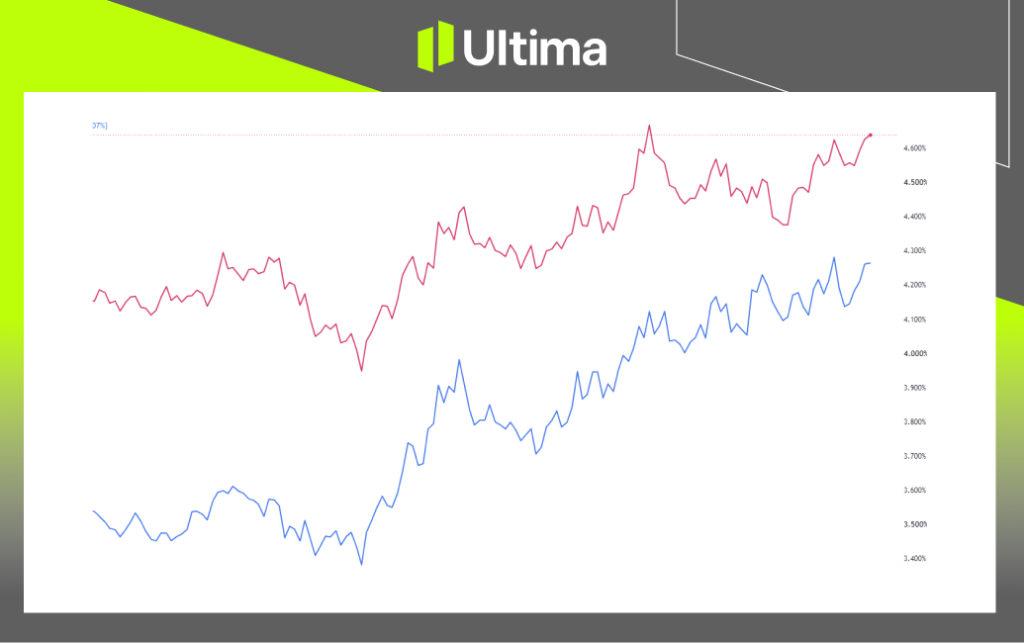
Treasury Yields Rebound: Bond markets sold off as traders factored in higher future inflation. The benchmark U.S. 10-Year Treasury yield rose to 4.65%, reflecting higher term premiums and tighter financial conditions.
U.S. Dollar Dominance: Rising yields combined with risk-off market sentiment pushed the U.S. Dollar Index (DXY) higher against major currencies.
Gold’s Defensive Surge: Gold broke higher despite rising real yields, supported by strong safe-haven demand alongside a nervous stock market.
US 2-year and 10-year Treasury Yield on 18-Months High
With these shifts taking hold, all eyes now turn to the upcoming late-July FOMC meeting, which will set the pace for financial markets heading into August.
What’s Next for the Federal Reserve?
The Federal Reserve now faces a tricky situation. Central bank officials are currently in their mandatory blackout period ahead of the upcoming July FOMC meeting, leaving investors to assess the impact on their own.
The June CPI drop was heavily driven by a temporary slump in energy prices before the military escalation. With crude prices now up 25%, headline inflation figures over the coming months face significant upward pressure. Even if core inflation remains calm, second-round effects from higher fuel costs can easily spill into broader goods and services.
As a result, market expectations for the late-July FOMC meeting point toward a noticeably cautious Federal Reserve. If Chair Warsh and the Committee signal a hawkish tone to keep long-term inflation expectations anchored, the U.S. Dollar could gain the momentum needed to continue its broader uptrend.
Currency Outlook: The U.S. Dollar Index (DXY)
From a macro perspective, the U.S. Dollar Index remains supported by two primary drivers: rising interest rate expectations and global safe-haven capital flows.
Rising Energy & Geopolitical Risks: Spiking oil prices and escalating Middle East tensions reignite inflationary pressures.
Shift to Hawkish Fed Stance: Re-accelerating inflation forces the Federal Reserve to adopt a more cautious, aggressive posture.
Higher Rate Expectations: Markets reprice policy expectations, driving up bets on a September rate hike and further tightening into 2026/2027.
Bullish Dollar Momentum: Higher yield differentials and safe-haven demand combine to push the U.S. Dollar Index (DXY) higher.
Key Technical Level: 101.00 Resistance
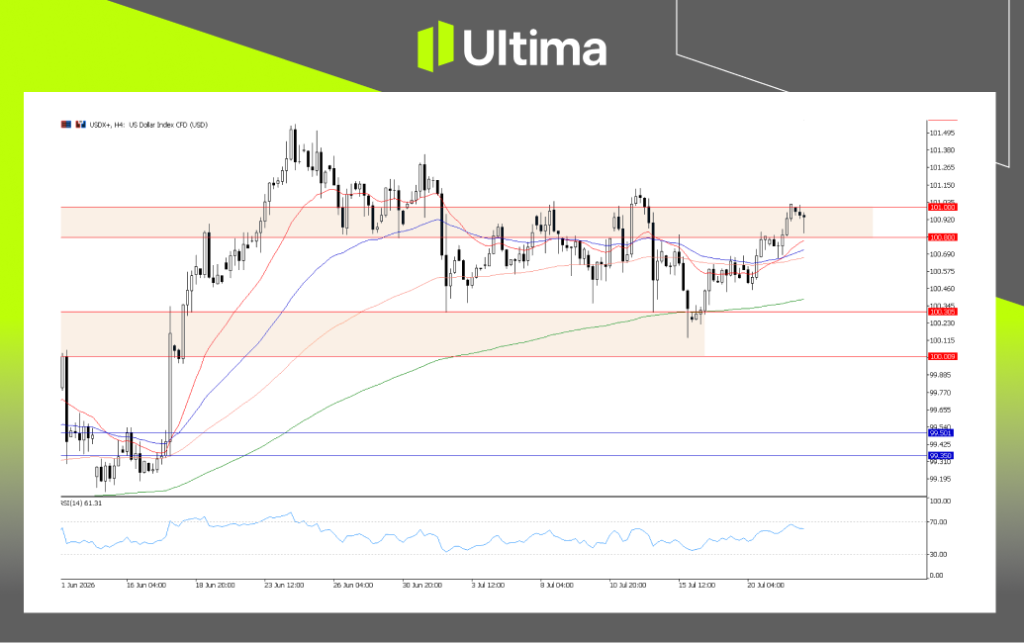
From a technical perspective, the Dollar Index’s 101.00 level serves as the primary resistance level to watch.
If Middle East tensions escalate further, oil prices stay elevated, and the Fed delivers a firm hawkish stance, the U.S. Dollar Index could gather the fundamental strength needed to break decisively above 101.00.
DXY, H4 Chart | Ultima Market MT5
The Downside Risk: On the other hand, if the Federal Reserve refrains from signaling explicit rate hikes, adopting a purely data-dependent posture without firm forward guidance (similar to Kevin Warsh’s preferred policy approach)—the Dollar may struggle to maintain momentum above 101.00.
In the short term, the U.S. Dollar outlook remains bullish to consolidating, with upside risks closely tied to geopolitical developments, at this point.
Commodity Spotlight: Gold’s $4,000 Floor
Another major focal point for traders is Gold. Precious metal price action currently reflects a tug-of-war between rising interest rate headwinds and safe-haven demand.
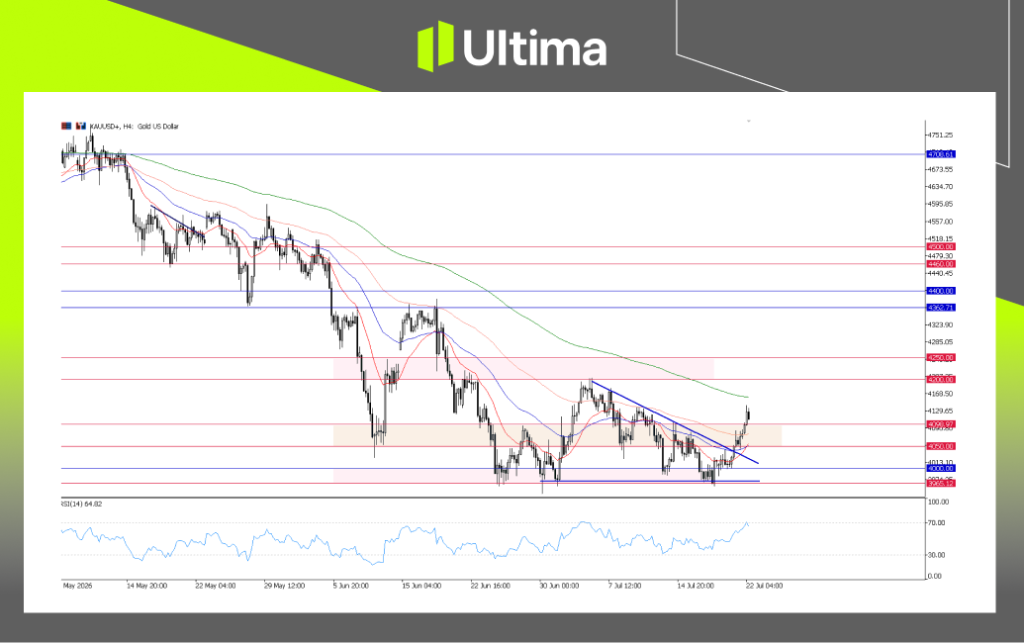
After dropping toward the $4,000 psychological support level, Gold staged a defensive rebound. This recovery was driven by safe-haven buying amid stock market cautiousness and escalating Middle East headlines. Holding above $4,000 was an important technical victory for buyers.
XAUUSD, H4 Chart | Ultima Markets MT5
However, traders should note that Gold remains within a broader technical bearish phase, and building a firm, long-term base will take time. The main challenge facing Gold continues to be rising U.S. Treasury yields (4.65%), which increase the holding cost of non-yielding bullion.
For Gold to start a lasting rally beyond temporary crisis-driven pops, bond yields will need to turn lower—a scenario that typically requires the U.S. Dollar to ease back. Until then, Gold’s upside moves may remain tactical rather than structural.
Summary & Key Takeaways
As markets head into August, financial assets are being driven by a clear domino effect where Middle East developments directly shape the global market narrative.
In the baseline scenario where conflict persists, elevated crude oil prices directly threaten the disinflation progress seen in June. Facing renewed energy-driven inflation risks, the Federal Reserve will likely adopt a cautious or hawkish tone at the late-July FOMC meeting, reinforcing expectations for higher rates or delayed policy easing.
Conversely, if Middle East tensions ease, the market dynamic would reverse quickly. Falling oil prices would relieve inflation pressures, allowing the Fed to stay flexible and data-dependent without further tightening. As safe-haven demand fades, the U.S. Dollar would struggle to break above 101.00, relieving pressure on bond yields and supporting risk assets and Gold.
Disclaimer
Comments, news, research, analysis, price, and all information contained in the article only serve as general information for readers and do not suggest any advice. Ultima Markets has taken reasonable measures to provide up-to-date information, but cannot guarantee accuracy, and may modify without notice. Ultima Markets will not be responsible for any loss incurred due to the application of the information provided.
Thank you for visiting the Ultima Markets website. Please note that this website is intended for individuals residing in jurisdictions where access is permitted by law. Ultima and its affiliated entities do not operate in your home jurisdiction.
By clicking ‘Acknowledge’, you confirm that you are entering this website solely on your own initiative and not as a result of any specific marketing outreach. You wish to obtain information from this website based on reverse solicitation principles, in accordance with the applicable laws of your home jurisdiction.