This website is managed by Ultima Markets’ international entities, and it’s important to emphasise that they are not subject to regulation by the FCA in the UK. Therefore, you must understand that you will not have the FCA’s protection when investing through this website – for example:
You will not be guaranteed Negative Balance Protection
You will not be protected by FCA’s leverage restrictions
You will not have the right to settle disputes via the Financial Ombudsman Service (FOS)
You will not be protected by Financial Services Compensation Scheme (FSCS)
Any monies deposited will not be afforded the protection required under the FCA Client Assets Sourcebook. The level of protection for your funds will be determined by the regulations of the relevant local regulator.
Note: UK clients are kindly invited to visit https://www.ultima-markets.co.uk/. Ultima Markets UK expects to begin onboarding UK clients in accordance with FCA regulatory requirements in 2026.
If you would like to proceed and visit this website, you acknowledge and confirm the following:
1.The website is owned by Ultima Markets’ international entities and not by Ultima Markets UK Ltd, which is regulated by the FCA.
2.Ultima Markets Limited, or any of the Ultima Markets international entities, are neither based in the UK nor licensed by the FCA.
3.You are accessing the website at your own initiative and have not been solicited by Ultima Markets Limited in any way.
4.Investing through this website does not grant you the protections provided by the FCA.
5.Should you choose to invest through this website or with any of the international Ultima Markets entities, you will be subject to the rules and regulations of the relevant international regulatory authorities, not the FCA.
Ultima Markets wants to make it clear that we are duly licensed and authorised to offer the services and financial derivative products listed on our website. Individuals accessing this website and registering a trading account do so entirely of their own volition and without prior solicitation.
By confirming your decision to proceed with entering the website, you hereby affirm that this decision was solely initiated by you, and no solicitation has been made by any Ultima Markets entity.
Discover what is a nonce crypto here. See how Bitcoin and Ethereum use nonces and learn why they matter for transaction order and blockchain security.
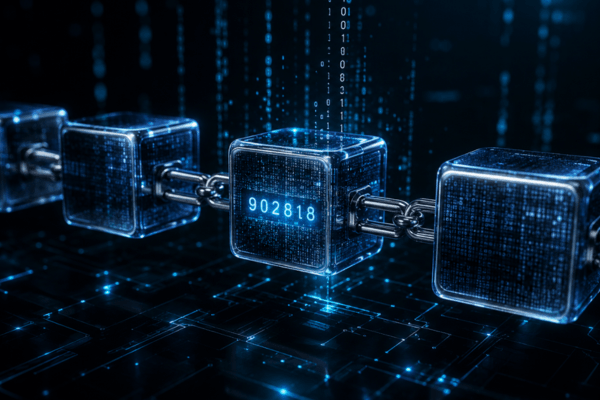
If you are searching for what is a nonce crypto, the simple answer is this: a nonce is a number used by a blockchain to make a block, transaction, or cryptographic action unique. It is often described as a “number used once,” although in practice, its exact role depends on the blockchain system.
A nonce may sound technical, but it plays an important part in how crypto networks stay secure and organised.
In Bitcoin, miners change a nonce repeatedly while trying to find a valid block hash.
In Ethereum, a nonce works more like a transaction counter, helping the network process transactions in the correct order and prevent duplicate use.
So, when people ask what is a nonce crypto, they are usually asking how this small number helps blockchain systems verify activity without needing a central authority.
Why Does a Nonce Matter in Blockchain?
Blockchains are designed to work without banks, payment processors, or central databases. Because of this, they need strict rules to confirm that data is valid, transactions are not repeated, and blocks are added fairly.
A nonce helps with this by creating uniqueness. It tells the network that a specific mining attempt, transaction, or signature is different from another.
For example, if the same transaction could be copied and used again, a user might accidentally or maliciously send the same funds more than once. In account-based blockchains like Ethereum, the nonce prevents this by making sure each transaction from the same wallet has its own sequence number.
In proof-of-work blockchains like Bitcoin, the nonce helps miners search for a valid result. Miners are not guessing randomly without structure. They are changing the nonce, hashing the block data, and checking whether the result meets the network’s difficulty target.
This is why a nonce is small in size but large in importance.
The Main Types of Nonces in Crypto
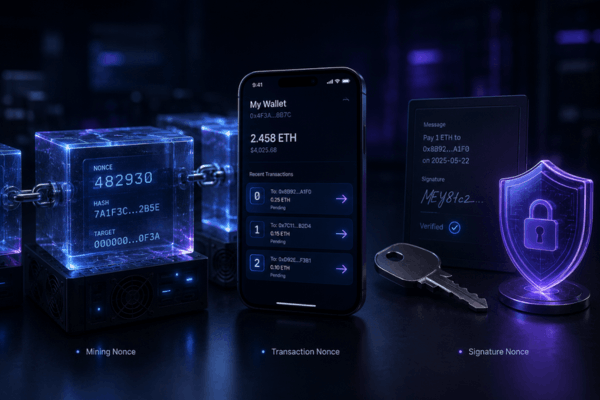
One reason the topic can be confusing is that a nonce does not always mean the same thing in every crypto context. To understand what is a nonce crypto, it helps to separate the main types.
Type of nonce
Where it is used
Main purpose
Mining nonce
Bitcoin and proof-of-work blockchains
Helps miners find a valid block hash
Transaction nonce
Ethereum and EVM-compatible chains
Orders transactions and prevents replay
Signature nonce
Cryptographic signatures
Helps protect private keys when generated safely
A mining nonce is used during block creation. Miners change this number to produce different hash results.
A transaction nonce is used by wallets and accounts. It shows the order of transactions sent from an address.
A signature nonce is used in cryptographic signing. This type is more advanced, but it is important because weak or reused signature nonces can create security risks.
These types are connected by one idea: the nonce helps make something unique within a specific context.
How a Nonce Works in Bitcoin Mining
Bitcoin uses proof of work to add new blocks to the blockchain. Miners collect transactions, build a block header, and then try to find a hash that meets the network’s difficulty requirement.
The nonce is one of the fields inside the Bitcoin block header. Miners change this value again and again. Each change creates a different hash output. If the hash does not meet the target, the miner changes the nonce and tries again.
A simplified process looks like this:
A miner gathers transactions into a block.
The miner creates a block header.
The miner changes the nonce.
The miner hashes the block header.
If the hash is not valid, the miner tries another nonce.
If the hash is valid, the block can be broadcast to the network.
This does not mean the nonce itself is the final answer. The goal is to find a nonce that helps produce a valid block hash. Some people call this successful value a “golden nonce,” although it is more of an informal term.
Because Bitcoin’s standard nonce field has a limited range, miners may eventually run through all possible values. When that happens, they can change other block data, such as the timestamp or coinbase transaction, which gives them more hash possibilities.
How a Nonce Works in Ethereum Transactions
Ethereum uses nonces differently from Bitcoin. Instead of being mainly a mining tool, an Ethereum nonce is tied to an account.
Every externally owned account, such as a regular crypto wallet, has a nonce. This number counts how many transactions the account has sent. The first transaction may use nonce 0, the next uses nonce 1, then nonce 2, and so on.
This makes Ethereum transactions easier to organise. If your wallet sends several transactions, the nonce tells the network which one should be processed first.
It also helps prevent replay attacks. A replay attack happens when someone tries to reuse a signed transaction. Because each Ethereum transaction has a specific nonce, the network can reject a duplicate once that nonce has already been used.
For example:
Wallet action
Nonce
First transaction
0
Second transaction
1
Third transaction
2
Fourth transaction
3
This is one of the clearest examples of how a nonce supports blockchain security in everyday crypto use.
Can a Wrong Nonce Cause a Stuck Transaction?
Yes. On Ethereum and EVM-compatible networks, nonce problems can sometimes cause transactions to get stuck.
If a transaction uses a nonce that is too low, it may be rejected because that nonce has already been used. If a transaction uses a nonce that is too high, it may wait until the missing earlier nonce is processed.
For example, imagine your wallet has a pending transaction with nonce 5. If you then send another transaction with nonce 6, the second transaction may not go through until nonce 5 is completed. This can create a queue.
This is why some wallets offer “speed up” or “cancel” options. These features usually work by sending a new transaction with the same nonce but a higher fee. The network then has a reason to process the replacement transaction instead of the old one.
Most beginners do not need to manage nonces manually. Wallets usually handle them automatically. However, understanding the idea can help if you ever see errors such as “nonce too low” or “replacement transaction underpriced.”
Signature Nonces and Security
There is another type of nonce that appears in crypto security discussions: the signature nonce.
When a wallet signs a transaction, it uses cryptographic methods to prove that the owner authorised the action. In some signature systems, a nonce is used during the signing process. This nonce must be unique and should be generated safely.
If a signature nonce is reused, leaked, or predictable, it can create serious security risks. In extreme cases, attackers may be able to recover a private key. This is different from the public nonce used in Bitcoin mining or the visible account nonce used in Ethereum.
For most users, the key takeaway is simple: use trusted wallets and avoid tools that ask you to expose seed phrases or private keys. Secure wallet software should handle signature nonces safely in the background.
Conclusion
So, what is a nonce crypto in simple terms? It is a value that helps make blockchain activity unique, ordered, or secure.
For beginners, the easiest way to remember it is this: a nonce is a number that tells the blockchain, “this action is unique in this context.”
FAQs
What is a nonce in crypto?
A nonce in crypto is a value used to make a block, transaction, or signature unique within a specific blockchain context.
What does nonce stand for?
Nonce is commonly explained as “number used once,” although it is better understood as a value used once within a specific context.
Can a nonce be reused?
In transaction systems like Ethereum, the same account nonce should not be reused. Reuse can cause rejection or transaction errors.
Is a nonce the same as a hash?
No. A nonce is an input value, while a hash is the output created after data is processed by a hash function.
Share Now
Disclaimer:This content is provided for informational purposes only and does not constitute, and should not be construed as, financial, investment, or other professional advice. No statement or opinion contained herein should be considered a recommendation by Ultima Markets or the author regarding any specific investment product, strategy, or transaction. Readers are advised not to rely solely on this material when making investment decisions and should seek independent advice where appropriate.
Thank you for visiting the Ultima Markets website. Please note that this website is intended for individuals residing in jurisdictions where access is permitted by law. Ultima and its affiliated entities do not operate in your home jurisdiction.
By clicking ‘Acknowledge’, you confirm that you are entering this website solely on your own initiative and not as a result of any specific marketing outreach. You wish to obtain information from this website based on reverse solicitation principles, in accordance with the applicable laws of your home jurisdiction.