This website is managed by Ultima Markets’ international entities, and it’s important to emphasise that they are not subject to regulation by the FCA in the UK. Therefore, you must understand that you will not have the FCA’s protection when investing through this website – for example:
You will not be guaranteed Negative Balance Protection
You will not be protected by FCA’s leverage restrictions
You will not have the right to settle disputes via the Financial Ombudsman Service (FOS)
You will not be protected by Financial Services Compensation Scheme (FSCS)
Any monies deposited will not be afforded the protection required under the FCA Client Assets Sourcebook. The level of protection for your funds will be determined by the regulations of the relevant local regulator.
Note: UK clients are kindly invited to visit https://www.ultima-markets.co.uk/. Ultima Markets UK expects to begin onboarding UK clients in accordance with FCA regulatory requirements in 2026.
If you would like to proceed and visit this website, you acknowledge and confirm the following:
1.The website is owned by Ultima Markets’ international entities and not by Ultima Markets UK Ltd, which is regulated by the FCA.
2.Ultima Markets Limited, or any of the Ultima Markets international entities, are neither based in the UK nor licensed by the FCA.
3.You are accessing the website at your own initiative and have not been solicited by Ultima Markets Limited in any way.
4.Investing through this website does not grant you the protections provided by the FCA.
5.Should you choose to invest through this website or with any of the international Ultima Markets entities, you will be subject to the rules and regulations of the relevant international regulatory authorities, not the FCA.
Ultima Markets wants to make it clear that we are duly licensed and authorised to offer the services and financial derivative products listed on our website. Individuals accessing this website and registering a trading account do so entirely of their own volition and without prior solicitation.
By confirming your decision to proceed with entering the website, you hereby affirm that this decision was solely initiated by you, and no solicitation has been made by any Ultima Markets entity.
Learn how the Weighted Moving Average (WMA) works, its benefits in trading, and how it compares to other moving averages for trend analysis and signals.
In the world of technical analysis, one of the most widely used tools for trend analysis and decision-making is the moving average. Among the various types of moving averages, the Weighted Moving Average (WMA) stands out for its ability to place more importance on recent data points, making it particularly useful for traders who need a more responsive indicator in volatile markets.
In this article, we will explore the concept of the Weighted Moving Average, how it works, and why it can be an essential tool in your trading strategy.
What is a Weighted Moving Average?
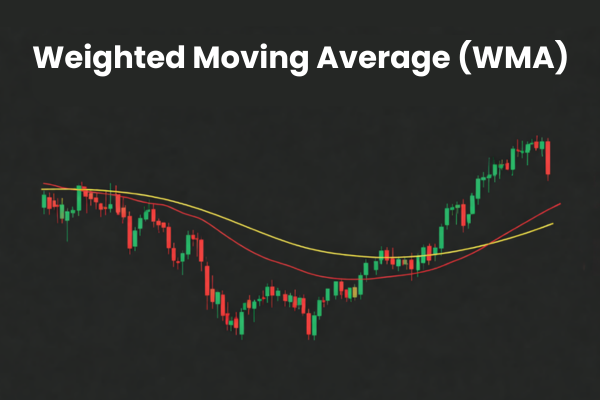
A Weighted Moving Average (WMA) is a type of moving average that assigns a higher weight to the most recent price data. Unlike the Simple Moving Average (SMA), which gives equal weight to all data points, the WMA adjusts the significance of each price based on its position in the series. The most recent price gets the highest weight, making the WMA more sensitive to current market conditions.
For example, if you’re calculating a 5-day WMA, the most recent day’s price would be multiplied by 5, the next by 4, and so on until the oldest price gets a weight of 1. The resulting values are then summed and divided by the total of the weights.
How Does a Weighted Moving Average Work?
To calculate the WMA, follow these steps:
Choose the time period for your moving average (e.g., 10 days).
Assign weights to each day, with the most recent day receiving the highest weight.
Multiply each day’s price by its corresponding weight.
Sum the results of these multiplications.
Divide the total by the sum of the weights to get the average.
The weighted average calculation places more emphasis on recent prices, which allows the WMA to react more quickly to recent price changes compared to other moving averages like the SMA.
Why Use a Weighted Moving Average?
There are several reasons why traders prefer the WMA over other types of moving averages:
1. Sensitivity to Recent Market Movements
One of the key advantages of the WMA is that it reacts more swiftly to recent price movements. Since it gives more weight to the most recent data, it can help traders identify trends earlier than the SMA, which treats all prices equally. This makes the WMA ideal for traders who need quick signals, especially in fast-moving markets.
2. Better Reflection of Short-Term Trends
The WMA is particularly useful for short-term trend analysis. While other moving averages like the SMA or Exponential Moving Average (EMA) can smooth out market fluctuations and offer long-term trend insights, the WMA is more focused on capturing the current market sentiment by emphasising the latest price action.
3. Improved Entry and Exit Signals
The WMA can help traders make better entry and exit decisions. For example, a cross-over strategy might involve using a short-term WMA (e.g., 5-day) crossing above a long-term WMA (e.g., 50-day) as a potential buy signal. Similarly, when the short-term WMA crosses below the long-term WMA, it could signal a potential sell.
4. Dynamic Support and Resistance
Since the WMA adjusts quickly to price changes, it can also act as a dynamic support or resistance level. Traders may watch for price reversals around the WMA, especially in trending markets, where the WMA could indicate areas where price is likely to bounce or face resistance.
Key Differences: WMA vs. SMA
The Simple Moving Average (SMA) is one of the most commonly used moving averages. While the SMA provides a straightforward average of prices over a set period, the WMA gives more importance to recent prices, making it more responsive to current trends.
Feature
SMA
WMA
Weighting
Equal for all data points
Higher weight to recent prices
Responsiveness
Slower reaction to price changes
Quicker reaction to market trends
Smoothing of price data
Smoothes out fluctuations
More sensitive to recent data
Ideal for
Long-term trend identification
Short-term trend analysis
As the table above shows, the WMA’s ability to react faster makes it more suited for short-term trend-following strategies, while the SMA is often preferred for identifying long-term trends due to its stability.
When to Use a Weighted Moving Average in Trading
The WMA can be used in various trading strategies, including trend following, support and resistance analysis, and crossovers. Here’s how you can incorporate WMA into your trading approach:
1. Trend Identification
The WMA is a useful tool for identifying the direction of a trend. When the price is above the WMA, it typically indicates an uptrend. Conversely, when the price is below the WMA, it suggests a downtrend. For traders looking to follow market trends, the WMA offers an adaptive solution that reacts to market movements quickly.
2. Support and Resistance Levels
WMA can also act as dynamic support or resistance levels. When the price approaches the WMA from below, it may act as support, and when it approaches from above, it may serve as resistance. This can provide traders with valuable insights into potential price reversals.
3. Crossovers for Signals
A popular strategy among traders is using WMA crossovers. When a shorter-term WMA crosses above a longer-term WMA, it can signal a buying opportunity (golden cross). On the other hand, a cross below can indicate a selling opportunity (death cross). These crossovers can be strong indicators of trend changes and help traders time their entries and exits.
Limitations of the Weighted Moving Average
While the WMA offers many advantages, it is not without its limitations:
1. Lagging Indicator
Like all moving averages, the WMA is a lagging indicator. It is based on past price data, so it cannot predict future price movements. While it reacts more quickly to changes than the SMA, it still reflects historical trends.
2. Prone to False Signals in Choppy Markets
In volatile or sideways markets, the WMA can produce false signals due to its sensitivity to recent price fluctuations. Traders should be cautious and consider using additional indicators to confirm the signals generated by the WMA.
3. Requires Careful Parameter Selection
The effectiveness of the WMA depends heavily on the period and the weightings chosen. If the period is too short, the WMA may be overly sensitive to short-term noise, while a longer period may result in a slower reaction. Traders need to experiment and adjust these settings based on their trading strategy and market conditions.
Conclusion
The Weighted Moving Average (WMA) is a powerful tool for traders seeking to capture short-term trends and make informed decisions based on recent price data. Its ability to react quickly to changes in the market makes it a popular choice for those looking to trade with precision.
However, like all indicators, the WMA should be used in conjunction with other technical tools and risk management strategies to maximise its effectiveness.
By understanding the nuances of the WMA and integrating it into your trading approach, you can enhance your ability to identify trends, time your entries and exits, and navigate the complexities of the financial markets.
FAQs
What is the difference between WMA and SMA?
The WMA places more weight on recent prices, making it more responsive to market movements, while the SMA treats all data points equally.
How can I use WMA in my trading strategy?
The WMA is useful for trend identification, dynamic support and resistance, and crossover strategies to signal potential buying or selling points.
What are the drawbacks of using WMA?
WMA is a lagging indicator and may produce false signals in volatile or sideways markets. It also requires careful selection of parameters for effective use.
Share Now
Disclaimer:This content is provided for informational purposes only and does not constitute, and should not be construed as, financial, investment, or other professional advice. No statement or opinion contained herein should be considered a recommendation by Ultima Markets or the author regarding any specific investment product, strategy, or transaction. Readers are advised not to rely solely on this material when making investment decisions and should seek independent advice where appropriate.
Thank you for visiting the Ultima Markets website. Please note that this website is intended for individuals residing in jurisdictions where access is permitted by law. Ultima and its affiliated entities do not operate in your home jurisdiction.
By clicking ‘Acknowledge’, you confirm that you are entering this website solely on your own initiative and not as a result of any specific marketing outreach. You wish to obtain information from this website based on reverse solicitation principles, in accordance with the applicable laws of your home jurisdiction.