This website is managed by Ultima Markets’ international entities, and it’s important to emphasise that they are not subject to regulation by the FCA in the UK. Therefore, you must understand that you will not have the FCA’s protection when investing through this website – for example:
You will not be guaranteed Negative Balance Protection
You will not be protected by FCA’s leverage restrictions
You will not have the right to settle disputes via the Financial Ombudsman Service (FOS)
You will not be protected by Financial Services Compensation Scheme (FSCS)
Any monies deposited will not be afforded the protection required under the FCA Client Assets Sourcebook. The level of protection for your funds will be determined by the regulations of the relevant local regulator.
Note: UK clients are kindly invited to visit https://www.ultima-markets.co.uk/. Ultima Markets UK expects to begin onboarding UK clients in accordance with FCA regulatory requirements in 2026.
If you would like to proceed and visit this website, you acknowledge and confirm the following:
1.The website is owned by Ultima Markets’ international entities and not by Ultima Markets UK Ltd, which is regulated by the FCA.
2.Ultima Markets Limited, or any of the Ultima Markets international entities, are neither based in the UK nor licensed by the FCA.
3.You are accessing the website at your own initiative and have not been solicited by Ultima Markets Limited in any way.
4.Investing through this website does not grant you the protections provided by the FCA.
5.Should you choose to invest through this website or with any of the international Ultima Markets entities, you will be subject to the rules and regulations of the relevant international regulatory authorities, not the FCA.
Ultima Markets wants to make it clear that we are duly licensed and authorised to offer the services and financial derivative products listed on our website. Individuals accessing this website and registering a trading account do so entirely of their own volition and without prior solicitation.
By confirming your decision to proceed with entering the website, you hereby affirm that this decision was solely initiated by you, and no solicitation has been made by any Ultima Markets entity.
What is FOMO in trading and why does it cost traders money? Discover how fear of missing out drives poor decisions and learn how you can trade smarter.
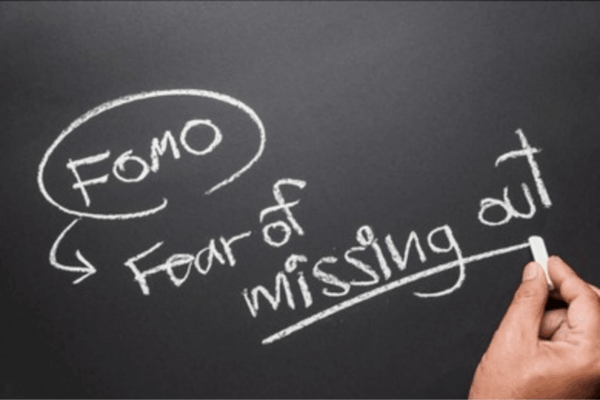
What Is FOMO in Trading? How to Avoid It?
If you have ever watched an asset surge and felt a sudden, almost irresistible urge to jump in without a clear plan, you have already experienced what is FOMO in trading firsthand.
FOMO, or Fear of Missing Out, is one of the most powerful and destructive psychological forces in financial markets. It is not just a feeling; it is a documented behavioural pattern that costs retail traders real money.
Studies show that more than half of young investors aged 18 to 40 put more capital into a trade than they originally planned because of FOMO. Understanding what drives it, how to spot it, and how to manage it is essential for anyone serious about building long-term trading success.
What Is FOMO in Trading?
FOMO in trading refers to the anxiety a trader feels when they believe others are profiting from a market move they are not participating in. At its core, it is an emotion-driven phenomenon rooted in fear, greed, and peer pressure; forces that drive illogical investment decisions and undermine even the most carefully built strategies.
Rather than entering a trade based on technical or fundamental analysis, a FOMO trader acts out of urgency and social pressure. They buy near the top of a rally, chase a surging asset, or abandon their trading plan entirely, simply because a stock or cryptocurrency is trending online. The entry is not driven by data; it is driven by the fear of being left behind.
The Psychology Behind Trading FOMO
To understand why FOMO is so difficult to resist, it helps to look at the science behind it. The human brain is wired to avoid loss and seek social belonging, and financial markets constantly trigger both instincts.
When traders see peers posting screenshots of gains on social media or watch an asset climbing sharply, the brain interprets inaction as a form of loss. This cognitive bias is known as loss aversion, and it is one of the most well-documented concepts in behavioural finance.
The problem is amplified significantly in the digital age. The more connected market participants are through platforms like X (formerly Twitter), Discord, Telegram, and Reddit, the faster FOMO spreads through a crowd.
Research also shows that FOMO’s impact is notably stronger in democratic countries where the free flow of information and social influence makes investors more susceptible to sentiment-driven decision making.
Beyond the mental dimension, FOMO also has physical symptoms worth recognising. Traders in the grip of a FOMO moment often report a racing heartbeat, mild sweating, and a mental loop that keeps returning to the trade they feel they are missing. Being aware of these physical cues can be just as valuable as reading a chart pattern.
The Global FOMO Index: What the Data Says
FOMO is no longer just a theoretical concept; it is now measurable at a macro level. Researcher Yosef Bonaparte developed the Global FOMO Index using Google Trends data spanning 2004 to 2024, tracking six key search terms related to investor anxiety. The index revealed a clear upward trend across two decades, with major spikes in 2018 and 2021 coinciding with Bitcoin reaching $20,000 and $69,000 respectively.
The index reached a new peak in 2025 following Donald Trump’s re-election and Bitcoin surpassing $100,000. Importantly, the index carries a serial correlation coefficient of 0.991, making it one of the most statistically stable sentiment indicators in financial research.
In practical terms, this means FOMO is not a random event; it is a recurring, predictable force that shapes market cycles.
The data also shows a direct cost to performance, with high FOMO periods consistently associated with a 4% decline in Sharpe ratios, meaning risk-adjusted returns deteriorate whenever fear of missing out takes hold of market sentiment.
How Did FOMO Play Out in the Market
Understanding what is FOMO in trading becomes even sharper when you look at how it has played out in live markets.
Bitcoin, October 2025
Following a surge of approximately $985 million in Bitcoin ETF inflows on a single day in early October 2025, FOMO-driven buying pushed prices towards the $120,000 level. What followed was a sharp correction into the $83,000 to $86,000 support zone as open interest fell from around $95 billion to $70 billion, wiping out leveraged traders who had entered at the peak.
The Fake ETF Tweet, 2023
When Cointelegraph falsely reported that the SEC had approved BlackRock’s Bitcoin Spot ETF, FOMO flooded the market instantly. Bitcoin surged past $30,000 and triggered over $103 million in liquidations, with more than 80% hitting traders on the wrong side of the move. Once the rumour was corrected, the price reversed just as quickly, leaving late entrants with significant losses.
GameStop and WallStreetBets, 2021
When Reddit’s WallStreetBets community drove GameStop from $20 to over $400, FOMO led thousands of retail traders to buy near the top. The subsequent crash erased a large portion of those late entries within days, serving as one of the most publicised examples of crowd-driven FOMO in market history.
These are not outliers. They are textbook demonstrations of FOMO operating at scale, and they follow the same pattern every time.
Five Warning Signs You Are FOMO Trading
Recognising FOMO in your own behaviour is the first step to correcting it. Watch out for these patterns in your trading:
Entering without a plan. You open a trade without defining your entry criteria, exit level, or risk parameters because the market is moving and you feel you need to act immediately.
Chasing after a large candle. You enter immediately after a sharp price spike, fearing the trend will continue without you, even though the move has already happened.
Widening your stop-loss. You move your stop further away because the prospect of being wrong feels worse than accepting extra risk, which is the opposite of sound risk management.
Trading based on screenshots. Someone posts a profit in a group chat and you place a trade to match it, without doing any personal analysis or understanding the original thesis.
Switching instruments impulsively. You move between currency pairs, stocks, or coins rapidly, chasing whichever asset is currently “moving” rather than sticking to instruments you have properly researched.
How FOMO Damages Your Trading Account
The financial cost of what is FOMO in trading is well-documented and worth taking seriously. A 2025 Empower survey found that 57% of Americans admit to making financial decisions based on the social media lifestyles they observe online.
In forex markets specifically, FOMO leads traders to ignore overbought and oversold signals on currency charts, chasing moves backed by unverified rumours rather than technical data.
At a portfolio level, FOMO trading typically results in late entries, inflated position sizes, and abandoned stop-losses; three of the most common causes of blown trading accounts. When combined with the measurable 4% Sharpe ratio decline seen during high FOMO periods, the pattern is clear: emotional trading does not just hurt individual trades, it degrades overall portfolio performance over time.
How to Manage FOMO and Trade with Discipline
The good news is that FOMO is manageable, and the traders who build lasting careers are those who develop systems to counter it. Here are the most effective approaches.
Follow a written trading plan. Before placing any trade, define your entry criteria, position size, stop-loss level, and profit target. If an opportunity does not meet your criteria, it is simply not your trade. A written plan removes emotion from the equation.
Accept that missing a move is part of trading. Markets generate new opportunities every single session. The asset you feel you missed today will be replaced by another setup tomorrow. No single trade defines a trading career.
Limit social media exposure during market hours. Platforms like X and Discord are well-known breeding grounds for hype cycles, where influencers post profit screenshots without context. Reducing your exposure to this noise directly reduces the frequency of impulsive entries.
Keep a trading journal. Recording your emotional state alongside your trade outcomes over time reveals exactly when and how FOMO is influencing your decisions. Self-awareness built through journalling is one of the most underrated edges in retail trading.
Use pre-defined watchlists. Focus only on instruments you have already researched and understand. Chasing an unfamiliar stock or token because it trended overnight is a classic FOMO mistake with a well-documented outcome.
Conclusion
So what is FOMO in trading at its core? It is the gap between what the market is doing and what your emotions are telling you to do.
Keep in mind that the traders who succeed long-term are not the ones who catch every rally. They are the ones who remain structured and disciplined when the crowd is reacting on emotion.
At Ultima Markets, we believe that education and psychological discipline are as important as any technical strategy. Understanding FOMO is not just useful knowledge; it is your first real edge.
FAQs
What is FOMO in trading?
FOMO in trading stands for Fear of Missing Out. It is the impulse to enter a trade driven by anxiety rather than sound analysis or a pre-planned strategy, and it is one of the most common causes of impulsive trading losses.
How does FOMO affect trading performance?
It leads to late entries, abandoned stop-losses, and inflated position sizes. Research links high FOMO periods to a 4% decline in Sharpe ratios, meaning risk-adjusted returns deteriorate significantly when emotion overrides strategy.
How do I stop FOMO from affecting my trades?
Follow a written trading plan, reduce social media exposure during market hours, and keep a trading journal to track emotional patterns. Accepting that missing a move is normal is the foundation of disciplined, long-term trading.
Share Now
Disclaimer:This content is provided for informational purposes only and does not constitute, and should not be construed as, financial, investment, or other professional advice. No statement or opinion contained herein should be considered a recommendation by Ultima Markets or the author regarding any specific investment product, strategy, or transaction. Readers are advised not to rely solely on this material when making investment decisions and should seek independent advice where appropriate.
Thank you for visiting the Ultima Markets website. Please note that this website is intended for individuals residing in jurisdictions where access is permitted by law. Ultima and its affiliated entities do not operate in your home jurisdiction.
By clicking ‘Acknowledge’, you confirm that you are entering this website solely on your own initiative and not as a result of any specific marketing outreach. You wish to obtain information from this website based on reverse solicitation principles, in accordance with the applicable laws of your home jurisdiction.