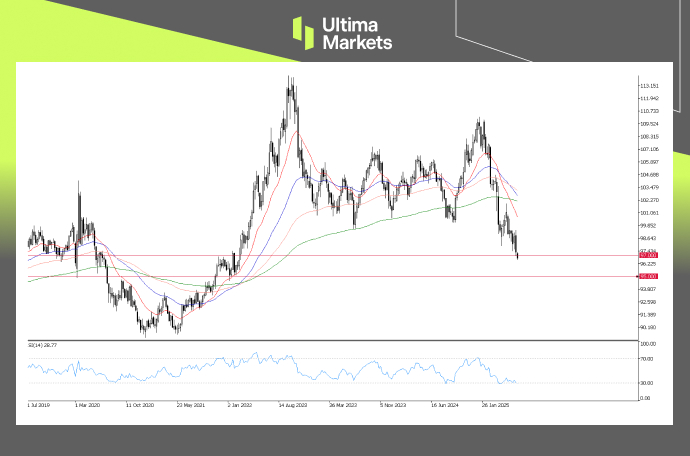
The U.S. Dollar came under renewed selling pressure on Monday, with the U.S. Dollar Index (USDX) sliding below the 96 mark—its lowest level in more than three years. The greenback has now lost nearly 11% in the first half of 2025, marking its worst first-half performance since 1973.
What’s Driving the Dollar Decline?
Several key factors are contributing to the dollar’s sharp depreciation:
- Dovish Federal Reserve Outlook Market participants have increasingly priced in the potential for rate cuts later this year, as the Fed maintains a cautious, data-dependent stance. This has diminished the appeal of the dollar compared to higher-yielding or risk-linked currencies.
- Mounting U.S. Fiscal Concerns The U.S. government faces a growing fiscal challenge, with over 55% of the $9.2 trillion in Treasury debt maturing in 2025 coming due in July. Investors are increasingly uneasy about the scale of refinancing required amid persistent deficits.
- Uncertainty Around Trump’s Trade and Fiscal Policy The 90-day pause on Trump’s tariff policy is set to expire on July 9, raising concerns about a renewed wave of trade disruptions. Meanwhile, sweeping tax cuts and spending proposals from the Trump administration are further fueling deficit worries.
“Potential increases in the budget deficit, persistent fiscal concerns, and lingering uncertainty around upcoming tariff decisions are all weighing heavily on the U.S. Dollar,” said Shawn, Senior Market Analyst at Ultima Markets.
Markets React: Equities Climb as Dollar Lags
Despite the dollar’s weakness, U.S. equities continue to hit fresh record highs, reflecting investor appetite for risk assets and a rotation out of traditional safe havens. The dollar’s decline is also creating tailwinds for overseas markets, particularly in Europe and emerging economies.
The EURUSD extended gains to a four-year high, approaching the 1.1800 level as of writing. This divergence between falling dollar strength and rising equities underlines shifting capital flows away from the dollar and into global growth opportunities.
What to Watch Next
The weakness in the U.S. Dollar is likely to persist under the current macro landscape. With little in the way of supportive catalysts, market attention will now shift toward key U.S. labor market data this week—most notably the ADP employment report (July 2) and the Non-Farm Payrolls (NFP) report (July 3).
These data points will be crucial in shaping expectations around the Federal Reserve’s rate path and how market sees the U.S. economy outlook.
- Stronger-than-expected job figures could cool Fed rate cut bets, offering some short-term support for the dollar.
- Weaker labor market data, on the other hand, would signal economic softness and deepen expectations for monetary easing, keeping further pressure on the dollar.
Simply put, If the U.S. labor market shows signs of weakening, it would reinforce the view of a slowing economy—and the dollar could see more downside ahead.
USDX, Weekly Chart Outlook | Source: Ultima Market MT5
The U.S. Dollar slipped below the 97 mark, hitting its lowest level since January 2022.
Disclaimer
Comments, news, research, analysis, price, and all information contained in the article only serve as general information for readers and do not suggest any advice. Ultima Markets has taken reasonable measures to provide up-to-date information, but cannot guarantee accuracy, and may modify without notice. Ultima Markets will not be responsible for any loss incurred due to the application of the information provided.