This website is managed by Ultima Markets’ international entities, and it’s important to emphasise that they are not subject to regulation by the FCA in the UK. Therefore, you must understand that you will not have the FCA’s protection when investing through this website – for example:
You will not be guaranteed Negative Balance Protection
You will not be protected by FCA’s leverage restrictions
You will not have the right to settle disputes via the Financial Ombudsman Service (FOS)
You will not be protected by Financial Services Compensation Scheme (FSCS)
Any monies deposited will not be afforded the protection required under the FCA Client Assets Sourcebook. The level of protection for your funds will be determined by the regulations of the relevant local regulator.
Note: UK clients are kindly invited to visit https://www.ultima-markets.co.uk/. Ultima Markets UK expects to begin onboarding UK clients in accordance with FCA regulatory requirements in 2026.
If you would like to proceed and visit this website, you acknowledge and confirm the following:
1.The website is owned by Ultima Markets’ international entities and not by Ultima Markets UK Ltd, which is regulated by the FCA.
2.Ultima Markets Limited, or any of the Ultima Markets international entities, are neither based in the UK nor licensed by the FCA.
3.You are accessing the website at your own initiative and have not been solicited by Ultima Markets Limited in any way.
4.Investing through this website does not grant you the protections provided by the FCA.
5.Should you choose to invest through this website or with any of the international Ultima Markets entities, you will be subject to the rules and regulations of the relevant international regulatory authorities, not the FCA.
Ultima Markets wants to make it clear that we are duly licensed and authorised to offer the services and financial derivative products listed on our website. Individuals accessing this website and registering a trading account do so entirely of their own volition and without prior solicitation.
By confirming your decision to proceed with entering the website, you hereby affirm that this decision was solely initiated by you, and no solicitation has been made by any Ultima Markets entity.
Ultima Markets does not have an establishment in Singapore and does not operate from Singapore.
Ultima Markets does not provide products or services to citizens or residents of Singapore, and account applications from Singapore citizens or residents will not be accepted.
If you are a citizen or resident of Singapore, please do not open an account or use Ultima Markets’ products or services.
By selecting “Acknowledge and Continue Browsing”, you confirm that you are accessing this website on your own initiative and that your access is not the result of any direct marketing, targeted advertising, solicitation, or promotional activity by Ultima Markets.
Nothing on this website constitutes an offer, solicitation, or promotion of products or services in any jurisdiction where such activity is prohibited. You are responsible for ensuring that your access to and use of this website complies with applicable local laws and regulations.
RBA Minutes Signal Dovish Tilt, Data-Dependent Path Ahead
RBA Minutes Signal Dovish Tilt, Data-Dependent Path Ahead
The Reserve Bank of Australia’s (RBA) minutes from its August 11-12 meeting revealed a stronger dovish bias, with policymakers acknowledging a solid case for lowering the cash rate by 25 basis points.
RBA Minutes Key Takeaways
Over the minutes, the Board noted that while policy remains “somewhat restrictive,” further reductions in the cash rate are likely needed over the coming year. The pace of easing, however, will be determined by incoming economic data and the evolving balance of global risks.
Policymakers weighed arguments for both a gradual and a faster pace of rate cuts. On one hand, lingering uncertainty about the economy’s spare capacity and the neutral rate argues for a measured approach. On the other hand, if the labor market has already reached balance, faster easing may be required to prevent inflation from undershooting the target midpoint.
The minutes also pointed to several supporting factors:
Inflation remains above the midpoint but contained.
The labor market still “a little tight”.
Domestic demand is showing signs of recovery.
Tariff risks remain significant, though the worst outcome now appear less likely.
The board members forecasts continue to see Australia on track to meet its full employment and inflation objectives, while house price increases but remain within easing cycle norms, with home building starting to pick up.
On balance sheet policy, the Board decided against accelerating the reduction of government bond holdings, preferring instead to continue running them down as they mature.
Market Implications on RBA
The minutes suggest the RBA is tilting more dovish than previously expected, opening the door for rate cuts in the months ahead. However, officials remain cautious and data-dependent, making upcoming CPI and labor market reports critical in shaping the central bank’s next move.
Key Data to Watch:
Monthly CPI Indicator (27 August): Recent readings have pointed to a disinflationary trend, making tomorrow’s release particularly important for near-term policy expectations.
Q3 Consumer Price Index (29 October): This will be the critical update for assessing progress toward the inflation target and could heavily influence the RBA’s next policy move.
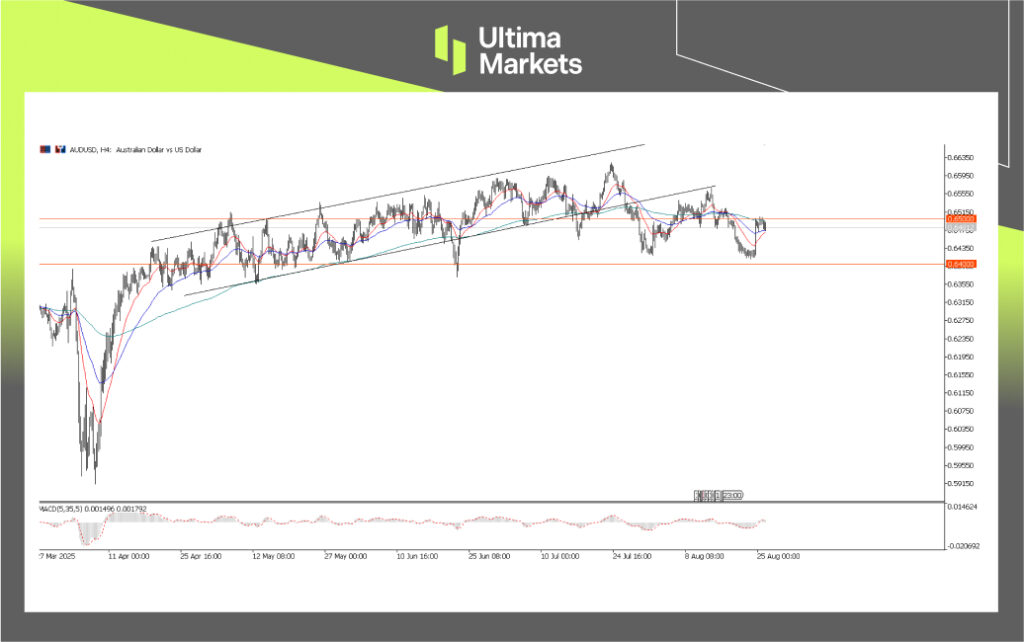
AUD/USD: Downside Bias Emerging, but Limited by USD Weakness
AUD/USD, 4-H Chart Analysis | Source: Ultima Market MT5
The AUD/USD has broken below its recent uptrend channel, signaling rising downside pressure for the Australian dollar. However, the move lower has been partially contained by ongoing weakness in the U.S. dollar.
That said, sustained price action below the 0.6500 level could reinforce a bearish outlook for the pair, particularly against stronger major currencies. Near-term sentiment remains cautious, with key upcoming data releases likely to dictate the next directional move.
Disclaimer
Comments, news, research, analysis, price, and all information contained in the article only serve as general information for readers and do not suggest any advice. Ultima Markets has taken reasonable measures to provide up-to-date information, but cannot guarantee accuracy, and may modify without notice. Ultima Markets will not be responsible for any loss incurred due to the application of the information provided.
Thank you for visiting the Ultima Markets website. Please note that this website is intended for individuals residing in jurisdictions where access is permitted by law. Ultima and its affiliated entities do not operate in your home jurisdiction.
By clicking ‘Acknowledge’, you confirm that you are entering this website solely on your own initiative and not as a result of any specific marketing outreach. You wish to obtain information from this website based on reverse solicitation principles, in accordance with the applicable laws of your home jurisdiction.