ECB Cuts by 25 Bps as Expected, Focus on Growth Risks
On March 6, the European Central Bank (ECB) announced its latest interest rate decision and key monetary policy measures. As widely expected, the central bank cut all three key interest rates by 25 basis points:
- Deposit Facility Rate: 2.50%
- Main Refinancing Operations Rate: 2.65%
- Marginal Lending Facility Rate: 2.90%
Since the rate cuts were largely anticipated, market focus mainly shifted to the ECB’s monetary policy statement and its economic outlook.
ECB Economic Outlook
Over the inflation outlook, the ECB expects core inflation to stabilize around its 2% medium-term target. However, domestic inflation remains elevated, driven by delayed wage and price adjustments. While wage growth is moderating, corporate profits are absorbing some of the inflationary impact.
Meanwhile, the ECB revised its GDP growth forecasts downward, reflecting weaker exports and sluggish investment due to heightened trade policy uncertainty:
- 2025: 0.9%
- 2026: 1.2%
- 2027: 1.3%
ECB Press Conference Highlight
In the post-meeting press conference, ECB President Christine Lagarde addressed several critical issues, including global trade tensions and the economic uncertainty linked to Trump’s tariff policies:
- Trade Tensions: Lagarde highlighted concerns over escalating tariffs and their negative impact on global trade, adding uncertainty to the economic outlook.
- Global Uncertainty: She described the current environment as one of “phenomenal uncertainty”, suggesting that the ECB may pause rate cuts in the coming meetings.
- Fiscal Policies: The ECB continues to monitor German/EU spending plans, which could play a role in supporting growth.
- Growth Risks: Economic risks remain tilted to the downside, with trade tensions posing a major threat.
- Inflation Risks: While fiscal spending plans could boost inflation through increased aggregate demand, downside risks persist.
What This Means for the ECB’s Policy Direction
The ECB’s main concern appears to be the impact of global trade uncertainty on Eurozone growth. While inflation is now close to the ECB’s target, policymakers are shifting their focus toward stimulating economic growth, beyond just monetary easing.
However, the ECB remains cautious about inflation risks and will likely adjust its policies accordingly. The central bank emphasized a data-dependent, meeting-by-meeting approach to future monetary policy decisions, avoiding any commitment to a predetermined rate path.
This stance has led to what can be considered a “hawkish cut” in the March meeting.
EUR/USD Gains on Hawkish ECB Stance – More Upside Ahead?
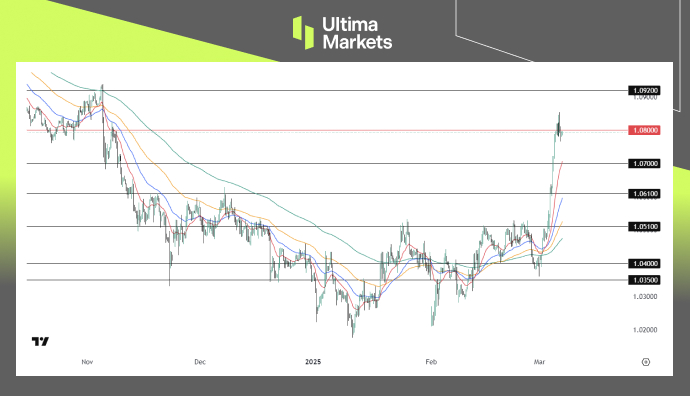
This week, EUR/USD has experienced a strong bullish run, fueled by optimism surrounding German/EU spending plans and weakness in the US dollar. The ECB’s hawkish shift may continue to favor the euro in the near term.
(EUR/USD, 4-Hour Chart Analysis; Source: TradingView)
From a technical perspective, EUR/USD has staged a remarkable rally, approaching the 1.0800 mark. The bullish setup remains intact, and with the ECB’s slightly hawkish tilt, the pair may see further upside.
However, traders should remain cautious of potential short-term pullbacks. Key support levels to watch are 1.0700 and 1.0610, which could act as strong support should retracement occurs.
Disclaimer
Comments, news, research, analysis, price, and all information contained in the article only serve as general information for readers and do not suggest any advice. Ultima Markets has taken reasonable measures to provide up-to-date information, but cannot guarantee accuracy, and may modify without notice. Ultima Markets will not be responsible for any loss incurred due to the application of the information provided.