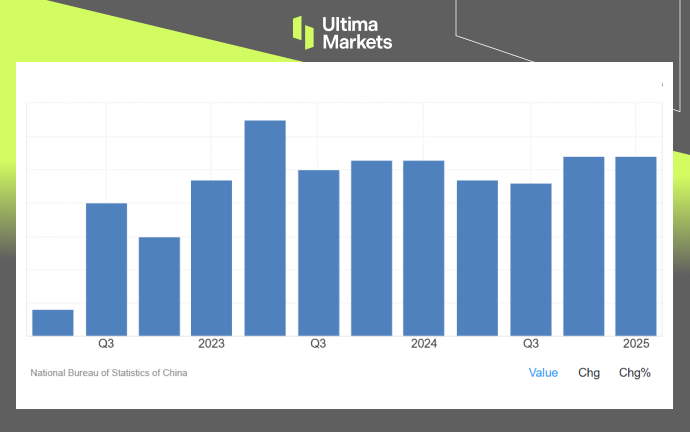
China’s economy showed resilience in the first quarter of 2025, with GDP expanding by 5.4% year-on-year—beating market expectations of 5.1%, according to data released on Wednesday.
March’s economic data also painted a promising picture. Retail sales rose 5.9% year-on-year, up from February’s 4% increase, while industrial production surged by 7.7%, highlighting continued domestic strength.
(China GDP YoY; Source: National Bureau of Statistic of China)
A Pre-Trade War Surge?
Despite the upbeat numbers, questions remain over the sustainability of this momentum. The recent imposition of steep tariffs—145% on Chinese goods by the U.S., countered by China’s retaliatory 125% tariffs—has escalated tensions into a full-scale trade war, raising concerns about the economy’s trajectory for the rest of the year.
Some economists suggest the Q1 surge may reflect a front-loading effect, with exporters rushing shipments ahead of the widely anticipated April tariff announcements. If so, the true economic impact of the trade conflict may only become evident in subsequent data releases.
PBoC’s Response: Easing Ahead
In response to rising external pressures, the People’s Bank of China (PBoC) is expected to ramp up policy support. The central bank has already cut the reserve requirement ratio (RRR) for select banks, aiming to boost liquidity—particularly for small and medium-sized enterprises (SMEs) vulnerable to export disruptions.
More targeted RRR cuts are anticipated if trade tensions intensify. Additionally, further interest rate cuts remain on the table should the tariffs significantly impact growth or employment.
While China’s Q1 performance was stronger than expected, the worsening trade conflict with the U.S. presents a significant downside risk. Policymakers are likely to continue deploying both monetary and fiscal tools to cushion the economy. However, the full extent of the trade war’s impact is expected to surface in the coming quarters.
“The PBoC is likely to roll out additional easing measures to navigate the challenging period brought on by the trade war,” said Ultima Markets senior analyst Shawn.
“China is clearly prepared with a full range of policy tools when it decides to confront the US in full-scale trade conflict,” he added.
What’s Next for USDCNH?
The U.S. Dollar strengthened against the offshore Chinese Yuan (CNH), despite broader dollar weakness. This move is largely attributed to the People’s Bank of China’s (PBoC) ongoing easing measures and a possible “managed depreciation” strategy to support China’s export sector amid rising trade tensions.
(USDCNH, Day-Chart Analysis; Source: Ultima Market MT5)
Technically, USDCNH briefly broke above the key resistance level at 7.36, marking a new record high. This suggests that pressure for CNH depreciation remains intact due to both monetary easing and trade war concerns.
Although the pair quickly pulled back from the highs, indicating limited short-term bullish momentum, the broader outlook still favors upside potential. As long as USDCNH holds above the 7.22 level, further gains remain possible in the near term.
Disclaimer
Comments, news, research, analysis, price, and all information contained in the article only serve as general information for readers and do not suggest any advice. Ultima Markets has taken reasonable measures to provide up-to-date information, but cannot guarantee accuracy, and may modify without notice. Ultima Markets will not be responsible for any loss incurred due to the application of the information provided.