The foreign exchange market saw heightened volatility on Thursday as two major European central banks—the Bank of England (BoE) and the Swiss National Bank (SNB)—delivered policy updates that reflected diverging paths on rate decisions.
BoE Holds Steady, But Signals Cautious Easing Ahead
The Bank of England left its benchmark interest rate unchanged at 4.25%, as expected. However, the tone of the decision hinted at a shift toward easing in the near term. The 6-3 vote split on the Monetary Policy Committee (MPC)—with three members voting for an immediate rate cut—was slightly more dovish than markets had anticipated.
This shift suggests that momentum is building internally toward rate reductions, although the BoE emphasized that future cuts would be “gradual and carefully considered,” given lingering inflation risks.
Key Drivers Behind the Decision:
- Jobs market weakness: June payrolls saw their biggest monthly drop since 2020, a sign of softening labor demand.
- Sticky inflation: While headline inflation eased to 3.4% in May, services inflation remained elevated, keeping underlying price pressures stubbornly high.
- External risks: Ongoing Middle East tensions and higher oil prices (~$77/bbl), alongside the uncertainty of U.S. tariffs, added pressure to the UK’s economic outlook.
BoE Economic Outlook & Market Expectations
The central bank also updated its economic projections, highlighting a mix of moderation and persistent risks:
- Inflation: Expected to peak near 3.7% in Q3, then ease slightly to around 3.5% in the latter part of the year.
- Growth: Revised modestly higher for Q2 (~0.25%), though underlying momentum remains subdued.
Markets are now pricing in the first BoE rate cut in August, with a terminal rate of 3.75% by year-end, assuming inflation trends lower and economic activity continues to cool.
SNB Cuts Rate to Zero, Ending Tightening Cycle
In a more decisive shift compared to the Bank of England’s cautious approach, the Swiss National Bank (SNB) lowered its policy rate by 25 basis points to 0%, officially marking the end of its tightening cycle that began in late 2022. This move represents the sixth rate cut since March 2024 and the SNB’s first return to a zero-rate environment since 2022.
The decision was driven by easing domestic inflation pressures and the ongoing strength of the Swiss franc, which has continued to appreciate amid safe-haven inflows triggered by global geopolitical uncertainty. The stronger franc has helped contain imported inflation, giving the SNB room to ease policy.
SNB’s Policy Rationale and Forward Guidance
In its policy statement, the SNB highlighted several key concerns and strategic considerations:
- The rate cut aims to counter weak inflation trends and reduce upward pressure on the franc.
- The bank flagged ongoing global risks, including trade barriers, geopolitical tensions, and slowing global demand, which could further suppress both growth and inflation in Switzerland.
- While moving toward a neutral policy stance, the SNB emphasized it remains ready to act again should inflation deviate from target levels.
FX Intervention and Negative Rates: Still on the Table
One of the more notable elements in the SNB’s communication was its renewed emphasis on foreign exchange intervention. The central bank made clear that it retains flexibility in using both interest rates and FX market tools to maintain price stability and support the broader economy.
FX intervention remains a live option to manage excessive appreciation of the franc. Meanwhile, negative interest rates are not entirely ruled out. However, the SNB stressed that such a move would be considered only with caution, acknowledging the potential side effects on financial stability and bank profitability.
GBPCHF: Rebound on Policy Divergence
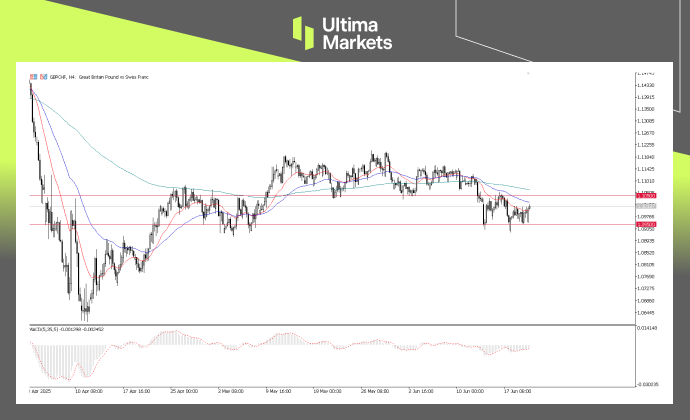
The GBPCHF pair rebounded from a two-month low, lifted by the growing policy divergence between the Bank of England and the Swiss National Bank.
After dipping to the 1.0950 level, the British pound regained ground against the franc, supported by expectations that the BoE will remain more cautious compared to the SNB’s dovish turn.
GBPCHF, 4-H Chart Analysis | Source: Ultima Market MT5
While the policy divergence between the two central banks could be favorable to the pound, traders should remain cautious about any short-term moves.
Technically, 1.0950–1.1050 serves as a major range-bound zone for the pair; a clearer move would only emerge upon a breakout from this current range.
Disclaimer
Comments, news, research, analysis, price, and all information contained in the article only serve as general information for readers and do not suggest any advice. Ultima Markets has taken reasonable measures to provide up-to-date information, but cannot guarantee accuracy, and may modify without notice. Ultima Markets will not be responsible for any loss incurred due to the application of the information provided.