At its May meeting, the Bank of England (BoE) cut its benchmark interest rate by 25 basis points to 4.25%, marking the fourth consecutive cut since August 2024. The move aims to support the UK economy amid rising global trade uncertainty, particularly those tied to recent U.S. tariff actions.
BoE’s Remarks & Updated Economic Projections
The BoE revised its economic outlook during the May meeting, factoring in the growing impact of global trade disruptions.
Key Updated Projections:
- 2025 GDP growth: 1.0%, down from 1.2% in the February forecast
- Inflation: Peaking at 3.5%, expected to return to the 2% target by 2026
- Unemployment: Rising modestly to 5%, up from 4.5% previously projected
The downward revision in growth and rising unemployment rate reflects the ongoing trade headwinds, especially from U.S. tariffs and broader global uncertainties.
Governor Andrew Bailey signaled a cautious approach to future rate moves, stressing that monetary policy is not on a fixed path. He emphasized that the Monetary Policy Committee (MPC) remains data-dependent, with upcoming decisions to be guided by evolving economic conditions—especially those influenced by global trade dynamics.
Implication for Future Policy Path
Although both the MPC and Governor Bailey emphasized that there is no predetermined path for interest rates, the overall tone and vote breakdown suggest that the BoE is leaning more dovish, particularly with its focus on supporting the UK economy.
Monetary Policy Committee (MPC) Vote Breakdown:
- 5 members voted for a 0.25 percentage point cut.
- 2 members advocated for a larger 0.5 percentage point cut.
- 2 members preferred to maintain the current rate.
This unexpected three-way split reveals a divergence of views within the committee on how to respond to the current economic challenges. Still, with a growing number of members backing rate cuts, the BoE appears increasingly open to further easing in the coming meetings.
UK-US Trade Deal Finalized
At the same time, U.S. President Donald Trump announced a new trade agreement with the United Kingdom, marking the first major deal since the implementation of broad tariffs in April.
Key elements of the agreement include:
- Tariff Reductions: Elimination of the 25% tariffs on British steel and aluminum exports to the U.S., and a reduction of car tariffs from 25% to 10% for up to 100,000 vehicles annually.
- Agricultural Access: The U.K. will increase imports of U.S. goods, including beef and ethanol, under specific quotas.
- Pharmaceuticals and Customs: The deal ensures preferential treatment for U.K. pharmaceuticals and includes commitments to reduce trade barriers
U.K. Prime Minister Keir Starmer described the agreement as “jobs saved, not job done,” indicating that further negotiations are anticipated.
Pound-Dollar: Market Sentiment Shifts
It was an eventful Thursday for the UK, with the Pound weakening against the US Dollar. Previously, US tariff policies had weighed on market confidence in the Dollar, prompting capital to flow into the Pound.
However, the landscape has now shifted. A dovish rate cut by the Bank of England, along with the finalization of a UK-US trade deal, could reversed sentiment—leading to renewed support for the Dollar and a potential reversal in the Pound’s recent strength.
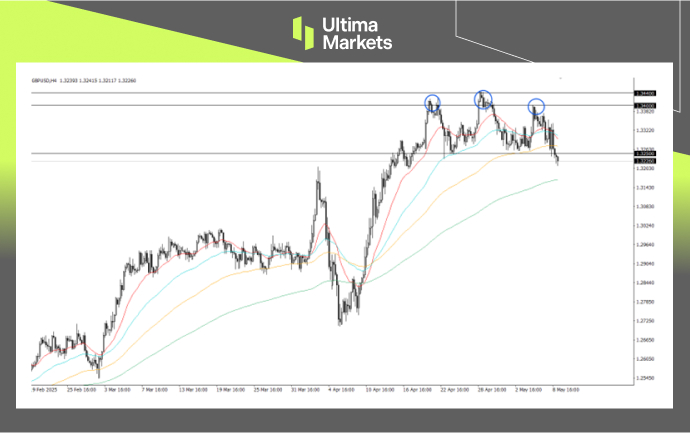
GBPUSD, 4-H Chart Analysis; Source: Ultima Market MT5
From the technical perspective, he GBPUSD is showing signs of a potential bearish reversal, with a possible triple top or head-and-shoulders pattern forming near the 1.3400 level. Price has now broken below the 1.3250 support area, confirming the neckline break.
Disclaimer
Comments, news, research, analysis, price, and all information contained in the article only serve as general information for readers and do not suggest any advice. Ultima Markets has taken reasonable measures to provide up-to-date information, but cannot guarantee accuracy, and may modify without notice. Ultima Markets will not be responsible for any loss incurred due to the application of the information provided.