This website is managed by Ultima Markets’ international entities, and it’s important to emphasise that they are not subject to regulation by the FCA in the UK. Therefore, you must understand that you will not have the FCA’s protection when investing through this website – for example:
You will not be guaranteed Negative Balance Protection
You will not be protected by FCA’s leverage restrictions
You will not have the right to settle disputes via the Financial Ombudsman Service (FOS)
You will not be protected by Financial Services Compensation Scheme (FSCS)
Any monies deposited will not be afforded the protection required under the FCA Client Assets Sourcebook. The level of protection for your funds will be determined by the regulations of the relevant local regulator.
Note: UK clients are kindly invited to visit https://www.ultima-markets.co.uk/. Ultima Markets UK expects to begin onboarding UK clients in accordance with FCA regulatory requirements in 2026.
If you would like to proceed and visit this website, you acknowledge and confirm the following:
1.The website is owned by Ultima Markets’ international entities and not by Ultima Markets UK Ltd, which is regulated by the FCA.
2.Ultima Markets Limited, or any of the Ultima Markets international entities, are neither based in the UK nor licensed by the FCA.
3.You are accessing the website at your own initiative and have not been solicited by Ultima Markets Limited in any way.
4.Investing through this website does not grant you the protections provided by the FCA.
5.Should you choose to invest through this website or with any of the international Ultima Markets entities, you will be subject to the rules and regulations of the relevant international regulatory authorities, not the FCA.
Ultima Markets wants to make it clear that we are duly licensed and authorised to offer the services and financial derivative products listed on our website. Individuals accessing this website and registering a trading account do so entirely of their own volition and without prior solicitation.
By confirming your decision to proceed with entering the website, you hereby affirm that this decision was solely initiated by you, and no solicitation has been made by any Ultima Markets entity.
Ultima Markets does not have an establishment in Singapore and does not operate from Singapore.
Ultima Markets does not provide products or services to citizens or residents of Singapore, and account applications from Singapore citizens or residents will not be accepted.
If you are a citizen or resident of Singapore, please do not open an account or use Ultima Markets’ products or services.
By selecting “Acknowledge and Continue Browsing”, you confirm that you are accessing this website on your own initiative and that your access is not the result of any direct marketing, targeted advertising, solicitation, or promotional activity by Ultima Markets.
Nothing on this website constitutes an offer, solicitation, or promotion of products or services in any jurisdiction where such activity is prohibited. You are responsible for ensuring that your access to and use of this website complies with applicable local laws and regulations.
Crude Oil Prices Remain Subdued: Will Supply Pressure or Geopolitical Risks Take the Lead?
Crude Oil Prices Remain Subdued: Will Supply Pressure or Geopolitical Risks Take the Lead?
The International Energy Agency (IEA) recently released its September 2025 Oil Market Report, highlighting that the market is currently caught between concerns over supply-demand imbalance and heightened geopolitical turmoil.
On one hand, increased output from OPEC+—together with China’s continued crude stockpiling—has eased concerns about future shortages. On the other hand, with hopes for a Russia-Ukraine settlement stalled, markets worry that further Western sanctions on Russia and Iran could restrict supplies.
Given the current downbeat trend in crude oil, the key question for markets is whether prices will extend their decline or find momentum for a potential rebound.
1. The Weight of Oversupply
Several factors are contributing to the current oversupply, keeping a lid on prices. Middle Eastern countries are increasingly using natural gas for power generation, which frees up more crude oil for export. Meanwhile, Russia is working to maintain its fiscal revenues by keeping its oil exports strong. While OPEC+ has tried to stabilize the market with production adjustments, these efforts have been largely offset by a combination of other factors, leading to a surplus.
In the U.S., a continued oversupply and weak fuel demand are also dragging prices down. Although U.S. crude inventories recently dropped due to a sharp decline in imports and a rise in exports, distillate inventories unexpectedly rose by 4 million barrels (well above the expected 1 million). This significant increase highlights the underlying weakness in demand.
Even a recent 25-basis-point rate cut by the Federal Reserve didn’t provide much support. While such a move typically stimulates the economy and boosts energy demand, the strong U.S. dollar negated this effect. A powerful dollar makes dollar-denominated crude more expensive for foreign buyers, further suppressing global demand.
2. Geopolitical Risks and Unexpected Shocks
Despite the bearish fundamentals, geopolitical risks remain the biggest source of uncertainty.
Although Ukraine’s attacks on Russian refineries continue, U.S. President Trump’s desire for lower oil prices has muted their impact. President Trump has also urged Europe to completely stop importing Russian crude, which could reduce Russia’s exports if it were to happen. However, India is likely to keep buying large volumes of Russian oil, and Japan has rejected the U.S.’s proposal for tariffs on countries importing Russian crude. Meanwhile, China continues to build up its crude stockpiles, adding another layer of complexity to the geopolitical landscape.
While these tensions have reignited political spats, they haven’t yet directly impacted the supply-demand balance. Their main effect has been to cause sharp, short-term swings in market sentiment. For now, a major, tangible supply disruption seems unlikely, so the influence of geopolitics on prices is expected to remain limited.
3. What’s Next for Crude Oil
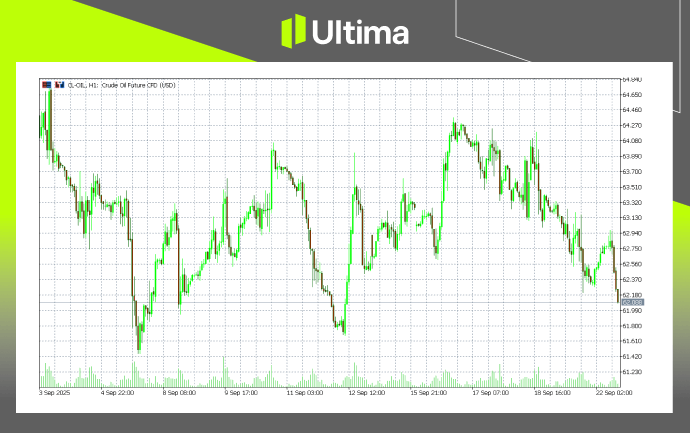
In September, Brent crude prices have been trading in a tight range between $61 and $65 per barrel, with bearish sentiment dominating the market.
For investors, a cautious approach is advised. One strategy could be to wait for a rebound towards the $64.00–$64.50 resistance zone. If prices show signs of weakness at this level, it could present an attractive opportunity to short the market. Conversely, a drop below the key $62.00 support level would reinforce the bearish signal and could lead to further selling.
Traders should be prepared for increased volatility if this breakdown occurs and be sure to use disciplined risk management.
While geopolitical uncertainty could temporarily lift prices, the underlying market conditions are still weak. Recent attacks on Russian energy facilities have created temporary fears of supply disruptions, but unless there is a significant, widespread event, the impact of these geopolitical factors is likely to be short-lived.
4. Conclusion
In the short term, the oil market is facing multiple bearish pressures. The key to navigating this environment isn’t to predict a specific price, but rather to understand the core drivers of volatility. The central theme remains oversupply, while geopolitical risk is the most significant wildcard.
A prudent approach for investors is to respect the current trend while remaining cautious. It’s important to use technical analysis to pinpoint potential entry and exit points and to always enforce strict risk management. Remember, markets are constantly changing, and any trading decision should align with your own analysis and personal risk tolerance.
Thank you for visiting the Ultima Markets website. Please note that this website is intended for individuals residing in jurisdictions where access is permitted by law. Ultima and its affiliated entities do not operate in your home jurisdiction.
By clicking ‘Acknowledge’, you confirm that you are entering this website solely on your own initiative and not as a result of any specific marketing outreach. You wish to obtain information from this website based on reverse solicitation principles, in accordance with the applicable laws of your home jurisdiction.