This website is managed by Ultima Markets’ international entities, and it’s important to emphasise that they are not subject to regulation by the FCA in the UK. Therefore, you must understand that you will not have the FCA’s protection when investing through this website – for example:
You will not be guaranteed Negative Balance Protection
You will not be protected by FCA’s leverage restrictions
You will not have the right to settle disputes via the Financial Ombudsman Service (FOS)
You will not be protected by Financial Services Compensation Scheme (FSCS)
Any monies deposited will not be afforded the protection required under the FCA Client Assets Sourcebook. The level of protection for your funds will be determined by the regulations of the relevant local regulator.
Note: UK clients are kindly invited to visit https://www.ultima-markets.co.uk/. Ultima Markets UK expects to begin onboarding UK clients in accordance with FCA regulatory requirements in 2026.
If you would like to proceed and visit this website, you acknowledge and confirm the following:
1.The website is owned by Ultima Markets’ international entities and not by Ultima Markets UK Ltd, which is regulated by the FCA.
2.Ultima Markets Limited, or any of the Ultima Markets international entities, are neither based in the UK nor licensed by the FCA.
3.You are accessing the website at your own initiative and have not been solicited by Ultima Markets Limited in any way.
4.Investing through this website does not grant you the protections provided by the FCA.
5.Should you choose to invest through this website or with any of the international Ultima Markets entities, you will be subject to the rules and regulations of the relevant international regulatory authorities, not the FCA.
Ultima Markets wants to make it clear that we are duly licensed and authorised to offer the services and financial derivative products listed on our website. Individuals accessing this website and registering a trading account do so entirely of their own volition and without prior solicitation.
By confirming your decision to proceed with entering the website, you hereby affirm that this decision was solely initiated by you, and no solicitation has been made by any Ultima Markets entity.
Why is XRP dropping? Discover the latest XRP price, key reasons behind the decline, SEC case update, and what traders should watch next.
Key Factors Behind Why is XRP Dropping
Cryptocurrency markets move in sharp cycles, and many traders are once again asking why is XRP dropping after a strong run earlier in 2025.
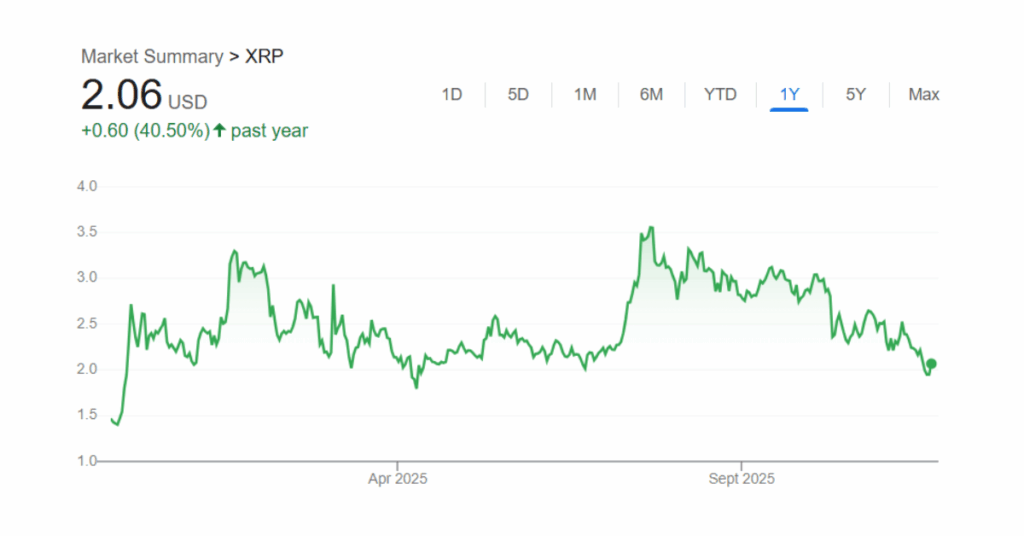
XRP climbed to a new all time high above 3.40 dollars in July 2025, fuelled by optimism around Ripple’s legal win, growing institutional interest and spot ETF filings. Since then, the token has given back part of those gains as market conditions turned more cautious.
At the time of writing in late November 2025, XRP trades around 2.05 dollars, roughly 40 percent below its peak but still significantly higher than a year ago. In this article, we will recap what XRP is, break down the main reasons behind the recent drop, and highlight the key factors traders are watching. We will focus on the drivers of the move, not price targets or predictions.
What Is the XRP Crypto?
Before we answer why is XRP dropping, it helps to understand what XRP actually is. XRP is the native token of the XRP Ledger (XRPL), a blockchain that focuses on fast and low-cost cross-border payments.
Transactions typically settle in a few seconds with low fees.
XRP is not mined. The entire supply was created at launch and distributed between Ripple Labs, early contributors and the wider community.
Ripple Labs still holds a substantial portion of XRP and uses it to support liquidity solutions, enterprise products and ecosystem development.
Because of this structure, XRP often trades as both a payments infrastructure token and a speculative macro asset that reacts to sentiment, liquidity and regulation.
Why is XRP Dropping Right Now?
XRP’s latest pullback is driven more by market conditions and positioning than by a new negative headline about Ripple itself. Here are the key factors.
1. Market-Wide Risk-Off Mood And Bitcoin Pullback
In November, the crypto market saw a broad selloff as investors took profits after a strong run and reacted to renewed macro worries.
Bitcoin fell from record levels above 110,000 dollars earlier in the month to the mid 80,000 range by November 24.
Risk assets in general faced pressure as traders questioned how long high interest rates and stretched tech valuations could last.
XRP usually moves with broader crypto sentiment, so weakness in Bitcoin and other majors tends to drag it lower even when project-specific news is neutral or positive.
2. Profit Taking After A Strong 2025 Rally
Another key reason why is XRP dropping is profit taking.
XRP has had a big year. After finally resolving its long running case with the U.S. Securities and Exchange Commission (SEC), XRP broke above its previous cycle highs and set a new record above 3.40 dollars in July 2025.
That move attracted both:
Long term holders who had waited out the legal uncertainty
Short term traders positioning for ETF news and momentum
As prices stretched higher, many early buyers started locking in profits. Several analyses point to long time holders selling into strength through the second half of 2025, contributing to the recent decline.
This is typical behaviour after a big rally. It does not necessarily mean sentiment has turned bearish for good, but it does create strong selling pressure in the short term.
3. Liquidity Drain And Whale Flows
On-chain and exchange data also help explain why is XRP dropping. Data shows that large XRP holders, often called whales, have been active around the recent move.
Reports highlight that whales sold or transferred hundreds of millions of XRP to exchanges over a short period in November, which usually signals potential sell orders rather than accumulation.
Other research notes that liquidity is being pulled out of the crypto market altogether instead of rotating between coins, which leaves order books thinner and amplifies each move.
When fewer buyers stand in the way, even normal profit taking can turn into a sharp pullback.
4. Mixed Signals From The Payments Narrative
XRP’s core story is still cross-border payments and financial infrastructure. 2025 brought a lot of positive headlines here:
SWIFT has continued its migration to the ISO 20022 standard, and research shows technical links between Ripple’s XRPL and global messaging systems.
Ripple’s CEO has argued that XRP could handle a meaningful share of SWIFT’s volume over time, highlighting the capacity of the network.
At the same time, some recent news has reminded traders that competition is intense in the payments space. For example, SWIFT’s 2025 global payments pilot reportedly chose an Ethereum Layer 2 solution rather than XRP, which sparked debate in the community over XRP’s long term role.
These headlines do not break XRP’s core use case, but they can cool speculative enthusiasm and add short term uncertainty.
5. Legal Risk Has Eased, But Perception Takes Time To Adjust
For years, the biggest weight on XRP was its legal battle with the SEC.
In August 2025, the case formally ended. A U.S. court approved a settlement where Ripple agreed to pay a 125 million dollar fine. The judge confirmed earlier findings that:
XRP sales to institutional investors can fall under securities rules
XRP trading on public exchanges does not constitute the sale of a security
The ruling also imposed an injunction on certain institutional sales, but removed the major question mark hanging over day to day XRP trading.
Legal Update: Is the SEC Case Still a Risk?
Legally, this is a net positive. However, market psychology moves slower than court documents. Some commentary still talks about “regulatory risk” out of habit, and traders are still adjusting to a world where XRP is both legally clearer and more tied into traditional markets.
What is the Current Price of XRP
To understand why XRP feels volatile, it helps to look at the recent numbers.
As of 24 November 2025, XRP trades around $2.05 per token.
Over the past week, XRP has swung between roughly 1.95 and 2.21 dollars, reflecting an active tug of war between buyers and sellers.
Over the past month, XRP is down only modestly, but that comes after a much stronger advance earlier in the year.
So when traders ask “why is XRP dropping so much?”, part of the answer is that the current decline follows a big rally. The starting point matters: a 20–30 percent pullback looks very different when it comes after a 200–300 percent move up.
How High Will XRP Go?
Analysts believe XRP could rise to $3–$5 in the next crypto bull cycle, driven by Ripple’s legal clarity and growing adoption in cross-border payments. However, upside potential depends on broader market conditions and Bitcoin’s trend, while resistance near $3.30 may limit short-term gains.
What Has Changed For XRP In 2025?
Even while the price has pulled back, the fundamental backdrop for XRP is very different from a few years ago.
SEC Case Resolved And Regulatory Clarity
The final settlement in August 2025 ended nearly five years of legal uncertainty. Ripple pays the agreed fine, institutional sales remain restricted, but exchange trading of XRP is no longer in legal limbo.
For traders, this means:
Reduced delisting risk on major platforms
Clearer rules for institutional and retail participation
A stronger base for future product launches around XRPL
In other words, the reason why is XRP dropping now has more to do with markets and sentiment than with regulation, which used to be the main risk.
ETF Approvals And Institutional Access
Another major shift is the move of XRP into regulated investment products.
Several asset managers filed for XRP spot ETFs in 2025, and analysts assigned high approval odds.
Grayscale announced XRP and Dogecoin spot ETFs that begin trading on the New York Stock Exchange in late November 2025.
Franklin Templeton also secured approval to list a spot XRP ETF on NYSE Arca, with a fee structure aimed at attracting both institutions and retail investors.
These products connect XRP to traditional brokerage accounts and retirement platforms. That can increase long term demand, but it also ties XRP more closely to flows and sentiment in the wider ETF market, which can increase volatility during risk-off phases.
Enterprise Push And Liquidity Products
Ripple has continued to build enterprise services such as Ripple Prime and fiat-linked tokens like RLUSD, positioning XRPL as plumbing for cross-border settlements and liquidity provision. This has helped drive institutional interest in XRP even as short term traders focus on price swings.
For now, these developments are more of a long term story than a daily price driver, but they form part of the backdrop that traders watch.
How to Buy XRP (Step by Step)
If you decide that XRP fits your strategy, it helps to approach it with a clear plan rather than reacting to every headline.
Choose A Reputable Platform Use a well regulated exchange or broker that offers transparent fees, strong security and clear risk warnings for crypto trading.
Secure Your Account Turn on two factor authentication, use a unique password and activate withdrawal protections where possible.
Plan Your Entry And Size Decide in advance how much capital you are willing to risk on XRP, and whether you will build the position in stages instead of all at once.
Know Your Exit Rules Set price alerts, think about areas where you would take profit, and define at what point you would cut losses if the market moves against you.
Think About Storage Many traders keep a small trading balance on exchanges and move longer term holdings to self custody wallets, especially hardware wallets.
Track Your Records Keep a record of trades for performance review and tax obligations in your region.
Conclusion
XRP’s recent drop is driven mainly by market-wide profit-taking, Bitcoin’s pullback, and short-term whale flows, rather than legal risks, which are now settled. With regulatory clarity in place, the long-term outlook for XRP will depend on adoption, global market sentiment, and whether it can break above resistance near $3.30.
For traders, volatility creates both risk and opportunity. At Ultima Markets, we provide the tools, insights, and secure trading environment to help you navigate assets like XRP with confidence. Whether you’re exploring crypto for the first time or fine-tuning advanced strategies, you can trade smarter and stay ahead of market shifts with us.
Share Now
Disclaimer:This content is provided for informational purposes only and does not constitute, and should not be construed as, financial, investment, or other professional advice. No statement or opinion contained herein should be considered a recommendation by Ultima Markets or the author regarding any specific investment product, strategy, or transaction. Readers are advised not to rely solely on this material when making investment decisions and should seek independent advice where appropriate.
Thank you for visiting the Ultima Markets website. Please note that this website is intended for individuals residing in jurisdictions where access is permitted by law. Ultima and its affiliated entities do not operate in your home jurisdiction.
By clicking ‘Acknowledge’, you confirm that you are entering this website solely on your own initiative and not as a result of any specific marketing outreach. You wish to obtain information from this website based on reverse solicitation principles, in accordance with the applicable laws of your home jurisdiction.