This website is managed by Ultima Markets’ international entities, and it’s important to emphasise that they are not subject to regulation by the FCA in the UK. Therefore, you must understand that you will not have the FCA’s protection when investing through this website – for example:
You will not be guaranteed Negative Balance Protection
You will not be protected by FCA’s leverage restrictions
You will not have the right to settle disputes via the Financial Ombudsman Service (FOS)
You will not be protected by Financial Services Compensation Scheme (FSCS)
Any monies deposited will not be afforded the protection required under the FCA Client Assets Sourcebook. The level of protection for your funds will be determined by the regulations of the relevant local regulator.
Note: UK clients are kindly invited to visit https://www.ultima-markets.co.uk/. Ultima Markets UK expects to begin onboarding UK clients in accordance with FCA regulatory requirements in 2026.
If you would like to proceed and visit this website, you acknowledge and confirm the following:
1.The website is owned by Ultima Markets’ international entities and not by Ultima Markets UK Ltd, which is regulated by the FCA.
2.Ultima Markets Limited, or any of the Ultima Markets international entities, are neither based in the UK nor licensed by the FCA.
3.You are accessing the website at your own initiative and have not been solicited by Ultima Markets Limited in any way.
4.Investing through this website does not grant you the protections provided by the FCA.
5.Should you choose to invest through this website or with any of the international Ultima Markets entities, you will be subject to the rules and regulations of the relevant international regulatory authorities, not the FCA.
Ultima Markets wants to make it clear that we are duly licensed and authorised to offer the services and financial derivative products listed on our website. Individuals accessing this website and registering a trading account do so entirely of their own volition and without prior solicitation.
By confirming your decision to proceed with entering the website, you hereby affirm that this decision was solely initiated by you, and no solicitation has been made by any Ultima Markets entity.
Explore McDonald's key competitors like Burger King, Wendy's, and KFC in the global fast-food market. Learn how they stack up against the industry leader.
McDonald’s has established itself as a leader in the fast-food industry, known for its global reach, consistency, and iconic menu. However, it faces stiff competition from various players vying for market share across different regions and categories.
As consumer preferences shift and the market becomes increasingly saturated, understanding McDonald’s key competitors is essential for both investors and consumers alike.
McDonald’s Competitors
1. Burger King
Burger King, a direct competitor to McDonald’s, has carved out its niche with its flame-grilled burgers, positioning itself as an alternative to McDonald’s fried options. Known for its flagship Whopper, Burger King’s marketing emphasises the quality of its flame-grilling method, which appeals to those seeking a distinctive taste.
In recent years, Burger King has undergone significant changes, launching new menu items and a refreshed marketing approach. The company’s promotions, such as the “Impossible Whopper,” cater to growing consumer demand for plant-based options, appealing to a broader demographic.
Despite facing similar challenges, Burger King continues to be a formidable competitor, especially in North America and Europe, where its advertising campaigns often rival McDonald’s.
2. Wendy’s
Wendy’s competes with McDonald’s by differentiating itself through its emphasis on fresh, never frozen beef, a key selling point for the brand. While McDonald’s relies heavily on fast, convenient meals, Wendy’s focuses on the quality of its ingredients, positioning itself as a more premium offering in the burger category.
Wendy’s has also mastered the art of social media engagement, using witty, often humorous content to connect with younger consumers. Its campaigns often highlight the freshness of its ingredients, contrasting them with McDonald’s offerings.
Although Wendy’s doesn’t have the same global reach as McDonald’s, it is a significant player in North America and continues to expand its footprint internationally.
3. KFC
While McDonald’s focuses primarily on burgers, KFC has carved a dominant position in the chicken market. Specialising in fried chicken, KFC’s offerings are more extensive than McDonald’s, with items such as chicken buckets and wings dominating its menu.
KFC’s global reach is comparable to McDonald’s, particularly in regions where chicken is the preferred protein, such as Asia and the Middle East. The brand’s recent success can be attributed to its ability to adapt to local tastes, from its spicier offerings in Asia to its more traditional recipes in the West.
While McDonald’s has expanded its chicken menu with items like McChicken, it has not been able to match KFC’s focus on poultry.
KFC vs McDonald’s
Factor
McDonald’s
KFC
Menu Focus
Burgers, fries, breakfast items
Fried chicken, wings, chicken buckets
Global Reach
Present in over 100 countries
Present in over 150 countries
Signature Item
Big Mac
Original Recipe Chicken
KFC’s ability to dominate the fried chicken category, combined with its extensive international footprint, makes it one of McDonald’s top competitors, especially in countries with a preference for chicken over beef.
4. Starbucks: Competing in the Beverage and Snack Segment
Though Starbucks isn’t a direct competitor in the traditional fast-food sense, it competes with McDonald’s in the beverage and snack categories. McDonald’s has made efforts to counter Starbucks’ dominance in the coffee market through its McCafé range, but Starbucks continues to hold the upper hand in terms of customer experience and premium pricing.
Starbucks’ focus on quality coffee, trendy beverages, and upscale offerings has attracted a loyal following worldwide. In contrast, McDonald’s is positioned more as an affordable, family-friendly brand. Starbucks also attracts customers who are seeking a lifestyle experience, an element McDonald’s has yet to fully replicate.
Despite these differences, the competition remains intense, particularly as McDonald’s continues to expand its breakfast menu and coffee options, aiming to capture more of the morning crowd.
5. Subway: A Health-Conscious Alternative
Subway presents an interesting challenge to McDonald’s by offering a healthier alternative through its build-your-own sandwich model. Unlike McDonald’s, which focuses on quick, traditional fast-food meals, Subway appeals to health-conscious customers by allowing them to choose from a wide variety of fresh ingredients.
Subway has become a popular choice for consumers seeking customisation in their meals. Its focus on subs, wraps, and salads has enabled it to carve out a unique position in the fast-food space.
While McDonald’s has attempted to diversify its menu with healthier options, Subway’s focus on fresh ingredients and lower-calorie meals continues to attract a growing segment of the market, particularly in North America and Europe.
6. Taco Bell: The Tex-Mex Challenger
Taco Bell, part of Yum! Brands, competes with McDonald’s primarily in the lunchtime and late-night markets. With its Tex-Mex-inspired menu, Taco Bell has become a favourite among younger consumers seeking quick, affordable meals. Its value-driven promotions, like the “Dollar Cravings Menu,” make it an appealing option for budget-conscious diners.
While Taco Bell’s footprint isn’t as vast as McDonald’s, its focus on bold flavours and affordable pricing has allowed it to develop a strong following. The brand’s continued innovation, with items like the Crunchwrap Supreme and plant-based options, ensures it remains a significant player in the fast-food arena.
7. Domino’s: Competing in the Delivery Game
While pizza isn’t McDonald’s primary focus, Domino’s has become a major competitor in the delivery and takeout space. The brand’s emphasis on convenience, with quick delivery times and a user-friendly app, has made it a go-to option for consumers seeking an easy meal at home.
Domino’s has continued to innovate, adding new menu items and upgrading its delivery service to compete with McDonald’s growing focus on digital ordering and drive-thru experiences.
Although McDonald’s does have a delivery option through partnerships with services like Uber Eats, Domino’s has a more established position in the pizza delivery market, making it a formidable competitor in the delivery sector.
8. Chipotle: The Premium Fast-Casual Competitor
Chipotle, a fast-casual restaurant, provides a premium alternative to McDonald’s with its focus on quality ingredients, sustainability, and customisation. While McDonald’s has tried to position itself as a healthier option with menu items like salads and wraps, Chipotle’s offerings are often perceived as fresher and more authentic.
Chipotle’s ability to offer a higher-quality dining experience, combined with its focus on transparency and sustainability, has helped it become a strong contender in the fast-casual space. As consumers increasingly seek healthier and more ethically sourced food, Chipotle’s brand strength continues to grow, especially among millennial and Gen Z customers.
Conclusion
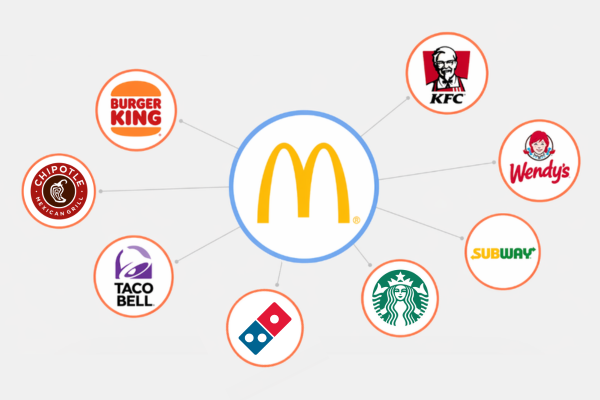
McDonald’s faces significant competition from a range of fast-food chains that are continuously innovating to capture consumer attention. Burger King, Wendy’s, KFC, Subway, Starbucks, Taco Bell, Domino’s, and Chipotle each offer distinct advantages and have carved out their own niches in the market.
Whether it’s through better quality ingredients, healthier options, or a more premium experience, these competitors challenge McDonald’s in various ways.
To maintain its dominance, McDonald’s must continue to adapt, offering both convenience and innovation. Its ability to balance affordability with modern consumer demands for quality, sustainability, and customisation will determine its success in the years ahead.
FAQs
Who are McDonald’s biggest competitors?
McDonald’s faces competition from Burger King, Wendy’s, KFC, Subway, Taco Bell, Starbucks, and Chipotle, among others. These competitors challenge McDonald’s in various segments, including burgers, chicken, coffee, and fast-casual dining.
How does McDonald’s compare to Burger King?
While McDonald’s focuses on consistency and affordability, Burger King differentiates itself with flame-grilled burgers. Both brands compete in the burger category, but Burger King appeals to consumers seeking a different flavour profile.
What is McDonald’s strategy to maintain market leadership?
McDonald’s focuses on offering value, expanding its menu with healthier options, and increasing its digital presence through apps and delivery services to meet the changing demands of consumers.
Share Now
Disclaimer:This content is provided for informational purposes only and does not constitute, and should not be construed as, financial, investment, or other professional advice. No statement or opinion contained herein should be considered a recommendation by Ultima Markets or the author regarding any specific investment product, strategy, or transaction. Readers are advised not to rely solely on this material when making investment decisions and should seek independent advice where appropriate.
Thank you for visiting the Ultima Markets website. Please note that this website is intended for individuals residing in jurisdictions where access is permitted by law. Ultima and its affiliated entities do not operate in your home jurisdiction.
By clicking ‘Acknowledge’, you confirm that you are entering this website solely on your own initiative and not as a result of any specific marketing outreach. You wish to obtain information from this website based on reverse solicitation principles, in accordance with the applicable laws of your home jurisdiction.